
Brazilian naturist pioneer Jorge Bandeira is an admirable activist. In addition to all his work for naturism in Brazil, and all his work as a playwright, actor, producer, theater critic and professor, he also owns and manages a second-hand book and record store in Manaus! I’m privileged to count him as a good friend, and since he doesn’t run his own website or Twitter account, I’m happy to help spread the word about his many naturist achievements. One of his most recent projects, a long time in the works, is an homage to one of the first writers who helped Jorge himself understand what naturism is all about: William Welby, an early twentieth-century English naturist and writer.

The Major Arcana
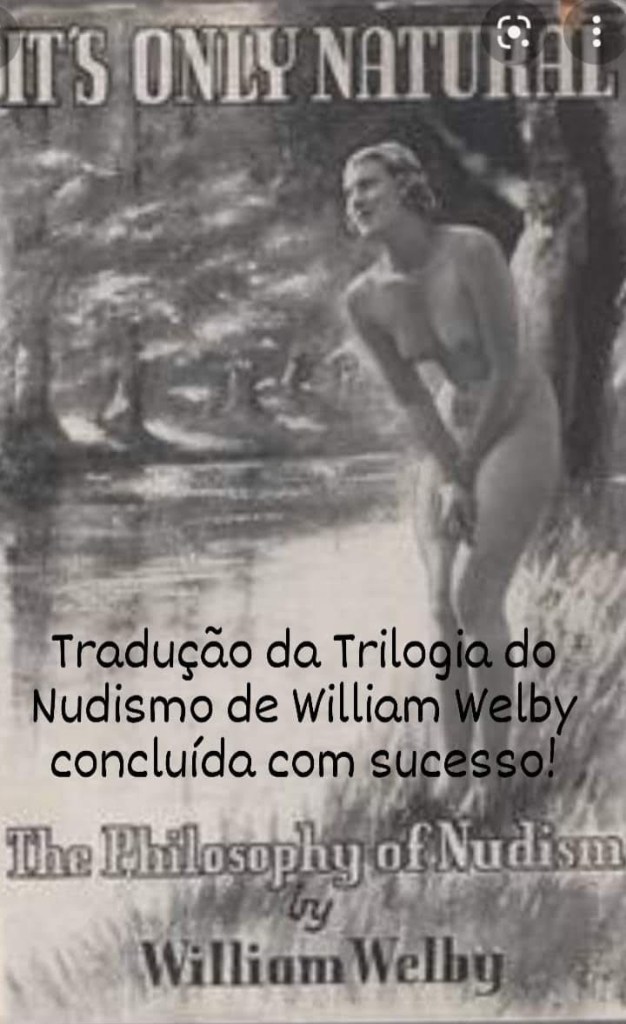
Last year (2023), the non-landed naturist group that Jorge Bandeira founded in Manaus celebrated an important twenty-year milestone. Grupo Amazônico União Naturista (GRAUNA) has been hosting events and normalizing naturism in the Manaus area for two decades now. As part of the celebration, Jorge launched the first-ever translation into Portuguese of William Welby’s trilogy of books on naturism, first published in England in 1934. In spite of relatively sparse attention from naturist historians, Welby’s books were reprinted and updated several times through the mid twentieth century. The original three titles–Naked and Unashamed; The Naked Truth About Nudism; and It’s Only Natural: The Philosophy of Nudism–now appear in one volume with the Portuguese title A Trilogia do Naturismo, translated by Jorge Bandeira and Mayara Campos, published by Metaphora Editorial, and with a striking cover representing water on skin.
In Bandeira’s introductory materials (initially published in the early 2000s over several issues of the erstwhile magazine Brasil Naturista), he praises Welby’s concise prose while highlighting the English writer’s insistence on the physical and psychological benefits to be reaped from naturism, or “nudism” as Welby more consistently named it. Bandeira also remarks on the stunning beauty of the photographs included in the original volumes, the majority of which were taken by Walter Bird.
Bandeira insists that Welby was ahead of his time, since he advocated for the “solar vitamin” we know now as vitamin D, especially regarding its role in the regular function of the endocrine glands. Welby also fought back against religious conservatives who viewed nudism as immoral, and against Henry Ford and others who championed motors over legs and photography over eyes. Yet Welby was not dogmatic, affirming that although many nudists were vegetarian, there were also plenty who ate meat, and plenty who smoked or drank alcohol; what was important was moderation. He condemned the practice of linking nudism to some sort of idealized eugenics.
For Welby, social nudism caused no harm to peoples or societies; on the contrary, nudism restored aspects of humanity that had been lost to the false morality of textiles. For example, Welby saw body acceptance issues–which he called an inferiority complex–as the direct result of societal expectations around clothing. For such issues and many other psychological diagnoses, Welby proposed naturism as highly beneficial, if not an outright cure – a proposition that recent research by psychologist Keon West, for example, strongly supports (example 1, example 2)

Bandeira quotes from the conclusion of the third volume regarding what Welby predicted for the future of naturism:
Eu não vejo com bons olhos o futuro do Nudismo somente em grupos isolados, como se fossem sociedades secretas. Se você é nudista, as pessoas irão lhe respeitar pelo seu bom senso e cordialidade, por sua conduta moral e ética, esteja você nu ou com roupas, o tratamento será o mesmo. O futuro do Nudismo, então, depende única e exclusivamente das atitudes dos nudistas. Se existir uma fraternidade e cooperação dentro do movimento nudista, a esperança é que tenhamos um futuro próspero.
William Welby, from the conclusion to The Naked Truth About Nudism, trans. Bandeira and Campos
Here’s my translation from Portuguese back into English:
“I don’t see a good future for Nudism if it’s only in isolated groups, as if they were secret societies. If you are a nudist, people will respect you for your good sense and cordiality, for your moral and ethical conduct; whether you are nude or clothed, the treatment will be the same. The future of Nudism, then, depends only and exclusively on the attitudes of nudists. If there can exist a fraternity, a cooperation within the nudist movement, then the hope is for us to have a prosperous future.”
In another paragraph, Welby does add that the future of nudism also hinges on the actions of non-nudists; in any case, the need for cooperation among nudists, naturists, nude-friendly folk, and our allies certainly still holds true today.
This first-ever translation to one of the world’s most spoken languages is a triumph for organized naturism in the Lusophone (Portuguese-speaking) world. Bandeira and Campos have given to Welby’s naturist classics from the temperate British Isles, a new voice for warmer nations of the Mediterranean and the tropics such as Brazil, Portugal, Angola, and Mozambique.
Jorge Bandeira is an outstanding naturist leader, activist, artist, and scholar. For more about his naturist art, theater, and writings, see my posts on an exhibit and performance on Indigenous traditions he did at Ecoparque da Mata, an exhibit he organized based on Kahlil Gibran’s The Prophet, and the celebrations and exhibits for GRAUNA’s 15th anniversary in 2018.