
Over the past five weeks, Netflix has brought to the screen two outstanding versions of well-known Latin American novels: Pedro Páramo by Juan Rulfo, and One Hundred Years of Solitude by Gabriel García Márquez. The former is a film, while the latter is a series with the first season of eight episodes now available. Both are beautiful, sumptuous, breathtaking visual recreations, faithful to the novels, and filmed in-country with nation-specific casts and crews (Mexico for Rulfo’s, Colombia for García Márquez’s). While both projects include nudity in sex scenes, they both also feature terrific examples of normalizing nudity on screen – the focus of this post.
While One Hundred Years of Solitude is the better known of the two novels – it is one of the most translated and most widely read books in the history of our planet – its author, García Márquez, credited reading Rulfo’s Pedro Páramo (while he was living in Mexico City, where he would write One Hundred Years of Solitude) for key epiphanies in how he would eventually bring the world of Macondo to life in his novel. It’s a wonderfully appropriate synergy that the two Netflix projects have debuted around the same time. Also, while he was alive, García Márquez collaborated willingly with filmmakers to turn some of his other novels and stories into films, but he always held out on his most famous novel, rightly insisting it would not fit into a two-hour film. After he passed in 2014, his two sons, Rodrigo García and Gonzalo García Barcha, both experienced in cinematography, decided that a streaming episode format with a massive budget could do it justice. The production has been a huge source of national pride in Colombia.
Director Rodrigo Prieto’s version of Pedro Páramo stars Tenoch Huerta (of Wakanda Forever fame) alongside a terrific cast that animate Rulfo’s eerie allegory of a rural despot’s vengeful reign over the town of Comala. The novel includes an episode in which the protagonist, Juan Preciado (Huerta) meets an Adam-and-Eve like couple, nude, who give him shelter. The film version recreates this with matter-of-fact nudity as the couple undresses to sleep. Similar nonchalant nudity is shown in one or more breastfeeding scenes. The most spectacular of these non-sexual nude scenes, though, is one that the production team invented to enhance a key moment in the book. When Juan Preciado dies, we see a swirling vortex of souls above him, something that looks like it would be at home in an adaptation of Dante’s Inferno, and the souls are depicted as ghostly nude bodies. A scene in which adolescent Pedro Páramo and his love interest Susana swim in a river could have been a nude scene, but for whatever reason was filmed with them wearing regular clothing. This scene is unspecified in the original novel, so I can’t really count it as an instance of “stolen nudity“; on the contrary, with the swirling souls scene, the production team has added nudity where there wasn’t before.

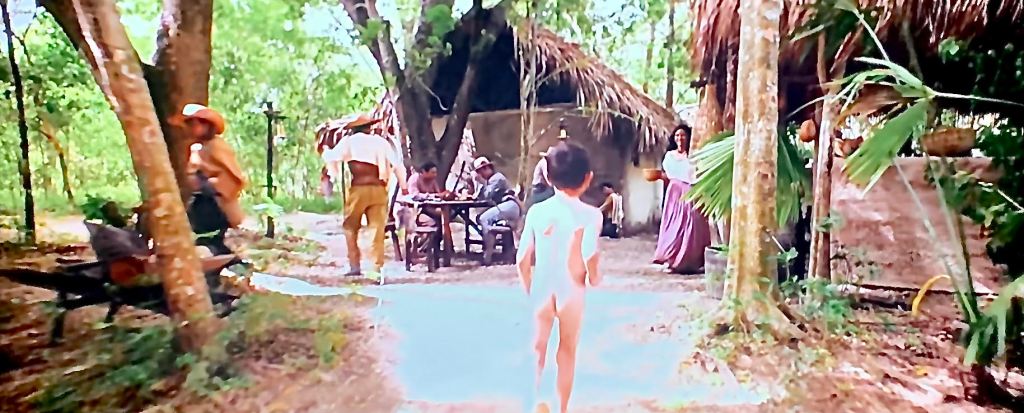
Alex García López and Laura Mora, the directors of One Hundred Years of Solitude, collaborated with a vast group of artisans in constructing the sets, costumes, and props for the series. The visual language they build into the production includes a lot of tracking shots, and one such shot that I consider iconic is our introduction to the town of Macondo in the first episode. We follow a young boy, nude, as he wends his way through town interacting with several people, only one of whom comments on his nudity. It’s a beautiful way of showing the innocence of the people and the natural connection of the town to its surrounding environs in the tropics. (It also reinforces a connection to 1850s watercolor illustrations of the Colombian countryside that served as production team references, as Andrew Quintana points out.) This boy is José Arcadio, oldest child of the founding couple José Arcadio Buendía and Ursula Iguarán. All three of Ursula’s childbirth scenes are shown quite naturally, and there is also plenty of nudity in amorous scenes throughout the episodes.
But two more instances of non-sexual nudity deserve mention. The first is a scene in which rival sisters Amaranta and Rebeca have just returned from a bath. Rebeca doesn’t mind being nude, but Amaranta does, and so Rebeca pulls her towel off, and as they are squabbling and laughing their mother, Ursula, opens the door, regards them, and immediately realizes they will both be wanting to get married soon. From this epiphany she hires a group of workers to remodel their house. The second instance happens many years later in the expanded house, when we see a tracking shot in episode 8 that parallels the one in episode 1. This time we follow a young girl, Remedios (the one who will come to be known as Remedios the Beauty, granddaughter of the boy in the first tracking shot) as she runs naked through the house smearing something brown on the walls with a stick. Her buttocks are also soiled – readers of the book may remember that this filthy habit is indeed a direct passage from the text. It is a shorter tracking shot, but it parallels the earlier shot’s sense of innocence, this time with a touch of creativity and mischief, and it prepares us for what we will hopefully see reproduced from the book in the second season of the series: Remedios the Beauty as a character who is truly naturist.
Neither of these novels was written as naturist fiction, of course, nor do their corresponding Netflix productions have any pretense of expressly supporting naturism. And while plenty of Netflix programming allows male frontal nudity, neither of these productions does so unless only fleetingly (in spite of the fact that the adult José Arcadio’s penis is a plot point from the novel that is discussed but not seen in the series). Yet both of these productions have introduced scenes of non-sexual nudity beyond what was indicated in their source novels. A cynic would say it’s just to entice the viewers… to which I would reply that for salacious content, they both have sex scenes already. These other nude scenes, I choose to conclude, do help to normalize nudity as a natural and pure state of being.
Both productions highly recommended!