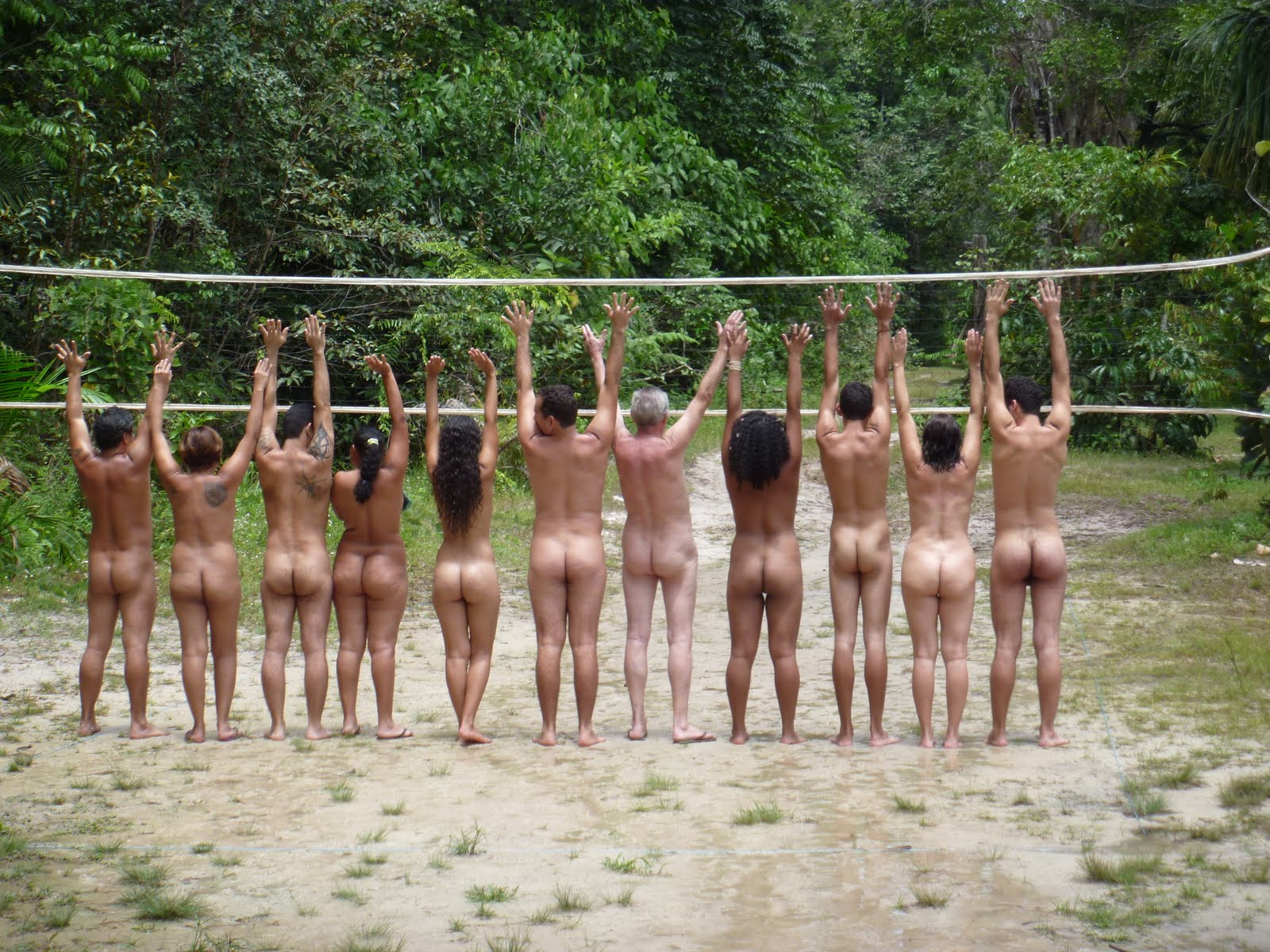
Freedom

One encouraging result of the Fall Arts Festival at Oaklake Trails is that one of the artists who attended has decided to make naturism the topic of her research paper in a sociology course. She asked to interview me, so we did, but the tape recorder wasn’t working properly and so I wrote a summary of the main ideas we discussed – that summary starts below this paragraph. But I also recommended to her the recent, very well-written posts by Sky Clad Therapist and the blogger for East Texas Area Naturists. These posts provide great insight into exactly what we gain and what we lose in our attempts to define what it is we are and what it is we do.

People go to a naturist park for freedom, above all. Even though there are people of many different political stripes (Green, Democrat, Libertarian, Republican, etc.) and religious backgrounds, they all strongly support the basic agreement: that if the weather is nice, they shouldn’t have to wear clothes. That’s the basic agreement, and around that are built some rules. An example of a rule is: no tolerance for overt sexual activity, just as there would not be most anywhere else. Another rule is no photography without consent. 

Also from the basic agreement of freedom from clothes there spring some corollaries. An example of a corollary is that people observe more openness and tolerance – a democratic effect accompanying social nudism that means that you “can’t tell the baker from the banker” since clothing as a status marker is gone.

While it’s true that Arkansas law is too strict to allow the existence of such a place, most states do have parks like Oaklake Trails, all organized through the American Association for Nude Recreation and The Naturist Society. (The Naturist Society is more focused on advocating nude use of public lands.) Other countries have similar groups, like in Brazil, the Federação Brasileira de Naturismo and in Canada, the Federation of Canadian Naturists along with the Fédération Québécoise de Naturisme

In my experience, younger people tend to be more cautious about joining anything / “committing to” anything, whether it’s a movement or a membership. Young Naturists America, Nurba, and Vita Nuda, however, are a few groups not based on a physical location that are gathering momentum lately among youth. Older people tend to have the attitude, the time, and the money, generally, to invest in the actual founding and upkeep of the special places that are naturist parks. Older people may tend to know better, with greater confidence from experience, what they want out of life, and arrive at a point in their lives when they have the resources to make a commitment. The right-hand column of this blog features many more links to sites and groups that honor the basic agreement of freedom from the tyranny of clothes.

For some people, skinny-dipping is a “bucket-list” kind of experience. Often, though, after just one time swimming “un-costumed,” people understand (or, nuderstand) better what it’s all about and seek opportunities for more such experiences. But what normally stops people from having even one naturist experience is a fear of shame that they have been conditioned to accept since they were children. As adults they lack either the will or the desire–or even the knowledge–to break out of that conditioned shame of the body (especially the nude body), so they end up preferring that very shame over what they perceive as a fear, or a crime, or a sin. 

But the real shame is that so many people live their lives without the specific, empirical knowledge of feeling the elements all over their bodies, without the knowledge of self, and respect for nature and humanity, that are the most important corollaries to arise from naturism / social nudism.

Threadbare

(A short story, based very-loosely-not-too-tightly on Acts 9:34-42)

In the city of Joplin there lived a widow named Dory, who was always doing kind things for others, especially the poor. She was a skilled seamstress, and since the time of her husband’s death, several rooms of her home had been overtaken by bolts of cloth, and sewing machines, and a loom, and baskets of yarn, and great piles of clothes. She loved to sew and weave and knit clothes to give to her friends and family as well as to charity, though at times she felt obligated to continue her work only because of her reputation and because of her investments in so many supplies. One day, after working for weeks on an assortment of sweaters and socks, scarves and mittens, plaid shirts and plaid skirts and work pants and onesies, she donned her shawl, loaded up her gifts, and drove to the community shelter.

Dory was humble about her work, not an ostentatious giver. But to her surprise the shelter manager, who knew she was coming, made a big fuss over her that day. She draped over Dory’s shoulder a special sash that read, “The Lord loveth a cheerful giver,” and she encouraged her to walk among the people of the shelter to distribute her gifts. And so she did, and she was pleased to see joy from some, and confounded to see indifference from others, when she gave them the garments and raiments made by her own hands.

At last, in the far corner of the shelter, there was a young couple with a baby. They smiled and introduced themselves as Peter, Maggie, and baby Nicolas. Dory could not help noticing that Peter’s pants and shirt were threadbare, and Maggie had uncomfortably hoisted up her stained blouse over her breast to feed her baby. When Dory offered them a onesie, they insisted on undressing the baby to try it on him at that very moment. It was a perfect fit, and they were very grateful. When Dory offered the mother one of her specially designed sweaters with an ingenious buttoned flap over the chest for ease in breastfeeding, Maggie insisted on removing her blouse and bra to try it on at that very moment. The sweater was comfortable and the flap worked like a charm as she lifted it to continue feeding baby Nicolas.

Dorcas clothing the poor

Dory was a little surprised by the candor of this couple, but she also felt quite exhilarated by their appreciation. So without hesitation she offered Peter a pair of work pants with a plaid shirt. He insisted on trying them on at that very moment. As he began to remove his clothes, Dory looked away, feeling awkwardly prim even as she confirmed that others in the crowded shelter were watching the scene with interest. After a time in which she imagined that Peter would have finished putting on the new clothes, she turned around, and saw that he stood naked before her.

She suddenly felt very flushed, very stifled. Was it the shock of his nudity, was it the heat of the packed room, a lack of oxygen, was it the weight of the clothing she was both wearing and carrying? For some set of reasons, she fainted, and her clothes spilled all around her.

When she came to, Peter was standing over her, saying, “Get up, Dory!” And when she saw him, she sat up. He gave her his hand and helped her up, and called out to the others in the shelter, “She is recovered!” and “The Lord loveth a cheerful giver!”

The shelter manager told Peter to try on the new clothes already. But Peter did not, saying instead, “Thank you, Dory, for your gifts to clothe me and my family. There are times when we need clothes, just as there are times when we need food, when we need shelter. But our bodies are also gifts–glorious gifts from God–and when we share our gifts unwrapped, we share in the generous community of God’s likeness. We are humble and unashamed.”

Dory still felt overly warm, but much better, and her mind was suddenly clear. She pulled the sash over her head and placed it, speechlessly and fearlessly, over Peter’s shoulder. She removed her shawl and draped it over the shelter manager’s back. She hugged Peter and his family, saying, “I have been hiding myself, binding myself tightly. But I believe you, and I believe in our gifts.” Then she turned to leave, and as she walked back through the shelter to the entrance, she removed her shoes, her stockings, her sweater, her pants, her blouse, her undergarments, giving all of these items cheerfully to the astonished people of the shelter.

The news raced through the town, and there were many who believed Peter. And Peter and his family stayed a long time in Joplin, living with Dory, the seamstress, who continued to sew and weave and knit for charity, even while practicing with her houseguests and friends a more fundamental and absolutely threadbare generosity.

Bare-abouts

The woods that day were fairly wet;
thick fog hung in the air.
She’d left before we’d eaten yet;
we did not know her whereabouts…

Although her coat lay on the rail,
her boots upon the stair,
we guessed she must have walked the trail
down to the lake, or thereabouts.

We grabbed her coat, her boots, some food,
and searched for hide or hair,
and when we found her, she was nude –
her skin, her only wear-abouts!

Too smug and flushed in our steamed clothes,
we laughed. “Was this a dare?”
She smiled. “A dare…? I don’t suppose
You’d join me? Don’t be stare-abouts!”

We gulped, and it began to rain.
Our garb we did compare, 
and quickly heaved off drenched constraint
to run with derrière-abouts,

and laughed and whooped and jumped and splashed
and sang without a care,
for we became, quite unabashed,
fanatic forest bare-abouts!

On Act Naturally

“Costume Designer: Madre Naturaleza.”

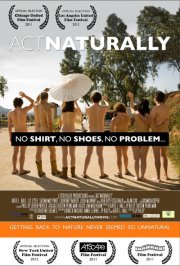
This quick joke, hidden in plain sight among the opening credits of Act Naturally, is just one of the many little jewels in this NDST-friendly film’s treasure chest. Screenwriter and director JP Riley has crafted an all-around terrific film that works so well on so many different levels: it’s a primer on social nudism that’s also a collection of profound stories about journeys to acceptance.

The main characters are the estranged sisters Leah and Charlie. Leah is anal..ytical and high-strung, while Charlie is more of a free spirit, not without her own peeves. But their character arcs—as they travel together across the country to deal with the realities of claiming their father’s inheritance—trace out their trajectories in surprising, and complementary, ways. 
If you’ve seen the trailer (which you should, but don’t stop there! See the whole film!), you know that their inheritance is a nudist resort. And each of the resort regulars–from manager Kristi to legal counsel Rusty to chef Cory, and yoga instructor/lifeguard Lauren and handyman/bartender Trevor and resident newlywed Natalie–holds a piece of the puzzle that the sisters must work out as they learn to let it all hang out. Why did their dad own this place? Why didn’t he tell them about it? Why on earth would anybody want to live at a nudist resort?!?!
The characters’ own stories of how they came to embrace social nudism are illuminated by pithy flashbacks, and these quick glimpses into the past are just as important, or more, for Charlie and Leah’s understanding than the “eyefuls” of flesh all around them. It turns out that love is complicated and sex is messy (surprise!) but that all of the resort regulars have learned that the place where they most feel at home, and where they most feel themselves, is there at Bear Lake, the naturist resort that Leah and Charlie are now contemplating selling to developers… Will the sisters make the right decision?
The film is graced by wonderful actors who give spot-on performances, great on-location shooting at Olive Dell Ranch in California, and a catchy, very appropriate and current soundtrack. I happened to see the film at one of its many showings featuring a Q&A session with the director himself, who graciously spoke about the film’s challenging range of tonalities (from tragic to comic); the difficulty of off-season, cold-weather shoots; the casting process and what it’s meant for the actors; and the ridiculous “penis count” imposed by some Canadian province… In editing, Riley even had to digitally add a laptop here, a folder there, to keep the penis count at an acceptable dozen instances. Prurient, nude-phobic, pro-violence ratings systems in the US and Canada are woefully inadequate for a film like this, a fact that makes the film’s naturist audience all the more important for its support.

Ultimately the sisters’ epiphanies are hard-fought and for that, all the more meaningful. What they find is that even though nothing’s perfect, and nobody / no body is perfect, the acceptance and celebration of that essential imperfection can be almost…perfect.

Mammals

Feeling mammalian lately? Basic zoology texts tell us that we mammals are warm-blooded vertebrates that possess hair, mammary glands, three middle-ear bones, and a characteristically developed neocortex. Humans, like many mammal species, have sweat glands, specialized teeth, placental births, and dual-fluid penises (yep, you read that right).

Page from an early 1970s children’s book on animals

When I was a kid, what I wanted to be when I grew up was an ethologist – a scientist who studies animal behavior. I devoured books on animals like the one whose page I’ve featured above. The idea of being the man depicted in the drawing–walking along naked in nature with a horse, an elephant, a lion, a tortoise, etc.–was exciting to me. (Until recently there was a Vimeo video of an unclad man and a similarly unclad elephant–could have been the ones in this picture!–playing on the beach.)  As I grew older my interest in anthropology grew, and I discovered the now classic title The Naked Ape by Desmond Morris. His study considers humans in a comparative analysis with primates and other mammals, and spawned a series of successful books and television series for the British zoologist.

In The Naked Ape, Morris starts with the tongue-in-cheek proposition of trying to identify what kind of animals humans are by comparing us to other species. What stands out is the human condition of relatively hairless nudity. In contrast, the apes and other primates, while they may have bald patches or sparse hair, are nonetheless much more thoroughly hairy than we are. Morris mentions several hypotheses for our nudity–everything from parasites to sex signaling to the “aquatic theory”–but ultimately finds the most convincing explanation to be the need to help the sweat glands do their job in the bursts of energy required to hunt prey. Fast-running wolves or cheetahs have many advantages over humans as predators, but they have no sweat glands in their skin. For sweat glands to work properly, our skin needs to be exposed to the air. Too much fur or clothing impedes evaporation of the sweat and the cooling effect it provides.

But sweat also fills a more ancient function of scent-identification. In situations of high emotion–whether aggressive or erotic–our hair stands on end, our body temperature rises, and we also sweat profusely. Our bare skin acts as the massive surface of a warmed scented candle, letting off the smell of the hormones that have soaked our systems. Smell is one of the most primitive senses, yet we still struggle to explain exactly what are the effects that these body smells unleash. Studies on pheromones prove their general effect if not exactly how they play into a range of factors that influence our choice of a mate, for example. As artificial skin coverings, clothes don’t entirely conceal body odors, of course, but they may mitigate them in different ways based on textile variety, thickness, layers, etc., often trapping smells from both inside and outside the body all day long.

As biological anthropologist Barbara King has written, one of the characteristics of humans is precisely that we do seem to be the only species given to covering ourselves up and decorating ourselves, in certain culturally prescribed ways that vary wildly in context and design from “penis sheaths for males to full-body cloth claustration for females.” In the end, we are indeed mammals, but we’re very special ones (for many reasons) whose entire textile-driven array of cultural manifestations is intimately but ironically linked to the evolution of our almost hairless hides. Those of us who are naturists don’t desire to disavow clothing completely, but rather to nurture–more proactively and more frequently–that more ancient mammalian part of our nature that needs to feel and smell the elements on our bare skin.

Fall Arts Festival

st1\:*{behavior:url(#ieooui) }

[press release for immediate distribution, 
from Oaklake Trails Naturist Park]
Contact:  OLTNaturistpark@aol.com
Tel: 918-324-5999
Dateline: Depew, OK

Ever wonder what it would be like to experience the arts au naturel? Now is your chance! Oaklake Trails Naturist Park, located midway between Oklahoma City and Tulsa, is hosting the First Annual Fall Arts Festival, Saturday, September 22 from 11:00 AM. until late in the evening. The event will feature arts vendors, demonstrations, classes, live music and a screening of the newly released award-winning independent film ACT NATURALLY!

See a wonderful film about naturism, as nature intended!  Celebrate textile freedom and follow the protagonists of the indie smash hit through a quirky, touching, whirlwind of a ride! The screening will feature director JP RILEY for a Q&A session, along with other members of the cast and crew! The screening event will start at 6:30 PM.
During the afternoon, there will be demonstrations in body painting and massage. Two oil painting classes presented by Wine and Palette will be available. Wakefield and Native Spirits wineries will be offering tastings, and Flying Heart and Pro Galleries, along with several artists from Oklahoma City and Tulsa, will be showcasing their art, which will be for sale.
Wrap up the evening with live music from Loaded Dice to complete the perfect experience of freedom. During the day, all resort facilities will be available, including the Bare Buns Bistro, hot tub and pool, hiking trails, sand volleyball, shuffleboard, petanque, horseshoes, or simply enjoying the 400-acre resort. Please bring a towel, sunscreen, and hat. Lawn chairs are recommended.

Bodies on the Beach

an original naturist one-act play

Copyright Will Forest. Contact me at nudescribe at gmail dot com for performance inquiries.

Characters:
ANYBODY
EVERYBODY
NOBODY
SOMEBODY

(The stage is one long beach, divided into halves marked by a low fence of flimsy plastic and the signs: “NUDE BEACH” on one side and “NUDITY PROHIBITED” on the other. Nothing further distinguishes one half of the beach from the other. ANYBODY, NOBODY, and EVERYBODY, wearing swimming costumes, are reclining on the textile half of the stage. Each has a towel and a beachbag, at least. They are at the beach as individuals who do not seem to know each other. As the action begins, and during the first seven lines of dialogue, SOMEBODY enters the beach on the textile side, looking for the nude side. He/she sees the sign, and makes her/his way slowly toward the nude side, stopping from time to time to look at the others as if silently asking them why they’re not on the other side. The others continue their dialogue, watching with poorly disguised interest as SOMEBODY passes by.) 

EVERYBODY (to ANYBODY): Hey. Did you see that sign? That’s a nekkid beach, right over there. I can’t believe anybody would get nekkid in public like that.
ANYBODY: I most certainly would not. I mean, get naked. That’s perverted.
EVERYBODY: Yeah. Crazy, right? Nobody I know would do something like that.
NOBODY (overhearing): I would not! Why does everybody say that, anyway?
EVERYBODY: Well, I mean, would anybody in their right mind take off their clothes in public?
NOBODY: Where everybody can see?
ANYBODY: (repeating) I most certainly would not. I mean, everybody might think I would, but I wouldn’t. No way. Nobody would.
NOBODY (loudly, pointing across the beach): Somebody already did!

(SOMEBODY has stepped over the low fence to the nude side and is beginning to undress. The others pretend not to see–even as they are watching—while they continue the dialogue below. SOMEBODY, meanwhile, stretches out on the sand with a book.)

ANYBODY: Don’t look. Exhibitionist. Just wants attention.
NOBODY: (loudly) Won’t somebody do something?
ANYBODY: Quiet down. That’s somebody over there. Over here, everybody’s in their right mind.
EVERYBODY: I’ll say. (speaking loudly) Somebody over there doesn’t have any shame. 

(SOMEBODY reacts, looking across the beach to the others, and rolls over to face away from them.)

ANYBODY: Probably an exhibitionist. 
NOBODY: Anybody can see that.
ANYBODY: Everybody knows it’s a bad idea.
EVERYBODY: I’ll say. A bad idea, getting your junk out for anybody to see.

(SOMEBODY, frustrated, gets up and approaches the fence.)

SOMEBODY: Hey, it’s not about what you see or don’t see. You don’t see with your skin, do you? It’s about feeling: your skin feeling the waves, the sand, the sun, all over. Feeling free and natural. You should try it!
EVERYBODY (averting eyes): Just stay over there. Somebody could be offended.
SOMEBODY: You’re right. I’m offended that you said I have “junk”! I don’t have junk, I have a body.
ANYBODY: Everybody’s offended by something, but nobody’s going to say you can’t do as you please as long as you don’t bother us.
NOBODY (matter-of-factly): You can’t do as you please as long as you don’t bother us.
SOMEBODY: What? That doesn’t even make any sense! Look, I’m the one who should be bothered by you acting as if… as if wearing little squares of cloth is appropriate on a hot beach. I’m the one who should be offended by your misconceptions and your rush to judgment. Has anybody said that I’m perverted? Has anybody said I’m an exhibitionist? Why, yes. Yes, you have.
ANYBODY: Did I say that? Well, I must have been sure about it, then.
EVERYBODY: Somebody might think you could actually enjoy running around nekkid on the beach… swimming, running around…nekkid… (trails off)
SOMEBODY: You and me, you, all of us: we’re all just bodies, right? Everybody’s unique, nobody’s the same, and anybody’s going to have different sizes, shapes, and colors, but we’re all just bodies. 
NOBODY: I’d rather die than have everybody see me naked!
SOMEBODY: I already said, it’s not about what you see or don’t see, it’s about…ah, forget it.

(SOMEBODY walks away, to the furthest possible point on the nude half of the beach. Silence onstage for several beats.)

EVERYBODY: So… We’re all just bodies… (clearing throat) Would anybody like to go over there?
ANYBODY: I most certainly would not.
EVERYBODY: Well I think somebody over there’s got a good point. Nobody’s going to guess there’s any harm in it.
NOBODY (pondering): I guess there’s no harm in it…
EVERYBODY: I’m glad you agree!

(EVERYBODY gathers his/her things, stands up and steps over the fence to the nude side.)

NOBODY (unaware, continuing in thought): Oh…but I’d rather die than have everybody see me naked!
ANYBODY (seeing that EVERYBODY has already crossed and is disrobing): But everybody’s already naked!
NOBODY: What? (looks across, then looks away) That’s it. Everybody’s gone crazy.
ANYBODY: Everybody over there.

(EVERYBODY has approached SOMEBODY. They greet warmly and begin a game – volley, handball, Frisbee: director’s discretion. NOBODY, meanwhile, stands up and begins pacing back and forth, looking around anxiously.)

ANYBODY: But nobody over here has gone crazy. I most certainly would not. Nobody over here is shameless. (getting louder) Nobody over here has thrown in the towel and dropped the trou. Nobody over here has lost all inhibition, right down to the last thread of decency! I most certainly would not! (sputtering) Nobody over here has gone stark-raving stark-naked buck-naked bonkers!
NOBODY (stops pacing): I’m afraid it’s true! Anybody can read me like a book! But no… No, I’m not afraid anymore. I feel so transparent! What difference does it make if everybody sees me in the nude? We’re all just bodies!

(NOBODY takes his/her things, steps over the fence, disrobes, and joins the game to the welcome of EVERYBODY and SOMEBODY. ANYBODY looks on, astonished, then looks away, trying to ignore the growing whoops and shouts from the game on the other side of the fence. After a minute or so, SOMEBODY approaches the fence again while EVERYBODY and NOBODY continue the game.)

SOMEBODY (addressing ANYBODY, who listens without looking): Hey! We’re trying to set up teams of two over here, and we’re missing a body. Anybody will do! (waits a few beats) Would anybody care to help us out, over here?

(Receiving no answer, SOMEBODY gives up and returns to the game.)

ANYBODY (still not looking, and with a derisive but forced laugh): That’s the last straw. That’s the last little stitch of decorum, isn’t it? I most certainly… would…

(ANYBODY takes a moment to process this change of heart. Then she/he stands, taking his/her belongings, and steps over the fence. Her/his foot catches, and the fence falls down. ANYBODY sees this, considers fixing it, then shrugs. ANYBODY disrobes. The others have not stopped the game.)

ANYBODY (joining the game): Somebody need another body?

(The game continues onstage until the curtain drops or the actors take their bows.)

The End

Nude Immersions

I’ve recently read a couple of books related to naturism and nudity, and specifically to the idea of immersion: in water, in nature, in social nudism.

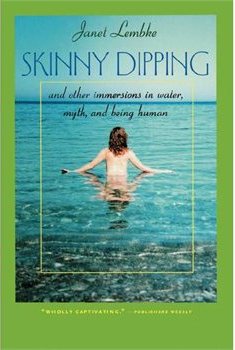
Janet Lembke’s Skinny Dipping (University of Virginia Press, 1994) is a collection of essays revolving around the theme of nature and human nature, or as the subtitle says, “and other immersions in water, myth, and being human.” In the introduction, Lembke presents skinny-dipping as a metaphor for immersion, whether in water or in ideas – as a way of inducing open exposure to a given experience. She recalls a childhood episode in which kids in the hot sun, and temporarily ignored by their parents, resorted to removing their clothes and playing in the birdbath. She concedes that the episode might have been forgotten were it not for the terrible over-reactions of most of the adults, which served to sear the event in her memory: “At that time in my life, even if the adults had tried to explain their objections to the coed nature of our skinny-dip, they’d have succeeded only in creating more bewilderment. Modesty, immodesty, exposure of private parts–these concepts had no meaning” (3). She attempts, in her writing, to reconnect with that “splashing, giggling , squealing child who knows without thinking that bare skin and water go together as wings go with air, roots with earth, and the phoenix with incendiary sun” (4).

The title essay on skinny-dipping starts out in the ancient Roman Empire, with an imagined day-at-the-beach, day-in-the-life of Pliny the Elder and his slave. To Pliny is attributed the line with which Lembke opens her essay: “This element–water–does not properly receive us unless we are naked.” At the Mediterranean shore, Pliny makes observations and asks questions, which his slave writes down, and then begins to wonder about the ocean. According to the author’s rendition of him, Pliny fears the sea due to his experience with shipwrecks and drowned sailors. But the salty spray tempts Pliny to enter the ocean, and he finally gives in, “dropping fears on the sand along with sweat-drenched clothes” (13). Lembke expands Pliny’s quoted  message to mean: “Stripping off not caution but the stale, crusty garments of preconception, peeling sensibility down to raw, new nakedness, is the only way to enter and be properly embraced by the world” (13).

The remembrance of Pliny is followed by a brief, present-day epilogue in which the author and her husband regard skinny-dipping as the time “to get exhilarated.” In a beautiful paragraph, Lembke describes the rejuvenating experience: “The water covers heat-stung nakedness as comfortably as scales and coaxes our arms and legs into an almost forgotten response […] Our boneless shadows skate over the sunlit sand below. It is as if we have begun to dissolve, to return to an element once our only home” (14).

Lembke’s skinny-dipping in an isolated pond contrasts jarringly with the crowded nude beach of Mexican writer Homero Aridjis’s novella, one of several short texts in a book of the same name, Playa nudista (Editorial Argos Vergara, 1982). The narrator is a young Mexican man who, finding himself with a few extra days in the Netherlands, decides to visit a nude beach. Refreshingly, there is no negative emotional threshold here – no conditioned sense of body shame that the man must struggle to vanquish. We don’t know much about his past, or whether he has much experience in this regard, but he simply removes his clothes nonchalantly. 

Unfortunately, the slim plot must hold together on the basis of the man’s happenstance meeting with a young woman at the beach. They flirt, they have a brief fling in her apartment, he looks for her in his remaining time, and finally finds her back at the beach with another man. It’s one of these stories more about ambiance and tone than about plot or character development. What is noteworthy is that the narrator describes the nude beach denizens candidly – his immersion, so to speak, happens not in the sea of saltwater but in the sea of flesh all around him. Even so, some of the descriptions are rather sordid, and I wonder if, given the time and place of publication, this was intended simply for shock value. One of the less sordid passages describes his first experience at the beach (below, with translation matching the low discourse level), but could also describe the book’s cleverly kaleidoscopic cover art, in which symmetric haunches haunt the book’s borders.

“Y como en un paisaje apacible de carne humana en reposo bañada suavemente por la luz de la mañana, él vio aquí y allá espaldas y muslos truncosos, culos como peras, vientres como flores, tetas como lunas y nalgas como platos.
Y tal vez ante la visión de tres elementos que no saben esperar: el agua, el aire, y la carne, se llenó de entusiasmo y caminó por entre los cuerpos desnudos igual que si anduviera por un pedazo de paraíso” (19)

[And as if in a pleasant landscape of human flesh in repose, bathed in the soft morning light, he saw here and there backs and thighs like logs, asses like pears, bellies like flowers, tits like moons and buttocks like plates.
And perhaps because of this vision of three elements that don’t know how to wait: water, air, and flesh, he felt full of enthusiasm and walked among the nude bodies as if he were strolling through a part of paradise.]

Anatomical vocabulary aside, there is no denying the twin feelings of belonging and liberation that overcome many of us in such experiences of immersion. The body of flesh and the body of water become part and parcel of the same encompassing experience, an immersion strongest when nude.

A Clothing Conundrum

Dear reader, I offer a clothing conundrum:
When standing in front of the washing machine drum,
how do you determine the ins and the outsides
of textiles that seem to have too many cloth sides?

I’ll help with the laundry. I’ll get the clothes gladly.
I’ll wrangle with hangers and fold the clothes badly.
But sometimes I can’t tell what’s what or what’s whose,
with too many openings. Which hole to choose?

There’s no doubt about it: this clothing’s bizarre.
There’s no understanding this feminine garb.
Which way does this thing go? Is it inside out?
Untangled it still seems all wrong-way about.

I cannot tell whether it tops or it bottoms,
but straps, it has lots, and they’re totally knotted:
spaghetti straps, threefold, all twisted and braided,
plus plastic straps – by which the hanging is aided?

This piece has some layers beneath other layers,
connected by stitches in seams that are fraying.
But why all the layers? They’re over the bosom,
and that explains all, for the eyes that peruse ’em:

They thoroughly cover what’s not to be seen,
and also make bigger the space in between.
The clever designer can play to folk’s fancies
or send them along, send their glancies askancies.

This mesh bag is hooked to these bra clasps, that’s clear.
The straps are all tangled from cups front to rear.
This top was my wife’s, now it’s shrunk way too tight.
Would it fit my daughter? (Would that be alright?)

Men’s clothes are no better. With pouches in pockets,
and linings in swim trunks, and socks vs. socklets,
and flaps with their buttons, they’re just as extreme,
since all clothes are simply more cloth with some seams.

We’re all better off when we doff. Take them off!
You’ll save on your budget. Enough is enoff!
You’ll save time, save water, and other resources.
You’ll save the world! Don’t wait! Do not hold your horses!

Go nude! Everybody should let their skin breathe,
feel sunshine, feel raindrops, feel leaves on the breeze.
You’ll weigh less, you’ll look fine, you’ll love life. You will!

I’m naked. You’re standing there all dressed up still??!!

Disrobing Suspense: Conclusions

This last post presents some concluding remarks culled from follow-up exchanges with the writers I’ve profiled here, followed by an example of my own work. Again, many thanks to fellow writers Grace Crowley, Tom Pine, and Cor van de Sande, whose imaginative works and friendly correspondence are sources of inspiration to me. Special thanks to Cor, who has been translating these posts into French and posting them on Naturistes du Québec!

The biggest guideline seems to be the recognition of literature as a temporal art, or at least an art much more temporal than spatial. By this I mean that authors should not attempt to approximate the visual arts, in which the nudity of a character would always be apparent. An always-apparent nudity in literature cannot be achieved by desperately inserting the words “naked,” “nude,” etc. at every moment. Once nudity is established for the character, scene, or setting, the writer must trust the reader to remember and construct the visuals to her or his own degree of interest and content.

Tom Pine says, “I agree with both authors’ comments about mentioning nakedness too much. I try hard to avoid that, only putting it in (when it’s not in a naturist context) to make sure the reader knows the character’s clothed state, or to describe the character’s reaction to being naked.” 

Here is a real-life example along these lines from Cor van de Sande: “Once a character has disrobed there is no further call to mention that the character is nude. Think about your own context: you are at the pool of your favorite naturist resort. You see a beautiful woman approach. She is right in front of you and she wants to talk. What do you talk about… her breasts [her state of nudity]? Of course not! You talk about her eight-year-old daughter who has just won the county ballet championship. The same applies to a naturist story.” 

Similarly, the narrative needs to contain more interest than merely moments of disrobing, of course. Stephen Crowley sums it up: “It’s more important to focus on the characters and their other issues and problems rather than only whether they are going to get nude or not.”

Here is a final example for this series on “disrobing suspense” from my novel Co-ed Naked Philosophy. Tabitha Lasseter-Peebles, philosophy department chair, resists her colleagues’ interest in social nudism even though she recognizes the resulting enrollment benefit and general interest in philosophy. (I posted on this blog a previous section of the novel in which she is featured interviewing a saucy Santa cyclist.) In the section below, she has been invited to a gathering of friends without being informed of the dress code. I’m sure that not everyone would agree with where I’ve specified the characters’ garb or lack or it in this passage, but to my mind the instances are justified in context.

Christopher turned to the door to see Karl, dressed, leading Tabitha Lasseter-Peebles from the house out onto the terraza. Just as she was crossing the doorframe she looked into the garden and stopped. She cut a commanding figure in one of her customary power outfits, but the purposeful stride of what would have been a grand entrance became merely the involuntary force of gravity as her foot fell with a leaden inertia antithetical to the high-heeled shoe that arched it.
Angela surmised the circumstances and whispered in Christopher’s ear: “Poor Tabitha has just stepped into a trap.”
“Please, Tabitha, have a seat here on the terraza and I’ll bring you something to drink,” said Karl, hopping back inside while averting his gaze from Tabitha’s frown of betrayal and disbelief. In a chair near the door, she sat as if turned to stone by the gaze of so many Greek statues, as if infused by the essence of marble that flowed out from them and into her suddenly heavy body, burdening her with their shocked immobility and consequently leaving the gods free to embody movement once again. And move they did. She observed them running and swimming and eating and walking, nude, joyful. She stayed still, too defeated to even ponder the incongruity of her shrouded presence among these beings of light.
James Pradier (1790-1852), Les Trois Graces
She saw but did not see, recognized but did not recognize, her colleagues and students and Florence. How could she resist Florence, whom she knew from so many GCU meetings and fundraisers? She flinched when the door opened suddenly and Karl reappeared, nude now as well, with a fresh margarita for her. Something happened – did he miss the step? did the door hit his bare foot? – and Tabitha’s statue spell shattered as an icy wash splashed across her lavender blazer and ivory blouse and raised her instantly to her feet, arms extended, gasping. Her ears registered the sudden, complete silence, and then Karl’s apology. Her eyes, arrested, absorbed again the gaze of the immobilized gods, and then the figure of Florence approaching her, leading her gently into the house.
Tabitha let her slack body be pulled, tripping along the carpeted hallway, to the master bedroom, where Florence propped her up against the bedpost. Tabitha could only look pleadingly at her friend and mentor, and Florence realized that Tabitha’s resistance to being nude had dissipated, but that her pride was injured. Florence found a towel and patted Tabitha’s chest, beginning to disrobe her, finally provoking her to speak.
“This is it, isn’t it? You tricked me by not telling me the nature of this gathering. Karl, I’m not sure, but maybe he spilled the drink on purpose. And Christopher, and Angela, and now you! I put up with so much demand from you people! Don’t you see I think of my body as a gift? For my husband mostly, for me as well, and when I dress every day I’m wrapping myself up for presentation to everyone I see. I don’t know why I should give myself away to…me, how I really look, with nothing left to the imagination—look at me! give myself away so…cheaply…like this.”
Completely exposed, Tabitha’s skin still held taut from the frozen splash, and from the soft currents borne of the overhead fan spiriting away the tequila from her compact nipples.
Florence studied the face of the philosophy department chair as if reading her life story: the crow’s-feet and laugh lines of Tabitha’s active social life, offset by a deep, vertical crease between her eyebrows from too much squinting or too much scolding. Her earlobes had begun to sag a bit. Her strict exercise and diet regimen, burning every stray calorie, had fed the flames of her glowing cheeks, sparkling eyes and combustible figure. Her auburn bob with reddish highlights illuminated the room around her like an exclamation torch. Any gray hair had been meticulously dyed and any facial hair strenuously eradicated.
Florence grasped the younger woman’s limp hands. “Don’t be stingy. Let yourself down, Tabitha! If you give yourself, as you put it, it has to be because you do so freely. You’re right that I tricked you. I can’t speak for Karl and the flying margarita, but we definitely both thought you just needed a little nudging. I’ve known you long enough to know that this will be good for you.”
“What? Running around naked at a party with colleagues and students?” Tabitha folded her arms across her breasts. “It could ruin my career.”
“I’m surprised at you! Do you really think so? You’re established, Tabitha! If there’s anyone’s career to be ruined, it’s Christopher’s, and he’s brave enough to risk it, because in fact, this just might help his career. And yours!”
“How long have you been in cahoots with him, anyway?”
“Anyone who reads the paper knows who he is. I invited him here, with Angela, some weeks ago to discuss their initiatives. I think they’re onto something, Tabitha, and this is the time to be brave about it. We all have bodies, you know. Don’t fear your own.”
Tabitha sighed and turned to look at herself in Florence’s vanity. “These stretch marks…”
“What?! Don’t talk to me about stretch marks, you think I don’t have any? I’ve had stretch marks since before you were born. You know, Tabitha, in some ways I feel like a mother to you. I even have at least a small say in your career as well as Christopher’s, and as I told him before, I’ll do what I can to protect him, and Angela, and you, all of you. But, even if you’re right, that your career is ruined, then I say to hell with it. To hell with all of it! If we cannot, as a people, as a society, recognize ourselves in our bodies, and acknowledge the damage we do by cloaking our humanity, then to hell with everything is what I say, Dr. Tabitha Lasseter-Peebles.”
The left side of Tabitha’s mouth rose uncontrollably, and she began to giggle, studying herself in the vanity while on the receiving end of a harangue similar to ones she herself had delivered to Christopher.
“Don’t even get me started. And don’t you laugh at me, I could really open your eyes about some things…”
“Oh, they’re open alright. More than you know. I’ve opened up. I…” Dr. Lasseter-Peebles looked at Florence, and gave. She gave in, she gave out, she gave all of Jaime Castellón Reyes’s prepositions at once, though she chose only one with which to finish her thought for Florence, passing her arm through hers and leading her back out onto the terraza: “I give up.”