Populate the Nudescape

I’m driving along an avenue in town, one I drive frequently, and I’m noticing these small green areas every so often along the sides of the avenue – areas bigger than yards but not big enough to be parks. They are easements, or “green belts,” areas around drainage ditches – places nobody thinks about except to make sure they get mowed a few times over the summer.
It’s not the first time I notice these places. I usually think of them when I drive by, and I think of how much I wish they could be populated by nudes – “nudified” – and documented. 
There are nude photos, and then there are nudescape photos. Far beyond the sincerity or sarcasm of nude selfies, and even beyond the benevolent but always strategically censored nude benefit calendars, there are the kind of social nudescapes that Spencer Tunick has come to define. We need so many more of those! What if it could be a mark of civic pride, to have your park or plaza or city hall front steps, or university library or stadium, commemorated with nudescape photos? 
The production of the nudescape genre is a participatory act that allows nude people to own or claim a given space in a way much more organic and immediate than they would if they were wearing clothes. It’s an act of subversion made utterly acceptable by strength in numbers, and because of the idea of the nudescape event as a special occasion. Those who participate can enjoy a communal, maybe even spiritual, act of citizenship in a subversion so radical that it is, in some ways, sacred. 
And even those who do not disrobe for the photograph but only view the event, or view the photos at removes of time and space, can still participate vicariously in the knowledge that this kind of act -a logistics miracle?- can in fact be organized, populated, carried out and commemorated for the benefit of all.  


Photo of Tunick nudescape, Mexico City Zócalo, from bbcmundo.com


Nude beaches and clubs have been hosting these kinds of photos since long before Mr. Tunick was born, of course. It’s a grand tradition of benevolent exhibitionsim that benefits anyone who can see the photos in a broad educational sense: nudists using their bodies to form a pyramid on the beach, or to spell the letters of the word “PEACE” in a field. But nudescapes in recognizable public and civic locales, such as the Mexico City Zócalo or the Sydney Opera House, have the most power to consecrate public, communal nudity. Even those who insist on seeing nudescapes as stunts must admit that the turnout is formidable. The same can be said for the World Naked Bikeride, in its many manifestations such as San Francisco’s Bare to Breakers or São Paulo’s Pedalada Pelada: throngs of people, enabled by the vulnerability and absolute sincerity of their nudity, take over a landscape in a temporary coup. They populate that landscape in a way that brings more value to it through their own increased intimacy with it. 
So we need an army of Tunick apprentices who can bring the practice of the nudescape genre to Anytown, Anystate, Anywhere and make it as much a part of civic pride as a parade is, or an election, or the dedication of a new school or hospital. If the nudescape, or the naked bikeride, were no longer as subversive, would it lose its appeal? I doubt it; its communally affirmative character is too strong. But we’ll never know until nudescapes become as frequent and commonplace as the local Sunday paper. 

Public Health Advocacy for Nudity

Nudity is a public health issue, but not for the reasons many people might assume. It is not because of the need to shield bus seats from bare buttocks, or to protect diners at restaurants from pubes in their salads.

No.

Nudity is a public health issue because nudity is the beneficial, natural state of our bodies. The advantages of outdoor skin exposure to the elements are recognized physically and psychologically, yet nudity is most often banished to bathrooms, bedrooms, and other enclosed spaces.

From “Bodies of Water” by Naked Club
Who is responsible for this banishment? It is a relatively recent–in terms of human history–collusion of government, religion, and media that tries ceaselessly, and largely succeeds, to convince people that our bodies are shameful and/or sinful and/or in need of constant grooming and shaping and other embellishments including clothes. 
Change won’t come from the churches (even though the intrepid iconoclast Pope Francis has publicly supported breastfeeding in public, which is a big step in the right direction). And the media? They’re all over the map, but “mainstream” media change very slowly. Aside from the always important actions of individual citizens, it is the government that can best act by harnessing the power of the media to promote healthy nudity and nude health. The fact is that just as a government wants its citizens to be aware of the signs of an oncoming stroke, or to learn how to live with diabetes, or to follow a good diet and exercise regimen, that same government should invest in educating its citizens about the benefits of nudity and naturism.

It is true that instead of cash-strapped governments, better endowed entities such as private organizations or companies can finance advertisements or public relations campaigns promoting the benefits of nudity. This is welcome and maybe even profitable for certain of these entities. But only governments have the power to designate vast swaths of public land for nude recreation. This is why it’s important to assist TNS and AANR in working with city, county, state, and federal governments toward that end.

Another proactive stance is to sign the current We The People petition to designate clothing-optional areas of federal lands initiated by Larry Darter of Dallas Nudist Culture Examiner. I’d rather such lands be designated for nude use only, as opposed to clothing optional, but that’s a quibble I didn’t let stand in the way of signing the petition.

Designating more areas for being nude outdoors, on public lands as well as on private property, will help bring more of the population to the “uncovery” that outdoor social nudity not only feels great but is great for you. We should all advocate that a happier, healthier, more nude-friendly population makes for a less stressful, less fearful, more open-minded society.

Happy Nude Year, Baby

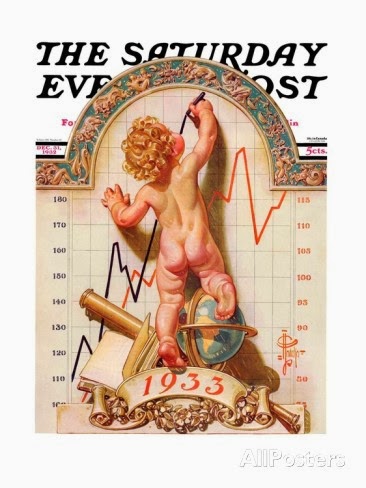
There’s an ancient allegory of the seasons, with spring as birth, summer as youth, autumn as maturity, and winter as old age. Even though the start of the year in the Western calendar – January 1st – doesn’t coincide with the vernal equinox, at some point the ancient allegory of the seasons was accommodated to the calendar by beginning the metaphor of the new year as a baby, replacing the old year – an old man. Still prevalant today, this iconography was very popular in early 20th-century print journalism, such as these classic 1930s examples from The Saturday Evening Post :

From a naturist or nude-friendly point of view, what jumps out about these illustrations is that the babies are depicted nude – no need for diapers, no need even for the sash that proclaims the digits of the new year. (Often in this graphic trope, the old man/old year, too, is shown wearing only a sash covering genitals and buttocks). Nowadays, unfortunately and unsurprisingly, baby new year is almost always depicted with diapers, at least in the mainstream media that censor even the nudity of an infant.

Why not take back the idea of a nude baby new year, and link it to a calendar of nude health and wellbeing? January, for example, would be a great month for educating new parents about the dangers and long-term disincentives of circumcision. For a baby new year, January, naturally, would also be the month for promoting not just breastfeeding but also the right of mothers to breastfeed anywhere, and their right to expose as much of their bodies as they want or need in order to do so.

There are lots of ways to extend the idea of nude growth throughout the year, ranging from “potty-training” in more natural (read: nude) ways that are less dependent on the diaper industry, to promoting the general benefits that growing up accustomed to nudity has on perceptions of sexuality, sexual identity, and sexual responsibility, and building synergy with the latest studies linking brain, skin, and movement development and sensitivity in all of the stages of life.
Nudity is not a shame or a crime. It is a fundamental health right of the body politic, and instead of being promoted by governmental or religious institutions, it is most often denied. Sometimes nudity is denied actively through legislation, penalization, condemnation…, but sometimes, merely, out of a banal inertia.
Let’s work to make 2014 a year of progress in the recognition that one of the fundamental birthrights – of every single person on the planet – is the right to be nude. 

Fishing for Nude Insights

Fellow naturist blogger Robert Longpré has produced a volume called Naked Poetry by the Sea and on the Prairies. The polished, succinct poems of his collection guide us to the naked core of truths both spiritual and physical. These are terrific poems! I had the honor of contributing a brief preface to the volume, which I’m reproducing here below. You can download the volume, which also features striking photographs for each poem, at Smashwords.

Writing poetry is like fishing in a lake of insights. A flash here, a splash there – a bite? Through skill and luck, a practiced fisher can deliver the shimmering sustenance of substance from the depths. Robert Longpré, an expert fisher-poet, has produced a terrific bounty of glittering insights from our unconscious depths in the form of poems that are brief meditations. These poetic meditations share the theme of nudity – how the shedding of clothes, as a return to our natural state, is complicated by modern society, by anxieties and fears, yet can be overcome in the joyous liberation that nudity can bestow us. As Longpré reminds us, “Even standing / naked in front of others / truth is hidden.” Yet in spite of inner anxieties that cloak aspects of our identity, “heaven is a return to the Garden of Eden / and Eden isn’t clothing optional.” In Longpré’s gem-like poems, nudity is often portrayed on the prairie. The wide-open vistas enhance the sense of skyclad freedom for all the prairie’s fauna:

The empty spaces soon filled with
life and colour and sound
with three deer staring back unafraid
of a human wandering naked on the prairie.

Birds, dragonflies, moths, grasshoppers and butterflies
moved with deliberation as though dancing
through the afternoon like the naked wanderer.

Above all, Robert Longpré’s poems form an important link between what we can call a literature of naturism, and a literature of meditation. Of course, writing and also reading poetry are acts of meditation in and of themselves, but Longpré brings the glowing immanence of nude meditation itself to the fore:

Sitting still, listening to breath
travel in and out: a glimpse of
naked soul brings an inner glow
that wraps itself around the naked body
on the cushion.

The example is manifest: read, write, meditate, wander… free from the restrictions of clothing and other arbitrary societal norms. Your journey—physical, spiritual, mental, emotional—will be all the more expansive and profound: to the middle of the open prairie, to the depths of your glittering insights.

Beautiful Nude Remedies

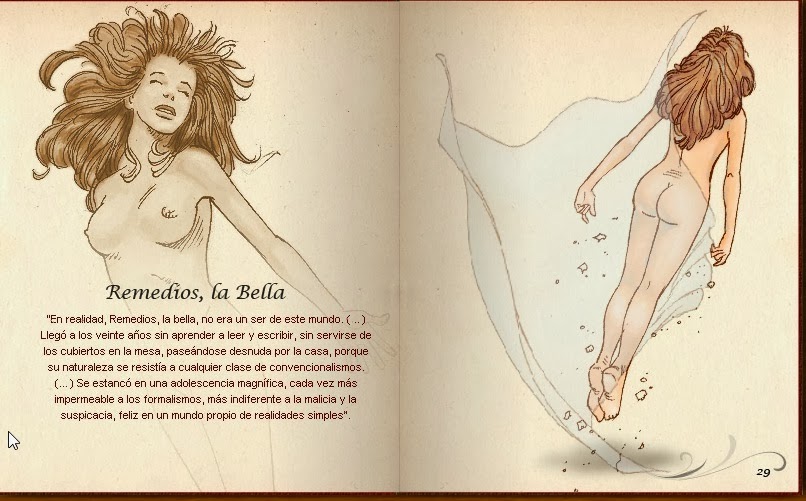
She is one of the most memorable characters from one of the most beloved books in the world, and it’s time to recognize her for what she is: a nudist. I’m referring to Remedios la Bella from Colombian Nobel Laureate Gabriel García Márquez’s Cien años de soledad (One Hundred Years of Solitude). 

“El realismo virtual de 100 años de soledad

What makes Remedios the Beauty interesting from a naturist or nudist perspective is the fact that she sees nudity as merely practical. When she has to cover herself at all (living near Colombia’s Caribbean coast) she wears a loose shift that “resolved the problem of dress, without taking away the feeling of being naked, which according to her lights was the only decent way to be when at home” (248). She has no use for fashion or convention. She takes long baths and likes to feel the elements on her body. Most of her relatives view her as simple-minded, but this is contradicted by the opinion of her great uncle, Coronel Aureliano Buendía, who thinks she has an extraordinary lucidity that “permitted her to see the reality of things beyond any formalism” (214). 

Remedios the Beauty is simply not capable of being a tease, but this is not understood by men from near and far who admire her, even to the point of dying for their misunderstanding. One man removes a loose roof tile to spy on her in the bath. She reacts with fright but not for her person; rather, she is concerned that he will fall. The voyeur sustains a desperate conversation with her as she bathes nonchalantly, and even asks her to marry him. She “answered him sincerely that she would never marry a man who was so simple that he had wasted almost an hour and even went without lunch just to see a woman taking a bath” (251). The intruder removes more tiles and does indeed fall and crack his skull. Another man travels from far away only to glimpse her face at mass. He gives her a rose, and as she accepts it she lifts her shawl and reveals her unworldly beauty to him and to all the witnesses, but she does this “to see his face better, not to show hers” (213).  
Remedios is so pure and guileless that she ultimately transcends this world for another. In one of the most cited passages of the novel, Remedios is out hanging sheets with some of the other women in the Buendía family, when she suddenly rises into the afternoon sky with the sheets, never to be heard from again.
The character’s name means “remedies,” and she is one of three characters in the book with that name. But Remedios, the Beauty, is the nude one. Is she nude because she’s beautiful, or is she beautiful because she’s nude? At one point she even shaves her head bald, to avoid having to deal with her hair, but she is still always the Beauty. From her act of lifting her shawl to better perceive the suitor at chapel, we can extrapolate that she preferred to remove her clothes to better perceive the world, not for the world to perceive her.
For many, going nude is most certainly a beautiful “remedy.” It’s a body-confidence building, vitamin D boosting, sensual, free, democratic, and above all natural way to be and to perceive the world. Perhaps Remedios the Beauty’s disappearance on a March afternoon, “waving goodbye in the midst of the flapping sheets that rose up with her, abandoning with her the environment of beetles and dahlias and passing through the air with her as four o’clock in the afternoon came to an end” (255), is a beautiful metaphor for the unmoored, unburdened, unclothed freedom we feel through the nature of nudity. 
Escape your clothes!
[Citations from the masterful translation in English by Gregory Rabassa, Harper Perennial Classics, 1998.] 

Because We Are Not Ghosts

Take an old bedsheet and throw it over yourself – voila!, you are a ghost, easiest and maybe the oldest or most basic Halloween costume of all. Why do ghosts wear sheets, anyway? Maybe because the sheet is a shroud, the cloth that wraps a corpse. The cloth catches the spirit and animates its ethereal presence as it rises from the cadaver… It is a bolt of cloth that entombs us… metaphorically, it is the clothing that enshrouds us in life.

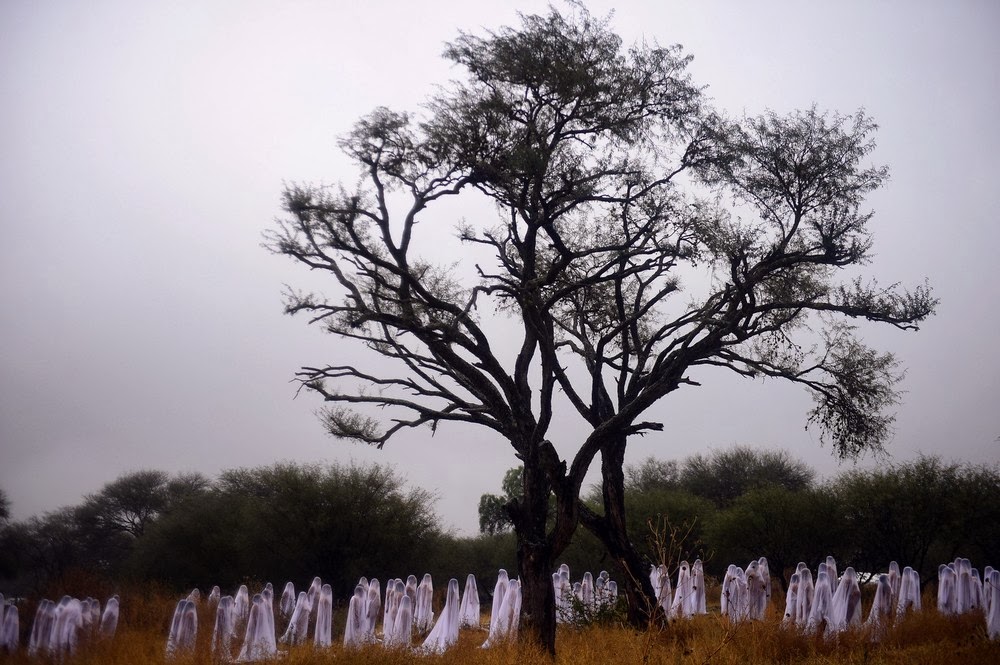
Spencer Tunick, Mexico, 2012

Because we are not ghosts, we celebrate Halloween, and we remember our departed loved ones on El Día de los Muertos. We detect on the breeze–in the flickering candlelight, in the wafting aroma of chocolate or coffee or chrysanthemums–the spirit of someone who used to be alive, who used to be animate, animated (from the root for soul, anima). Because we are our bodies, because we are embodied and fleshed, we don over our flesh a costume–a ghost, a skeleton–to remind us that the end of all things is death. “The secret of life is that it stops,” said Kafka.

Spencer Tunick, Mexico, 2012

Spencer Tunick’s 2012 photoshoot for el Día de los Muertos in Mexico features nude participants wearing translucent ghost shrouds, and it is a beautiful illustration of this idea: let us celebrate our living bodies while we can, while we are still alive – our living bodies that allow us to be animated, without shame, without fear. Underneath the sheets, and underneath the gravestone, we are all the same.

The Tailor

(in which a man “of the cloth” experiences a seam-splitting epiphany)


The tailor plied his trade for years –
a craft he chose o’er all careers –
and kept his shop on Fashion Street
where loyal clients he would meet. 
He stocked his buttons, threads, and lace
and reams of cloth o’erflowed the place:
from cottons, linens, wool, and silk,
to plaids and pleats of every ilk,
including leathers, knits, and felts
for molding caps and shoes and belts.
He had a special stool made flat,
where he could stand, but often sat,
to stretch the tape and bite the pins
while eyeing forearms, waists, and shins.
He’d chastely measure bosom vast
or round the groin from fore to ast,
from inseams, out seams, cuffs and necks:
a string of numbers most complex
he would compile for each request
to fashion clothes to fit their best.  


Il Tagliapanni (The Tailor), Giovanni Battista Moroni
The tailor’s fame grew day by day.
The most discerning folks would pay
his price to craft their bespoke clothes.
A playwright was but one of those –
he asked the tailor leave his store
to come backstage, since there were more
than twenty actors’ outfits sought
for men and women, to be bought.
The tailor brought his tape, and pen, 
and pad to note their measures, when
he stepped behind the curtained stage
and dropped the pen, the tape, and page.
 
For there before him stood a score
of naked folk – no clothes they wore.
Artistes,” the playwright said. “To bare
the flesh is one costume they wear.
Be calm. They’re used to it.” Indeed
the tailor spied no shame nor need
to cover up, but only pride
in form and fitness, hair and hide. 
 
“Oh, what a piece of work is man!”
the playwright cried. “And woman! And
the paragon of animals!
Each virtue humankind fulfills.”
 
And then, the tailor lost his mind, or so it
seemed as he began to run from one thespian to another as they posed and stretched, and he was muttering
incoherently and even
shouting at times that the sleeve and pant are nought 
but tubes to hide arm and leg,
and the knee and 
elbow need room to operate unencumbered,
that no cloth should breech the buttocks as the 
crowning glory of the legs, 
that the most intricately designed gusset falls
short of the armpit and is absolutely inferior in every way to the
vulva, that the brassiere is a mere contrivance, a cantilever dependent
entirely on the breasts’ magnificent
heft, that the heel and the toes suffer and chafe when feet are shod, and that
walking in shoes is like sewing while wearing mittens,
that even a codpiece-fitted pantaloon fails to accommodate,
much less accentuate, the shifting states of
the penis and the scrotum,
that no demon could contrive such evil as to entrap
the wonder of the
neck in tight ruffles,
that the nipples are the most glorious of buttons as adornment,
and that the navel is quite frankly the most
superb of un-buttons, and that when the navel is unbuttoned
the waist and the abdomen are freed to a much more perfect
function…


Exhausted, he knelt to the stage,
and felt his clothing like a cage.
He feebly made to rend his pants
and join the actors in their dance.
But short of breath, he could not grasp
a thing. “Please help,” he faintly gasped.
And quick the actors came to aid
the tailor to his tailor-made,
his birthday suit they helped expose.
At last he to his feet arose,
and spoke these words: “Dear playwright, friends:
Just like a needle, with thread, mends,
I lacked the sharp prick of your frank
display of chest and groin and flank
to understand my craft anew.
Your costumes I will make for you,
if you will stage your comedy
with clothes, but also nudity.”

It was agreed. And to the stage,
with all the tailor’s patronage,
attended crowds to see and learn
that to our bodies we should turn
not with disgust or shameful face
but awe and thanks and love and grace.

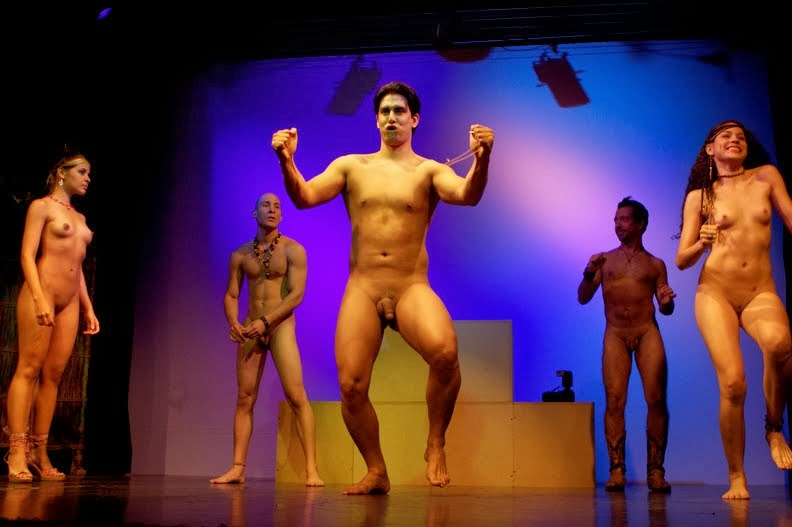
Al natural, by Venezuelan playwright José Vicente Díaz Rojas


Flankbook

Facebook has become Flankbook for naturists who brave its censorship vagaries. I haven’t even tried to accommodate the Nude Scribe site or its message to Facebook, but many intrepid naturists and naturist allies do attempt to yoke the massively popular site to their message of body acceptance and nude freedom. Some of them are actually quite successful, but also, almost all of them get censored by Facebook at one point or another, and punished with no images for a week, or even exile for a month. I do not support Facebook’s policy on images of nudity. Facebook censors already have been widely criticized for their Draconian reaction to photos of breastfeeding.

But so what do I mean by “Flank”book? (I’m not referring to a real site called Flankbook – something about ponies.) Here’s an excellent example of “Flank”book that I culled from one of the Facebook sites I support, “Live Life Leafless”:

Flankin’ on FB
This is a fine image–beautiful, even–nothing wrong with it by itself. The subject does indeed appear to be nude, and not only that, but she appears to have been photographed in a lovely natural location. But because the subject has been photographed from the side and with her arms crossed over her chest, it demonstrates the censorship I’m talking about: if it’s a flank or a haunch or a side, then it’s Facebook safe. So what that means is that ideas on Facebook related to how nudity can be experienced and what naturism can be – at least as expressed in images – must always be illustrated obliquely, at a slant, on the sly, from the side. The effect of all this is only slightly better than pixelization or black censorship bars, because once again the viewer is only allowed to tiptoe up to the fence and peep though the slats, denied access to a full understanding of naturism and body-positive nudity. It’s not called “full-frontal” for nothing. If the nude in nature can only be documented–on Facebook–as a nude always having to cover herself or himself, or pose stiffly from the side, then it is not a natural nude at all.
I support Live Life Leafless, who also posts excellent dietary information, and I support the immense wealth of naturist, nude-friendly, and body-positive material posted on Facebook by Steve White. I just wish we didn’t have to continue playing peek-a-boo(k). Facebook / Flankbook–directly or indirectly, who knows–continues to fetishize and commoditize breasts, genitals, and buttocks by banishing them from its online empire and thus forcing the association of mere nudity with pornography. 

Nudity is a Human Right

WHEREAS human beings manifest bodies that occupy physical volume in space as a necessity of existence;

WHEREAS human beings are born naked into these bodies and thus begin, naked, the basic acts of life through the intake of breath and breast;

WHEREAS nudity is thus the essential and most natural state in which human beings manifest their bodies;

WHEREAS the freedom to move the physical volume of the body through the elements without encumbrance is a natural and healthful practice for body, mind, and spirit;

WHEREAS human beings have devised intricate processes for crafting and distributing cloth and clothing, for use in protecting or adorning the surface of the body’s physical volume;

WHEREAS human beings have also devised layers of social significance that accompany the range of bodily clothing displays, from nudity through the most elaborately crafted costumes;

WHEREAS these layers of social significance are constructed arbitrarily according to custom, context, and cultural expression; and enforced arbitrarily by political or ecclesiastical contrivance;

WHEREAS the recognition of the right to practice diverse cultural expressions, such as freedom of religion or political party and freedom to form a family, is inherent in the protection of human rights;

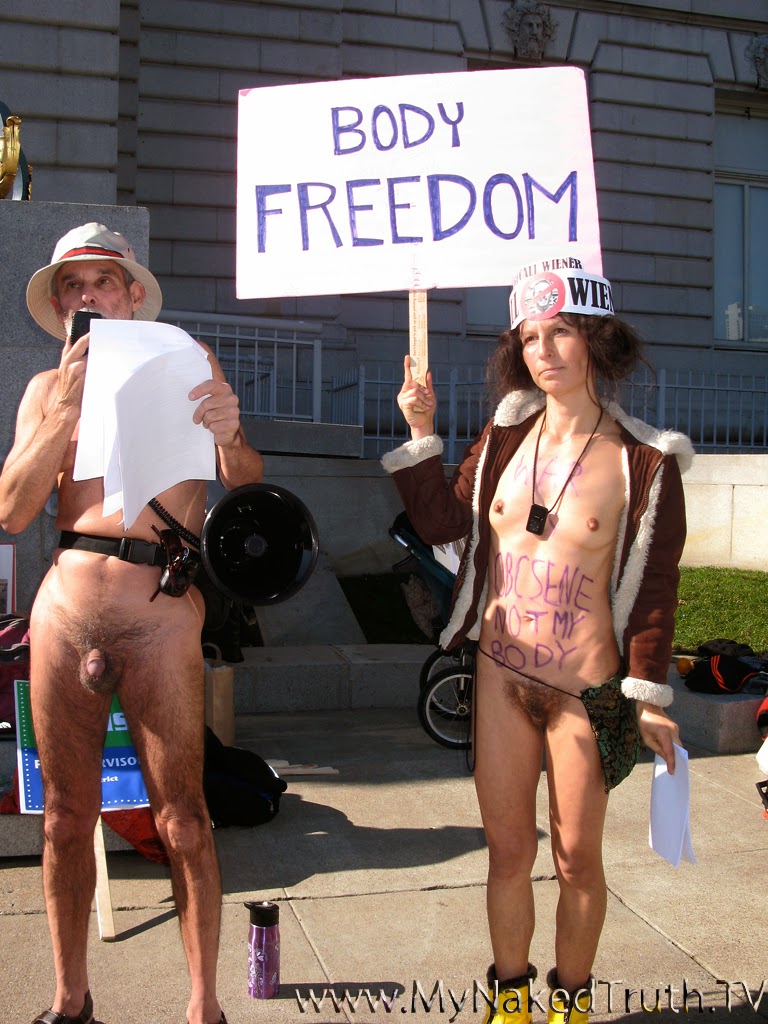
BE IT HEREBY DECLARED that FREEDOM OF DRESS, or the right to wear as much or as little clothing upon one’s body as one desires, including the right to manifest one’s body in its natural state, is a human right, to be fully protected by all governments for the betterment of humankind.

Body Freedom Activists George Davis and Gypsy Taub

Freedom of Dress

Today is a day to celebrate freedoms here in the United States, freedoms such as those depicted by the celebrated mid-20th-century American realist painter Norman Rockwell in his series called the Four Freedoms (clockwise from top left, below): Freedom of Speech, Freedom of Worship, Freedom from Want, and Freedom from Fear. These 1943 paintings, if not exclusively propaganda, were tied to government efforts to bolster faith in an American Way during World War II.

Norman Rockwell, Four Freedoms, 1943

Notice that Freedom of Dress is not included here. I can imagine it to be parallel to the Freedom of Worship: just as we are free to follow any religion – or none at all, we should be free to follow any dress code – or none at all. Far from being unimportant or insignificant, Freedom of Dress undermines not just long-held taboos about the body, but also traditional ways of enforcing gender identity and social status through textiles. The idea would seem to have been too radical for 1943.

Seventy years later, its time is ripe. Beyond the very American traditions of naturist parks and free beaches that AANR and TNS have so admirably defended – venues for social nudism as a vital lifestype option in these United States – the more international character of the WNBR, WNGD, and nude street or campus protests shows a worldwide longing to split the seams of restrictive rules on clothing. It’s worth noting, too, that the mass nude shoots of American photographer Spencer Tunick have found wide acceptance overseas, often more so than in these United States.

Can you imagine a Rockwell painting of a Tunick photograph? Perhaps that particular overlap between these two American artists is a stretch, but, returning to Rockwell, we can see that Freedom of Dress, in some ways, is not such a new idea. Another of his well-known paintings depicts some boys who have been skinny-dipping running away from the swimming hole, wet and struggling to dress: someone has discovered them. But the “No Swimming” sign, which is also the title of the 1921 painting, leads to the conclusion that the boys’ “crime” has been trespassing, not nudity. After all, in the early 20th century “swimming” was still largely synonymous with “bathing” in much of the country.

Norman Rockwell, No Swimming, 1921

Is there also an element of shame to the boys’ partially dressed haste? We don’t know who has discovered them, so it’s anyone’s guess. But continued social movement toward Freedom of Dress is also, very powerfully, the movement toward Freedom from Shame.

Happy Independence Day!