Brazilian Naturist Pioneer Luz del Fuego

A reflection for today by my friend Jorge Bandeira, fellow naturist and artist, and co-founder and current president of the ten-year old naturist group GRAUNA based in Manaus, Amazonas, Brazil. My translation:
On the 96th Anniversary of the Birth of Luz del Fuego 
[Luz del Fuego, or “Firelight,” was the stage name of Dora Vivacqua, 1917-1967, considered to be the founder of Brazilian naturism. She owned a naturist island in Rio de Janeiro’s Guanabara Bay called Ilha do Sol or “Sun Island.”]
What is the legacy of that naked woman?    
How many Ilhas do Sol saw the dawn?
Has the Sun been set and gone from 1967 to 2013?
So many dreams have resonated and still vibrate on our natural human skin, 
and children and adults alike share this Naturism that fills us with pride
against a calloused world. Perhaps Thoreau’s Walden can serve
as a tonic for our society. Or maybe, if in every country from West to East,
we had a Spencer Tunick to photograph the harmony of nude bodies wrapped in joy, 
to encourage all into nude community, women and men alike.  
What is the legacy, the sloughed-off skin, of Luz del Fuego, that snake dancer?
Luz del Fuego on the cover of her 1950 book promoting nudity against societal hypocrisy
The legacy is Abricó, Pinho, Massarandupió, Colina do Sol, Barra Seca, Galheta, Tambaba, and other beaches and clubs that make of Luz del Fuego’s brilliance a constant presence along the shore or throughout the beautiful countryside. The nudity of Dora, that cabaret dancer and actress who did so much for the benefit of all those who reject even the smallest vestment covering their bodies. The woman who dared to create a Naturist Party in Brazil, a country so thoroughly machista; the woman who was a tenacious protector of animals and nature, who paid with her own life for the defense of her noble ideals. Luz, I want Luz (light), I know that behind the curtains are blue squares and an infinity of curtains (to paraphrase the singer Chico Buarque de Holanda), she’s the Luz/Light that still guides us when others ask for the reason behind our desire to be naked, as if Naturism were nothing more than nudity. We embrace and adore nudity because we adore Planet Earth and its creatures; we love freedom and mutual respect; we love the right to come and go nude as we choose. We are not only our flesh and exposed skin: we are joyous transcendental souls that move about in our bodies in any direction and to any place where NUDITY is our guide. Sojourners of happiness is what we are, or what we try to be, in the singular truth of our nudity, which hides nothing from no one, which does not raise a scandalous finger to point out one body as superior or another as more beautiful. Everything all together, in the eyes of the good. 
 
So what exactly was the legacy of that woman called Luz del Fuego, Firelight?
An ethereal flame that outshines impertinent complaints.
A naked blaze that burns off the clothing of shame, the disguise of false morality.
A pyre that burns like a searchlight so we can find the nudity robbed from us in childhood. 
A conflagration of goodness, of peace, for the ardent multitude that goes by the name of Naturists. 
 
And wherever there is more than one nude, there she will be among them.
LUZ DEL FUEGO
 
Manaus, 21 February 2013
Jorge Bandeira – Naturist and Co-founder of Graúna

The Fig Leaf Fetish

Someone told me recently that naturism kills eroticism; in other words, that so much constant nudity eliminates the thrill of sexual anticipation.

I don’t always agree–context is everything–but I know that this point of view is widely sustained at different times and for different reasons. Naturists – always having to defend that we’re not generally orgy enthusiasts or generally prudes, either, but somewhere in the middle, like most people. Always having to toe the line between the matter-of-fact and the tongue-in-cheek.

It led me to think about the Adam and Eve story in a new way, and I find it to be a worthwhile interpretation that I’m still spinning out, discovering more consequences. 

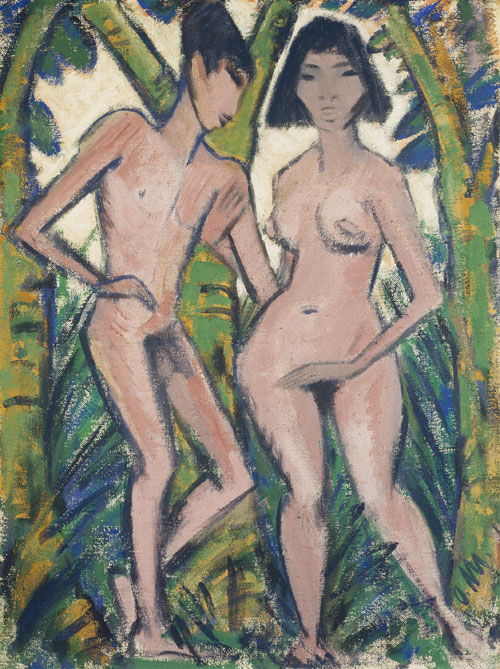
Otto Mueller (1874-1930), Adam und Eva

It goes something like this:

Imagine that God is going to feed you. What’s on the menu? Lasagna. You smell it: scrumptious. Your mouth is watering. God brings you the lasagna fresh from the oven, yet somehow it has instantly cooled to the ideal temperature to consume. You taste it, and it tastes heavenly: the light from a Renaissance oil painting bathes the scene, an angelic choir sustains a high G. Everything about this lasagna is a wonder. It is, after all, THE LASAGNA OF GOD. You feel like you have never tried anything so divine.

And then you reach for the saltshaker… … …

WHAT?!?!?!” roars Jehovah. (We know Jehovah to be a jealous god – he says so himself several times in the Old Testament.) “FINE! I will NEVER cook for you again! From now on, you must work the land, harvest the crops, prepare your food, da da da, etc. etc. etc.” For daring to even think about altering THE LASAGNA OF GOD in the slightest way, you have been expelled from the comforts of God’s holy kitchen.

So here’s the analogy: The saltshaker is the fig leaf. In this view, Adam and Eve didn’t so much cover themselves out of shame, as mess with the recipe out of cunning. They altered their appearance, for the sake of variety, the spice of life. But in the story, God supposedly can’t tolerate this – they have partaken of the Tree of Knowledge (none other than their own bodies) and enjoyed its fruits (their sexes) and decided to spice things up a bit with some fig leaf accesories. The fig leaf becomes the first erotic fetish, and all the rest of the variety of things we heap on our stifled bodies–from socks to scarves and sweaters to slacks and swimsuits to saris–carries on the tradition, even when these textiles may be simultaneously necessary for reasons of protection from the elements. When we see images of Adam and Eve wearing fig leaves, we see proof of the complicit partnership between censorship and eroticism, and how one often serves to support the other.

Any living organism, even the smallest microbe, inevitably alters the environment around it. But humans do this the most, for better or for worse. We use what we have at our disposal to invent things, whether complex languages or cultures or technologies. The fitting of a fig leaf onto the body was, in the context of this story, the first human invention of craft or technology, and this is what the Divine Being can’t abide. When you compare the Judeo-Christian account to other creation stories, there often comes a point in the narrative when the gods realize that their human creation is too godlike, too creative. The consequence is a divine punishment of some kind: a clouding of the eyes, for example, or, as in Genesis, an accumulation of toils and sorrows: the hard labor of farming, the hard labor of childbirth.

So, yes: variety is the spice of life, and in many ways our desire to create variety is the essence of humanity. Perhaps for this reason some nudists groove the fig leaf fetish. At some club-sponsored costume dances, the atmosphere can be more erotic precisely because the participants are not completely nude but rather minimally adorned. This kind of event would confirm the point of view expressed at the beginning of this post, that naturism kills eroticism, at least when it is a norm.

Most people’s current cultural perceptions hold that clothing is merely an everyday essential and that nudity is an erotic invitation. But the reality is that both extreme states of dress–fully clothed or fully naked–harbor the same potential for either a non-erotic normalcy or for eroticism. And it is the intermediate stages of dress–the swimsuit, the lingerie, the cheerleader outfit, etc.–that most recall the fig leaf fetish, or humanity’s inherent desire to create, to craft, to spice things up a bit for the sake of variety.

Danny C. Sillada (b. 1963), Adam & Eve

“Eroticism is the human dimension of sexuality, what imagination adds to nature.”
Octavio Paz, The Double Flame

Primal Magic

The “soundtrack” of naturism is the sound of nature: birds, water, the breeze in the branches, etc. But at a naturist park or nude beach, you’ll hear every kind of soundtrack from folk to rock to hiphop to country to… whatever. One of my favorite albums for naturist inspiration is Primal Magic by Strunz & Farah, and the reason stems from the beautiful cover art by Kathlyn Powell.

Primal Magic album cover. Art by Kathlyn Powell.

Powell has illustrated the covers of most of the albums by Strunz & Farah. Her covers are always bright and lush, but none of the other designs feature any nudity. Sadly, when I searched online for the image of the Primal Magic cover, I found at least one censored version, with a green smear blemishing all of the female figure except her head and arms. Inexcusable: it’s precisely the woman’s nudity that intrigues, as she wanders among the Neotropical flora and fauna that are depicted–let’s face it–in a similarly natural state. She looks back over her shoulder, she looks at you as you behold her, she invites you into the scene. If you’re going to follow her–if you’re going to listen to the music–you’d best remove your clothes and move your body: this is what her demeanor implies.

This particular album was a gift to me, and I enjoyed it so much I acquired most of the others they’ve made. The fantastic guitar duo consists of Jorge Strunz, from Costa Rica, and Ardeshir Farah, from Iran. They play original compositions with influences of flamenco, Latin, jazz, Middle Eastern, Mediterranean, and Native American styles, and their songs include percussion and other string instruments along with the two classical guitars.

There are no lyrics in the ten songs on Primal Magic, but no words are needed for the music itself to conjure up the tropical cover imagery, and from there, the associated sensations of being nude in nature. Some of the songs include bird calls, rushing water, and other natural sounds. The intensity of the listening experience reminds me of these potent lines by Paul Ableman about the abundance of sensation when nude among the elements, a very “primal magic” indeed:

“[…] the sun, the rain, the grass underfoot, the foliage which brushed their skin as they moved through forest or jungle, the water of lake, river or sea slipping past their bodies, above all the ceaseless communion with the wind. Anyone who has ever spent any time naked outdoors knows that the play of the elements over the body produces an ever-changing response that may reach almost erotic intensity. The skin becomes alive and responsive and a whole new spectrum of sensation is generated. Clothe the body and this rich communion is replaced by mere fortuitous, and often irritating, contact with inert fabric. It is a huge impoverishment.” 

The sensuous Strunz & Farah albums evoke tropical landscapes, Latin fiestas, dancing on the beach, and romantic candlelit evenings, all of which are far better without clothes!

New Brazilian Naturist Community

Just north of Salvador, capital of the Brazilian state of Bahia, there is a new naturist community under construction. It’s called Ecovila da Mata, which is like saying Eco-Town in the Jungle. Ecovila da Mata aims to be an ecologically sustainable community, less like the venerable Brazilian naturist collective Colina do Sol (founded 1995 in the southern state of Rio Grande do Sul) and more like the recent Cambium naturist development in the Dominican Republic.


Along one of the trails at Ecovila da Mata

Its tropical location is ideal. The 80,000 sq. meter site, full of coconut palms and bromeliads, includes a stream with swimming holes, and some natural clearings where the larger buildings will be constructed. The site lies just inland from the beautiful shores of Massarandupió, one of Brazil’s official nude beaches, and about an hour from Salvador, Brazil’s first capital and one of its largest, oldest, and most dynamic cities.

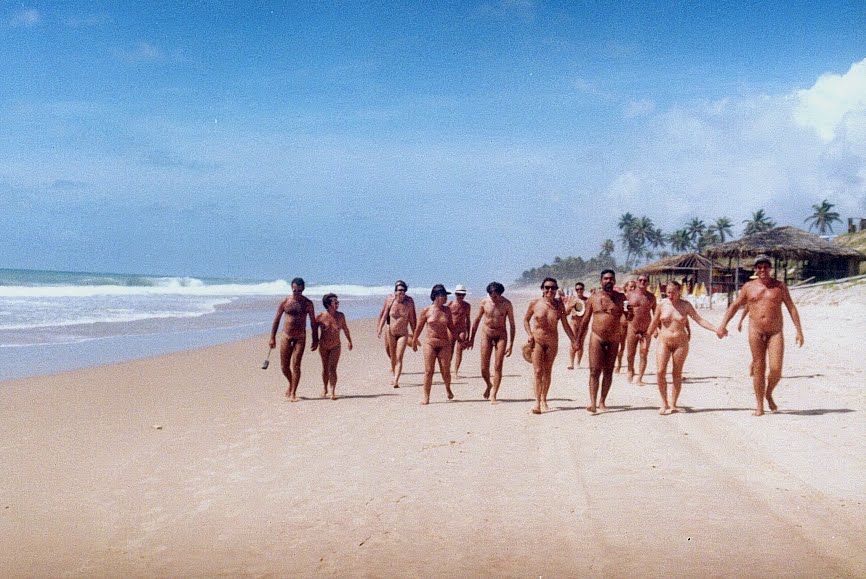
Naturism at Massarandupió Beach, Bahia, Brazil

Ecovila da Mata, with its accompanying Ecoparque (park), is being planned and sponsored by members of the Brazilian Naturist Federation or FBRN (Federação Brasileira de Naturismo), which will have a new headquarters there. The design includes about 50 sites for “self-sustaining” bungalows or cabins, distributed among the native trees and brush already on the land. The plans call for communal gathering spaces, a comunity center, a holistic health center, and a recycling center, along with a restaurant / bar, convenience store, game-room, forest trails, a camping area, a soccer field, auditorium, a community garden, a grassy parking area, and security posts. Construction is already underway. Link through to the website or Facebook page for a map, more photos of the work-in-progress, and the latest updates; there is also a video tour of the site.

Ecovila / Ecoparque founder Waldo Andrade’s statement, toward the end of the video, highlights the project goals of environmental protection, ethical naturism, spirituality, and interaction with local culture. Since the project site occupies a slice of the endangered Mata Atlântica (Atlantic Rainforest), the organizers are aiming to preserve local flora and fauna, and using slogans like “Conscientious Naturism” and “Sustainable Ecology.” They re-use in construction any trees that they need to cut down.

I think the project is exciting for naturists not just in Brazil but around the world. We all want this kind of venture to work, and to work well from ecological, naturist, and economic points of view. Considering the FBRN’s involvement in the project, and also the legal support of the municipality of Entre Rios and the state of Bahia, Ecovila da Mata is a promising possibility that may well serve as a model–and even create further demand–for planning more such naturist communities.

Exposed to Learning

Those of us who are educators as well as naturists / social nudists often ask ourselves how to bridge the two: What are good ideas for structuring a naturist education? What would be the practical constraints of establishing a school where people could be nude?
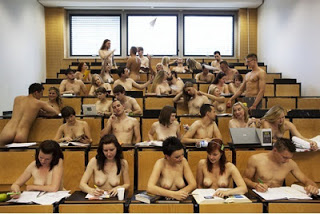
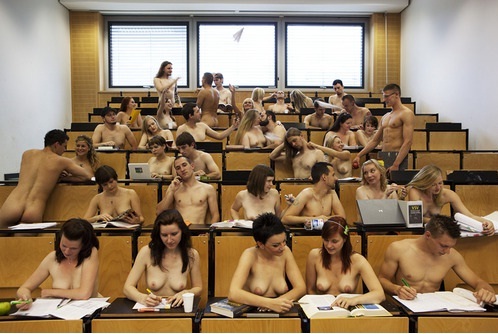
Nude Classroom I

While it’s possible to learn about socialism, for example, without being a socialist, or Catholicism without being a Catholic, the act of learning about naturism and social nudism is intrinsically enhanced by doing so while nude, because nudity is an integral part of both the method and the subject itself. A body-centered pedagogy, or whole body learning, fully engages our empirical uptake of new information and helps stimulate our brains more thoroughly and on more levels.

There have been many fine articles on nudity and education in Nude & Natural over the years, and often these articles cite scholarly research in education and the social sciences advocating greater engagement with the range of our corporeal faculties when learning. The Naturist Society’s Professors and Researchers SIG (Special Interest Group) hosts a webpage on Visionary Colleges organized by Paul LeValley, featuring a description of the nude Whatif College and the curriculum of a proposed Naturist Studies Institute.

Nude Classroom II

How about a Naturism Studies major? (There are plenty of “Fill-in-the-Blank Studies” majors already, like Southeast Asian Studies or Women’s and Gender Studies.) The program could start with a core course that all majors would complete, something like The History and Philosophy of Naturism, and then beyond that the students could fill out the required number of total credits by choosing from a variety of course offerings including Life Drawing; Aesthetics of the Body; Ecotourism and Sustainability; Ecological History of the United States; Human Anatomy; Naturist Health, Nutrition and Well-being; Human Sexuality, etc. Perhaps there could be a required number of credits in Physical Education, with selections such as Canuding; Nude Yoga; Gymnos Gymnastics; Co-ed Naked Volleyball; Gymnos Track and Field; No-Swimsuit Swimming, etc. There are similar suggestions for the proposed Naturist Studies Institute mentioned above.

The implementation of such a curriculum, let alone an entire school, would require not only willing professors but also willing students, as well as advocacy from naturist or nudist groups as well as professional education organizations. Perhaps it could become a reality somewhere like Florida or California, where both climate and abundance of naturist and nudist groups, beaches, and resorts would be favorable factors. Perhaps, in such a context, and given the viability of programs like Hotel and Restaurant Management, Naturism Studies could be considered an economically feasible major.

My novel Co-ed Naked Philosophy is but one such attempt to imagine the reality of a nude education. Here is a passage from the novel, in which the main character, philosophy professor Christopher Ross, describes an idealized nude Palace of Fine Arts in conversation with Daphne, a former student tending bar:

st1\:*{behavior:url(#ieooui) }

“Let’s play a guessing game,” said Christopher, repeating the line that Daphne knew well from his Introduction to Philosophy classes. “Imagine a place,” he thought out loud, “of monumental, open-air beauty. You with me?” 

Daphne put down the tray of dirty glasses she was carrying. Resigned, she closed her eyes. “I’m with you.”

“Sunlit figures pass among wispy tall trees and immaculately carved columns. The figures carry books and instruments; they pass by in groups or alone, they are young, middle-aged and old, but mostly young. Even the older ones are stricken more youthful by their company and by their surroundings.”

“Keep going.”

In his imagination, Christopher revisited Alexandria and Timbuktu, borrowing and shaping from Charlottesville, Texcoco, Salamanca and Coimbra and Oxford. “This is a place where all manner of pursuits relating humankind to itself and to its environment are welcome. The people we see engage themselves in animated discussions and demonstrations, of varying degrees of formality. Much effort is spent on proving, testing, experimenting, documenting and evaluating from a critical perspective. Factual conclusions are highly valued, but intuition and emotion are not without importance.”

“Go on.”

“There is much activity outside, but groups of people often go inside, where a variety of more specific engagements are practiced: reading, sketching, outlining, brainstorming, researching, painting, playing, sculpting, observing, listening, discussing, writing, creating…”

“Do you realize how many ‘-ing’ words you’re using?”

“Gerunds, yes, because this place I’m describing to you is a place of continuous and concentrated action. The effort is endless. When some people leave, others arrive. Changing perspectives, constant renewal.”

“I know what your place is,” said Daphne triumphantly, reaching for a dishtowel. “It’s a college campus, a university.” 

“Exactly. The Palace of Fine Arts.” 

“That’s what you call it?”

“That’s what I like to call it, yes.”

Daphne flashed her hazel eyes. “But what about chemistry, biology and physics?” she objected. “Or history and anthropology? Those aren’t fine arts.”

“You’re right, that’s a good point. I don’t wish to deny the importance of the natural and social sciences, of medicine and nursing, law, education and engineering. Oh yes, and even business! But I believe that artistic expression is how an individual can best juxtapose an original perception or emotion with the universals that unite us as humans. Henry Moore once said that Shakespeare’s Hamlet, or Michelangelo’s Sistine Chapel for example, never could have been created by anyone else, but Newton’s and Einstein’s discoveries would have been made sooner or later.”

“Maybe…But Newton and Einstein wouldn’t have made their discoveries without a creative and imaginative spirit, don’t you agree?”

“Absolutely.” 

“And besides, I remember learning that Shakespeare wasn’t the only one to tackle the story of Hamlet.”

“You’re right! And yet Newton’s laws could have been somebody else’s and they’d be exactly the same. But has anybody heard of Newton’s Hamlet?”

“Well I guess not, but still, the expression and even the limitations of the laws of gravity were conceived by Newton as a creative thinker.”

“Very good! Creativity is the foundation of the Palace of Fine Arts. Thank you for engaging my ideas. You have an inquisitive and well-ordered mind. Oh, and one more thing, Daphne, I almost forgot. In the Palace of Fine Arts, nobody’s wearing any clothes.”

“What?! You lost me.”

“Everybody’s naked.”

“Yeah, I understand that. I don’t understand why.”

“Nudity is truth. Nudity is sincerity. It allows us to see beyond social class and pretension, of which clothing is always an indicator. Paradoxically, nudity helps us see past gender, of which, again, clothing is always an indicator and even an exaggerator. And nudity encourages us not only to express ourselves unabashedly, but also to openly receive and understand the honest expressions of others.”

“Is that really how you think a college campus should be? I was starting to like your description, but not anymore.” Daphne reached up to hang a clean wineglass from the overhead rack. 

“You’ve got a hole in your blouse, right where the seam meets in the armpit.”

“What? Oh, I’m sorry!” She lowered her arm.

“Why do you apologize? Why do you cover yourself up?” 

“It’s embarrassing!”

“Look, I didn’t have to say anything about the hole. I just wanted to make a point. Clothes seem like our natural covering, but they aren’t. They rip and tear and get dirty and go in and out of fashion, and this is all very important for many people. Fact is: a lot of the time we don’t need clothes, we’re just conditioned to think we do.”

“Well, I’m not so sure.”

“What’s the shock? You know the basics of human anatomy, right?”

“But don’t you see? Being naked is being vulnerable. I’ve always been apprehensive about how I look, even with clothes on. Imagine being naked! I mean, I’m the kind of person who has that recurring dream about going to school naked and being laughed at! Let’s say you’re right, that maybe we can express ourselves better and understand others better in the nude. But what if you have something to hide? Everybody keeps secrets…”

“You mean like a birthmark? Or cellulite? Or that heat-of-the-moment tattoo?”

“Yeah, Professor Ross, but also psychological wounds, repressed emotions, unflattering personality quirks.”

“Ah, yes. We are all familiar with these inner afflictions. But is disrobing them worse than dressing them up, disguising them? Nobody knows what the world would be like if we could all be nude, not just physically but also emotionally.”

“I don’t know…”

“But bodily nudity is a start. And it’s a strong metaphor for spiritual nudity. We have to accept our bodies as we accept our common humanity.”

Daphne pondered this for a moment. “Do you think our bodies are just soul cages?”

Christopher swirled the rest of his drink around in the glass, watching the amber liquid catch the light. “Our bodies don’t imprison our souls. On the contrary, if it weren’t for our bodies, how could we express ourselves—our feelings, our desires, our limits and our aspirations?”
Dr. Ross, with the help of Daphne and other students and colleagues, goes on to implement a version of this ideal that rekindles interest in philosophy as well as education in general. Learning not just about naturism but within naturism is a methodological strength. It is a body-centered focus on truly mastering what we learn, and it provides a needed counterweight to our society’s obsessive reliance on the technological gadgets that store information outside our bodies.


No Real Nudity

Want to practice your life drawing skills? Here’s what the ad says: “Bare Talent. Come hone yours at the Museum, Thursday January 3 at the Life Drawing Studio.” Sounds fine, perfectly normal. Life drawing means rendering sketches of nude models, after all, hence the catchy phrase “Bare Talent.”

But here’s the kicker. The ad, from an art museum deep in the heart of the United States, ends with the caveat: “Don’t worry; there’s no real nudity.”

WHAT?!?!?!?

Cooking class! Don’t worry; there’s no real food. We’ll just use fake fruit and magazine ads.

Algebra tutoring! Don’t worry; there are no real integers. We’ll throw around some numbers and letters, but no one will suffer any math anxiety. Guaranteed!

Football practice! Don’t worry; there’s no actual exertion of energy. It’s all theoretical. No aggression, just lots of X’s and O’s on a chalkboard.
C’mon! How nudophobic can you get, when there’s not even “real” nudity at a life drawing class? And–most damning of all–when the museum staff feel compelled to assure their potential participants, “Don’t worry”? 
“Don’t fret now, folks, don’t get your undies in a bunch (although, geez, if you do, you better tough it out and keep those undies on); we’ll draw only from statues so that nobody could possibly be offended by the ordinary yet absolutely extraordinary sight of an actual unclothed human being who is holding still and not even moving around very much.”
I can only hope the museum’s extreme caution, probably meant to increase the number of attendees, yielded fewer participants instead of more.

The Empire’s New Clothes

Of 2012’s Events reviewed,
a rhyming Tale of Royals Nude.


There lies an Isle across the Sea

that hosts a Royal Family:
a Queen, her Son, two Princes – Heirs
and Scions of Celebrity.
The Family’s known in World Affairs,
their Lives attracting many Cares
since Princes’ Mum died fleeing Fame:
a Fairy Tale that’s seldom fair.
For Privacy, for Fear of Shame,
the Empire guards the Royal Name,
with Movement marked and Gesture planned
lest any Feelings stake their Claim.
But Mirth there was throughout the Land
when elder Prince asked for the Hand
of Girlfriend, now a Duchess, she
who complements him, coiffed and tanned.
Their Wedding brought great Joie-de-vivre.
Then followed more Festivities:
Olympic Games for Athletes’ Skill,
the Queen’s own Diamond Jubilee.
But younger Prince had had his Fill
of Duties. So, with Time to kill,
he sojourned to a City wild
to have some Fun while youthful still,
and there he laughed, and danced, and smiled.
By his friend Flash he was beguiled.
Said Flash, “No one will see this Shot.”
With that the Prince was reconciled.
But in the Pic the Papers got,
the Prince is wearing Clothing not,
and sports a rather altered State.
The Empire’s Brow soon formed a Knot.
The Prince was scolded. All Debate
on Nudity was far too late.
Then he was off, a War to fight.
Too soon, another Naked Fate:
The Newlyweds from Home took Flight.
In warmer Clime they did alight,
to rest and ramble in the Sun,
for each, the other’s sure Delight.
But barely had her Break begun
when Duchess, sunning, seen to None,
she thought, removed her Top. And then,
Flash sprang, and snapped. The Zoom Lens spun,
and Scandal bared its Chest again,
with one, then two, then five or ten
Newspapers, Magazines, and more
unveiling Eve in her Edèn.
The Royals and their Court abhor
a Breach of Privacy. The Door
of Shame should ne’er be left ajar,
lest Standards drop down to the Floor.
The Empire sued both near and far.
Meanwhile the Pair of trav’ling Stars
moved southeast, to the Tropics, where
the local Dancers spin and spar
top-free, and let Flash shoot and stare.
Of Cult’ral Diff’rences aware,
they nonetheless are proud to show
their Breasts before the blushing Pair.
And here’s the Rub, to learn and know:
Our Fears and Prejudices go
when we revel in Nudity.
And Flash? Import do not bestow.

Frostbite, the Snow Nude

♪ Frostbite, the Snow Nude, ♪
is a jolly, happy soul,
with a goofy smile and a runny nose
and his nipples hard as coal!

Frostbite, the Snow Nude,
is a crazy guy, they say.
When he runs through snow everybody knows
he’ll be red and sore for days.

There must have been some magic in
that old bath towel he found,
for when he stepped from his hot tub,
he began to dance around!

Oh, Frostbite, the Snow Nude,
is as nude as he can be,
and he laughs and plays on most any day
with a high of 33°F!

Floppity flop flop,
floppity flop flop,
look at Frostbite go!
Floppity flop flop,
floppity flop flop,
over the hills of snow.

Frostbite, the Snow Nude,
knew the wind was fierce that morn,
so he said, “Let’s run and we’ll have some fun,
naked just as we were born!”

Down to the village,
with a camera in his hand,
running here and there all around the square
saying, “Catch me if you can!”

He led us down the streets of town
right to the traffic cop.
And he only paused a moment when
he heard him holler “Stop!”

For Frostbite, the Snow Nude,
had to hurry on his way,
but he waved to me, saying “Stay clothesfree,
I’ll be back again some day.”

Floppity flop flop,
floppity flop flop,
look at Frostbite go!
Floppity flop flop,
floppity flop flop,
over the hills of snow.

(an obvious parody of “Frosty the Snowman,” written by Steve “Jack” Rollins and Steve Nelson, and first recorded by Gene Autry in 1950)

The Birds and the Bees

Birds and bees, flowers and trees: about as natural as you can get. I find it very interesting that “the birds and the beesworks as a euphemism for explaining sex, because it hides the idea of copulation even as it broadcasts that sex, too, is perfectly natural, and that all you have to do to learn about it is observe. Observation, after all, is how we learn about birds and bees – and we continue to learn so much more about them. The “birds and bees” euphemism has been around for at least two centuries, much longer than we’ve known about the dances that bees do to show the location of a pollen source, much longer than we’ve known about the magnetic retina strips that orient migratory birds. What more will we learn?
Yet the observation of our bodies, let alone our “birds and bees” organs, is what causes so much irrational alarm for large segments of the population. I believe that we still have much to learn from the observation of our bodies, and what’s more, we very much need that observation for our own good – mental, physical, emotional, spiritual. It reminds me of the phrase “starved for the sight of nakedness” by Cec Cinder, author of the exhaustive The Nudist Idea
“One does not object so much to the wearing of clothing in the larger society as to the insistence that clothing be worn always – with costumes even for going to bed and bathing – so that we are perpetually starved for the sight of nakedness and just so much the aesthetically and spiritually impoverished, as if we had been forbidden the sight of flowers forevermore (for what we do so admire in flowers are, in fact, their blatantly exposed sex organs); and also one is repelled by the nature of that clothing, which is, more often than not, uncomfortably tight, awkwardly cut and depressingly drab.” 
Cec Cinder from “Bare in Mind,” 1974.
Reproductive organs
What we admire in flowers are their sex organs. When I read or hear disparaging opinions about the aesthetic beauty of our sex organs, female or male – sometimes even from fellow naturistsit makes me frustrated that we are not more aware and more appreciative of ourselves. We need to be more objective, more botanical, about our “stamens” and “pistils.”
And I’ll add that we should also be a bit more bisexual about our bits. I mean this in the sense that  mystery writer Rita Mae Brown gives the term in this piece of advice for writers: Virginia Woolf said that writers must be androgynous. I’ll go a step further. You must be bisexual.” Her implication is that in order to write convincing characters of any gender, you need to be imaginative enough to put yourself in that gender. Whether you write or paint or analyze markets or repair cars, we all need to be empathetic, and observation of our bodies helps enormously.
The terrific photo above (I wish I could assign proper credit to it – does anyone know the name of the artist?) brings to mind a phrase in Spanish, a flor de piel. Literally the expression means “on the flower of the skin” but figuratively it means “with open and abundant passion or emotion.” Unfortunately, the English version of the expression“wearing your heart on your sleeve” – insists on covering up the Spanish “skin.” I prefer sleeveless. And I think there’s still so much more to learn from observing, with abundant passion, the unclothed flower of the skin.
 

Asking Better Questions

Naturism FAQs: Just because the questions in red strikethrough below are the frequently asked ones, doesn’t mean they’re the best ones…

Moving from: What if I see someone I know at the naturist park / I’m a single male / my spouse is reluctant?
Moving to: What can I do to get more people I know involved in social nudism?
Running into someone you know at a naturist venue is like running into someone you know at the supermarket, the dentist’s office, or the gym. There you are, living your life, and what do you know?, someone else is too. Besides, the same way that you want your loved ones to eat a healthy diet, get their teeth checked, and exercise regularly, you should want them to feel the elements all over their bodies, develop a more positive attitude toward their own bodies and those of others, and respect the natural environment of which we are a part.


Nature, exercise, body acceptance (courtesy GRAUNA)

Moving from: What if I’m overweight / pale / disabled / scarred / pierced / burned / tattooed / I’ve had a mastectomy, etc?
Moving to: Have you ever noticed that flowers are nourished by soil and water, bloom in the sun, set their fragrance loose on the breeze, and then they wither and die?
All of us are here but a short time before we shuffle off this mortal coil. Who among us dares to limit the right of anyone, regardless of any condition–physical or otherwise–to experience the sun, the wind, the water, the sand all over one’s body, and the companionship of social nudism? Our bodies are not statues but living organisms that vary in condition and appearance from day to day and year to year. Do your best to be healthy, and respect that all bodies are good. That’s body acceptance.

Moving from: What do I do if I have my period / get an erection?
Moving to: What are the benefits of naturism on sexual health?
Because being nude means exposing those organs most associated with sexuality, social nudism literally brings sexuality into the light as a common part of our humanity. But social nudism is just one part of naturism, which should include being conscious of the importance of physical activity, mental alertness, and a healthy diet, and how these all relate to the natural environment. All of these factors influence a healthy sexuality at all stages of life, and sexuality is an inalienable aspect of the body acceptance that naturists practice.

Moving from: What if I’m approached by a photographer / a swinger?
Moving to: Do I accept that no system is perfect, and that there will always be those with less than sterling motives?
You’re enjoying a fine restaurant meal when an acquaintance approaches and tries to sell you his car. You’re enjoying a movie at home when the doorbell rings and someone wants to sell you magazines or convert you to another religion. We tolerate these interruptions, more or less, because we know consent is key. Without your consent the sale or the conversion won’t happen. Similarly, if you’re approached by someone who wants to take your photo at a naturist park, it won’t happen without your consent (many parks use a colored wristband system to indicate photo consent). You may be startled or offended by a swinger’s proposition, but a loud and clear rejection is all you need. Ideally, these would not even be worries at a naturist park, and naturist parks are mostly successful at eliminating them, but the world is not ideal.

Moving from: Isn’t nudism a crime / a sin / inappropriate for children?
Moving to: How can it be that we willingly allow governments and churches to limit something so inherently natural and healthy?
Naturists tend to be patient and tolerant to a fault, because they understand that attempting to run around ripping people’s clothes off isn’t going to win any converts. Naturists see the long game, and they believe that the truth will out. “Try it, you’ll like it,” could be a naturist motto. Naturists also train on an obstacle course where they’re thwarted by dishonest purveyors of other products related to nudity–whether legal products or not–who seek to jump on their bandwagon, to benefit from misguided prurience and imperfect search engine algorithms. The best defense is honesty and openness. We don’t need more laws attempting to delimit, with ridiculously impractical precision, the parts of our bodies that can’t be exposed, or religious strictures shaming us over our bodies and their functions.

In fact, the best answer to all the FAQs about naturism is: Just try it already. You only live once. If for whatever reason you have a bad experience, or cause a bad experience for others, you won’t be back. But most probably you’ll have a good experience, and because you only live once, you’ll make the decision to live more nude.

Related: An excellent post by Stéphane Deschênes on Bare Oaks Blog proposing understandings of recreational naturism and ethical naturism along a scale of attitudes and practices, and how to move from the former to the latter.