Disrobing Suspense: Tom Pine

The third profile on the “Disrobing Suspense” series is Tom Pine, who has written numerous, very inventive naturist stories available on his site The Naked Truth Naturists. He has published novels, some of which are also naturist in content: The Neighbors, Father Al Takes a Vacation, and Father Al Has a Birthday Party. He has also published in Fig Leaf Forum, N, and other naturist outlets, and you can hear him interviewed by Stéphane Deschênes on the Bare Oaks podcast series.

For Tom, naturist fiction isn’t any different from other fiction in the sense that it’s important to vary formats, settings, and characters. He says, “I’m always considering possibilities that could occur in everyday life. Sometimes a character discovers being naked is the way to go all by him/herself; sometimes it’s as a protest; sometimes circumstances put him/her in a naked state; sometimes a character meets someone who lives naked and wants to know why, leading to his/her uncovering. Rather than a great ‘ta-da!’ moment, I usually try to keep it natural. After all, I’m trying to champion the cause, not shock the reader completely.”

But it’s the issue of everyday life possibilities in a naturist context that is often challenging. “The biggest hurdle, in my view, is to keep it realistic, something that could actually happen. Also, I try to keep it from being too sexy. ‘Sexy’ writing often seems puerile, silly and borderline-pornographic to me, though I never shy from accurately describing genitalia. Keeping sexual scenes on the down-low makes for a better story generally; after all, naturism isn’t about sex, per se, even though the characters in a story are sexual beings.” For instance, one of the biggest problems that Tom poses for his male characters is “dealing with their fear of ‘popping wood’ when disrobing. I’ve heard all the arguments about this rarely happening, but it sometimes does.” In his story “My Pal Sylvia,” a “coming-of-age story about two twelve-year-olds (a boy and a girl),” Tom incorporates a skinny-dipping scene in which the boy has an erection “and is shy about getting out of the lake.” The context of the scene is natural, leading to normal realizations about human bodies without being filtered through a sexual tone.

Regarding the construction of suspense around moments of disrobing, Tom agrees that “it’s essential to build tension and have that moment of epiphany in a story, or no one would wish to read it. Being naked completely is usually so far out of folks’ experience, that usually just the thought of being naked can provide tension. As a naturist, I’d like to see us all live naked all the time, so I often juxtapose the clothed character with someone who has no problem with being naked and generally lives that way. I even did one story [“Crazy Naked”] where the main character cannot physically endure wearing clothing on her body! In another [“The Naked Eye”], I had the protagonist discover a parallel dimension where the people all live naked. The possibilities are endless!”

Tom stresses that “an important element in most of my stories is the faith of the characters. Since the mission of TNTN, as I see it, is to build a bridge between naturists and Christians, I strive to show that a strong faith isn’t inimical to simple, social nudity, that the human body is NOT obscene, or disgusting, and has no sinful elements per se. I try to convey the thought that it’s what we DO, not what we ARE that causes problems.” This element of faith is present in a significant portion of Tom’s work, and is just as cherished by some readers as it is ignored by others.

In sum, Tom considers that even though “human nakedness is ‘unexplored territory,’ something so easy to do, but so difficult to imagine,” it is also true that “living naked seems so right and normal somehow—the way we should be by default and not the other way around—I sometimes feel I’ve lived naked (or should have lived naked) all my life. I guess my naturist fiction addresses that.”
Here is a sample from Tom’s story “The Mermaid of Mohasset Rock,” in which Stede, a seasoned New England fisherman, decides to explore what might be behind the stories about a sea siren. He discovers a free-spirited young woman, Alanis, living nude by the shore.

Every Sunday thereafter, Stede visited Mohassett Rock. Sometimes he’d take Alanis out in his sailboat and they’d enjoy a nice day on the water. Her unconcern over her nakedness amused him.
Sometimes, other boaters would do a double take when they noticed her nakedness, but she just waved
at them. She didn’t even bring something to cover herself. […] One fine day in early September, he and Alanis took a walk around the island. She pointed out the places where the birds nested, historical artifacts, and some interesting geological formations. It was a hot day and Stede was sweating profusely.

“Let’s go swimming,” Alanis said.

“I didn’t bring a suit,” Stede said, then realized what she meant when she just stood there with her arms akimbo. “Oh…you mean naked.”

“Of course. Don’t tell me you never skinny-dipped.”

“When I was a kid, and with Roberto, but he’s a man.”

“So just pretend I’m a man.”

“As if that’s possible.”

“Come on,” she said with a laugh. “I won’t try to jump you or anything.”

“What if I get…you know…? Weren’t you listening when I said that my faith’s very important to me?”

“And you know how I feel about that. I don’t think that one skinny-dip will get you kicked out of your church.”

“You didn’t answer my first question.”

“What, you think I don’t know about the birds and the bees? I’m a big girl. I think I can handle it.”

Stede realized his moment of truth had come.

***

“Look, I’ll go into the water first, and you can join me when you’re ready.”

Stede watched as Alanis ran down to the water and gracefully dove into the surf. He admired her self-assurance, even when naked. He wished he had her aplomb. He undressed slowly, until he was down to his boxers. He looked toward the water. Alanis was swimming around, unconcerned with looking at him. He pulled off his boxers, ran to the water, and swam out. Alanis swam toward him.

“I was wondering if you were ever going to come in,” she said.

“Well, I’m here. Now what?”

“Aw, come on. You have to admit the water feels great. It’s a beautiful day. Let’s enjoy it. Look, there’s a buoy over by that rock. Think you can make it out there?”

“I guess so.”

“Then, I’ll race you. Let’s go!”

Stede took off, stroking powerfully, but Alanis moved off like a porpoise. She certainly was at home in the water, and easily outdistanced him. She was waiting for him when he made the rock a couple of minutes later.

“You sure are clumsy in the water for a fisherman,” she quipped.

“Just because we fish, doesn’t mean we have gills and webbed feet. My first mate, Roberto, doesn’t even know how to swim.”

“Really? How come?”

“It’s a superstition thing, I guess. It goes way back. I suppose sailors would rather drown quickly if they get thrown overboard out on the sea than struggle and die slowly.”

“Sounds positively gloomy.”

“Not everyone’s a mermaid like you.”

“You say the nicest things. Come on out and join me up here. The water must be chilling you.”

“That’s all right.”

“What…you shy about me seeing you naked?”

“I told you I wasn’t up for this.”

“Look, don’t worry about it. I promise I won’t laugh or stare. Please?”

Stede considered for a moment, then hauled himself up onto the rock.

He steeled himself for the inevitable embarrassment.

***

Alanis had to admit this serious, formal fisherman was getting under her skin. He was good company and his embarrassment was endearing. She had had her fill of the self-confident, self-important studs she normally encountered—the ones who zeroed in on her obvious nakedness and thought it was prelude to a quick trip to the bedroom.

Stede was a hard-working, blue-collar kind of guy, not afraid to get dirt under his fingernails. She doubted that he had an egotistical bone in his body. She also liked the fact that he had a strong faith—and moral sense. His courtesy and politeness toward her was refreshing and flattering as well.

She watched him as he clambered onto the rock where she sat. He had a compact body, hardened by years of plain hard work. No one would accuse him of spending hours at the gym, working on a ripped physique. She doubted he looked at himself in the mirror, other than to shave.

Stede was the real deal, all right.

***

“There, that wasn’t so bad, now was it?” Alanis said.

“Maybe for you,” Stede grumbled. “I feel like I’m in a constant state of blushing. I don’t know how to move or what to do with myself. I feel so…so…exposed. How do you do it?”

“Oh, I was embarrassed at first,” Alanis said, as if picturing the scene in her mind’s eye. “My first time was as a life model in front of a class of art students. I took the job on a dare from one of my girlfriends. When I stepped in front of that class and removed my robe, I thought I’d pass out. Instead, I felt liberated. Though the students were staring at my body, I realized it was to draw me, not judge me. Soon, I could have posed on the corner of a city street. It wasn’t a big deal at all.”

“I’d have passed out for sure.”

“A big, strong guy like you? I doubt it. Come. Sit next to me. I won’t bite.”

Stede worked his way up to where Alanis sat. It occurred to him that a passing boater could see them both clearly. He looked around, prepared to jump in again if one came too close. Thankfully, no one was near them.

“You know, I really appreciate your coming to see me each week, and I also appreciate the stuff you bring. Why do you do it?”

Stede looked at Alanis. Her pretty face was inches from his. He wondered what it would be like to kiss her.

“Why? I suppose it’s because I’ve never met anyone like you. You run around naked, without a care for who sees you, yet you don’t seem…I don’t know…like that kind of woman.”

“And what does that mean exactly?”

“You don’t make it easy on a guy, do you? Well, even though you’re naked, you don’t come across as a tramp or anything.”

“That’s because I’m not. I may enjoy going naked, but it doesn’t mean I’ve thrown my morals out the window. Our society likes to judge people by how they look, when they should be looking deeper, at a person’s character. Take you, for instance.”

“What about me?”

Alanis gave Stede an appraising look. “Well, you’re reliable, polite with me, and genuinely humble. Though you were embarrassed, you stripped off to join me swimming. I think it was because you trust me.”

“So…it’s about trust then?”

“Sure. I can tell you’re not the type of guy who would suffer shame well. You have your pride. If I were to make fun of you, you’d go away and never come back. Plus, you have a solid moral core. Your religion is more than just something you do on Sunday. Am I right?”

Stede nodded, and Alanis moved her face closer. She closed her eyes, waiting…but the expected kiss never came.

A large splash in the water was her answer.

Next post: Conclusions

Disrobing Suspense: Grace Crowley

*This post has been updated. Since the time of the interview (July 2012), the artist has transitioned and now identifies as Grace Crowley (formerly Stephen).*
 
The second guest profile on “Disrobing Suspense” is Grace Crowley, famous for the Loxie & Zoot and The Bare Pit webcomics series, featuring Loxie, Zoot, Willow, Tash, Mungo and many others who live and work at Koala Bay Bares naturist resort. Crowley, aka Noodtoonist, began the initial Loxie & Zoot series in 2000. You can hear Crowley’s interview with Stéphane Deschênes on the Bare Oaks podcast series.
 
Crowley received from me the same query as Cor did about the necessity or the inevitability of scenes of disrobing when writing about the naturist experience. Recognizing that comics art is a different medium—since comics include a storyline as well as illustrations—, it is nonetheless interesting to see how some of Grace’s comments are similar to Cor’s. For instance, Crowley says, “One of the things I can find boring about reading nudist fiction is how it will go into detail about and continually reference the characters’ nudity. Obviously my cartooning gives me the liberty to simply draw characters nude and move on with the story so it’s a bit like comparing apples and oranges, but even so a lot of nudist stories belabor the point of the nudity to the point of tedium. ‘Yes, they’re nude, I get it, where’s the story please?’”
 
A further criticism that Crowley extends to naturist fiction is that it too often “comes undone” by “focusing on first-time disrobing”: “The core issue for me is that getting naked isn’t, in and of itself, a story. Getting naked and then finding out you need to save the world from an alien invasion while naked… now that’s a story. Or better still – a naked guy has to save the earth from aliens – why even bother with the ‘he has to get naked’ part at all? Just make him naked already! Yet time and time again stories (or at least the ones I’ve seen) all stop with ‘he/she got naked – it was great, it was liberating, it was awesome – the end’… pretty dull really. I have to say too, I often find there are uncomfortable sexual undertones in the disrobing element of some ‘first-timer nudist fix’; it’s almost fetishized in those stories.”
 
But Grace does agree that “naturist fiction can reasonably be said to require nudity and/or the desire to be nude/disrobe. However, because a lot of my characters have moved on to the stage of being nudists and they are comfortable with their nudity and the nudity of others, I have been at liberty to move past the ‘first-time’ clichés and focus on other stories and ideas. Even in my first story The Koala Bares, the first-time experiences were only a small part of the overall plot.” 
 
Concerning the issue of the “nervous first-timer,” Crowley maintains an attempt “to blend that into the overall narrative rather than making it a central part of it. Having a multitude of characters makes this easier to achieve, since the story isn’t so tightly focused on one individual which it usually seems to be in most naturist fiction. Also, in most cases, I aim for humor rather than dramatic emotion.”
 
Grace lists some of her stories in which there isn’t really any focus on disrobing per se: “Twinkle,” “Ghost Story,” “Enchanted,” “Frank.cam,” “Prudes & Prejudice,” the Halloween stories, and “Three-Hour Tour.” In most of the other stories, she says, the characters “who have issues about nudity are part of a broader narrative. In ‘Birthday Suits’ there is a lot more going on than Loxie’s family getting nude for the first time; likewise in ‘Nood World,’ Belinda’s and Jon’s discomfort is supplanted by the main plot involving jewel thieves.” 
 
In summary, Crowley says that in her perspective, “the nudity is only one element in the story; it isn’t the story. You may notice that in many stories I downplay the nudity, especially amongst the nudist characters. They just go about their business as normal; it’s only when the outside world interjects (or as in the case of ‘Prudes & Prejudice’ where Darcy interjects into the outside world) that nudity becomes an issue for non-nude characters.”
 
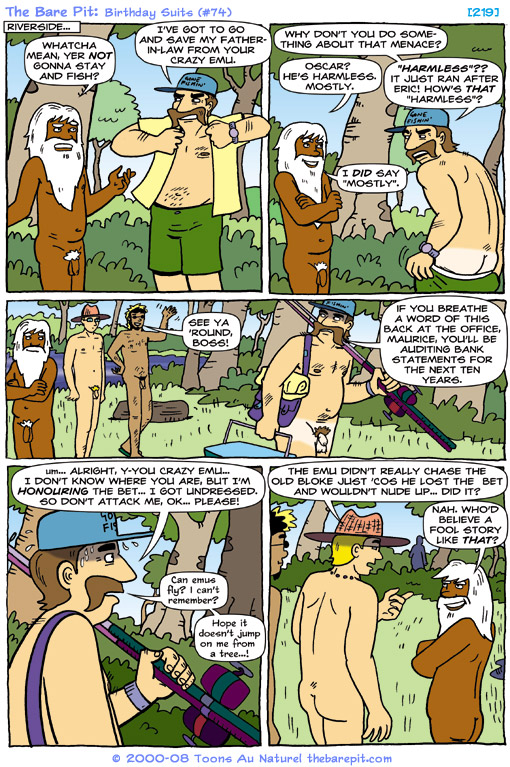
The following page is an imaginative example of suspenseful disrobing from the story “Birthday Suits” (page 74). Bob (Loxie’s brother-in-law) and Eric (Loxie’s dad) are compelled to visit Koala Bay Bares naturist resort for family reasons. While there, they remain dressed, but they lose a bet to Mungo regarding his spear-fishing abilities. In the scenes below, Bob complies with the “nude up” outcome of the bet, but Eric has refused, for which he was chased off-scene by an agitated emu. Meanwhile, Maurice is Bob’s co-worker, a fact that speaks, in the middle panel below, to many people’s concern of “What if I see someone I know?”
 
As Bob hikes through the outback looking for Eric (who has taken refuge up a tree), he discovers the joy of nude movement in nature. Eric does eventually remove his clothes, but only due to the emu’s belligerence. Losing a fishing bet with an emu as enforcer – where else but Koala Bay Bares? 
 
But just as compelling and creative are Crowley’s forays into the fantasy worlds of naturist gnomes and fairies (“Enchanted”), vitamin-D-craving vampires, and the mysterious were-nudist (“Tales to Scare Your Pants Off”). Her amazing art and story-telling know-how can easily move beyond (FAR beyond) the nerves of the first-time nudist, without abandoning portrayal of the exuberant epiphanies of naturism.
 

Disrobing Suspense: Cor van de Sande

Do you like a good whodunnit, murder mystery, or spy thriller? There is a huge market for books and films like these, and obviously many people love them. But if you’re a writer who’s not littering your text with corpses or carefully planned clues and red herrings, how do you engage suspense–the tension that makes your reader want to keep reading?
Of course there are plenty of literary works (novels, plays, scripts, etc.) that don’t feature dead bodies all over the place. But just as dead bodies might be typical of a thriller, murder mystery, or detective novel, there are specific conventions to be observed in other genres too. In vampire fiction, there have to be bite scenes; in epic poems or fantasy novels, there have to be battle scenes; in Westerns, you gotta have gun-slingers and shoot-outs; romance novels can’t lack heaving bosoms and star-crossed lovers. 
What about naturist fiction? Even if its a naturist murder mystery or nudist paranormal romance (!), I find it somewhat inevitable to construct suspense around scenes of disrobing – scenes that also function as epiphanies for characters learning the practice of social nudity. I decided to consult three fellow writers / crafters of fiction about social nudity to see what they think about disrobing suspense, with the aim of featuring their opinions, and sampling their works, in a series of posts. All three responded promptly and with many insights – my gratitude to them for the wealth of material! I will feature one contributor per post and follow up with a concluding post.
First up is Cor van de Sande, who has posted numerous single-author as well as collaborative stories about social nudity at Nudist Clubhouse. He is the former moderator of a naturist author forum, where, he says, the typical naturist story did not develop any kind of psychological context for the characters. A clothed character would observe a nude character sunbathing and “instead of going ‘EEEEK!’ and running the other way, walks up and says ‘I see you’re naked. That looks like fun. Can I try it? Sure! Oh, look! We’re naked together… Isn’t this fun.’ End of Chapter.” The next chapter would feature a new character with the same response, and so on. Beyond the poor writing, the general problem plaguing these kinds of stories, says Cor, is the constant need to “specify (usually once per paragraph) that the character was nude.”
Cor rejects the category of “naturist fiction,” asserting that what is today called science fiction (or speculative fiction) is the true genre for writing about social nudity, because science fiction is so diverse that its only commonality is the search to explore “the question ‘What if…?’” Cor lists Robert A. Heinlein, Isaac Asimov, and Piers Antony (and I’d add Philip José Farmer) as just a few examples of writers whose works often either explore issues of social nudity, or include social nudity casually as something of a default condition in society.
Cor recently finished a 98,000-word story called “San Francesco” [link] about “a Caribbean island where the Prime Minister, a woman in her early thirties, declares martial law and orders every single person on the island to disrobe, or be subject to exile. Once a person has disrobed—and in this case, martial law is to remain in force for six months—there is no further call to mention that the person is nude.” The extreme measure is enforced with the aim of isolating a “serial rapist who has been terrorizing the women of the island.”
The text below is a brief sample from “San Francesco” (text abridged from episodes 15 and 16). The Prime Minister, Elysia Farnsworth, announces her emergency measures and then “practices what she preaches”:
“We now come to the crux of San Francesco’s ‘Emergency Measures Act’. What are the measures that I plan to impose on you, San Francesco’s citizens?  […]
“Since I cannot jail someone I don’t know, the only thing I can do is neutralize his main weapon, his anonymity. Since he wears a black costume to hide his identity, I will make his black costume illegal; I will make the wearing of any costume within the limits of San Francesco illegal. Clothing was originally used to protect man from the elements, but this is no longer the case. Nowadays, clothing has become a symbol; it identifies a person’s worth, his role in society. It also hides the wearer’s identity; because we look at the costume and no longer at the person wearing it. I reject these symbols, I reject clothing. As of today, everybody is to be nude at all times. This order is compulsory and will apply to all persons on the island with the exception of babies wearing diapers.”
[…]
“The obligation to disrobe will come into effect at midnight tonight. I would have made it sooner, but I must allow time for the news to be spread and for San Francesco’s citizens to evaluate the implications, just as I have had to do when I first decided to promulgate this special law. Any person caught after this deadline will be arrested, investigated and given the chance to disrobe or stay in custody until he or she does disrobe. No criminal charges will be laid; at most, he will be charged with disturbing the peace. For the next six months, I will have no one, no one at all, wear any artificial barriers and thus perpetuate the stereotype that some persons are better than others.”
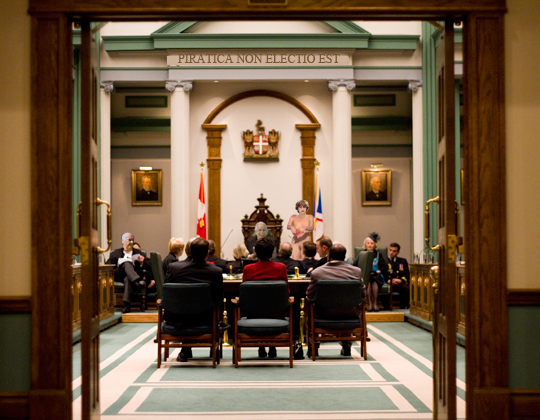
As Elysia Farnsworth, Prime Minister of the island of San Francesco, said these last words, she stepped away from the podium. In full view of all and sundry, she slowly unbuttoned her grey tweed jacket, draping it over the podium, she continued on with her white silk blouse. After depositing her blouse on her jacket, she unbuttoned her skirt and stepped out of it. At this point, she paused and looked at the assembled multitude, then reached behind herself, unclipped the strap of her bra and deliberately pulled it away from her shoulders. Finally, pushing her thumbs into the waistband of her panties, she continued to push downward as she lifted one leg, then the other. Adding her panties to the pile on the podium, she straightened up and stood in front of her audience in nothing but her high heeled sandals, as if daring them to say anything.

Ely’s speech. Photo montage created by Cor van de Sande.

She stood there, immobile, until the House slowly came back to life, first, a shuffle, then, a cough, a twitter until, finally, the background noise became such again that individual sounds could no longer be identified. At that point, she stepped back up to the microphone and said “Thank you and good afternoon.”

The warm climate and relatively small area of a Caribbean island make this fictional proposal an intriguing possibility! And Cor emphasizes that after this point in the story, he foregoes clumsily constant references to states of undress, not needing to mention Elys nudity except incidentally until some seventy episodes later when the Emergency Measures Act draws to a close and Ely dons a waist-high sarong. No doubt about it: this is a creative and theatrical example of disrobing suspense that plausibly proposes an innovative context for social nudity.   
Next post: Stephen Crowley

Happy 20th, Oaklake Trails!

Twenty years ago, a half-dozen brave naturists signed a collective agreement to purchase a large parcel of land in northeast Oklahoma, halfway between the state’s two largest cities (Oklahoma City and Tulsa). The forested land, including several small lakes and the highest point in Creek County, became Oaklake Trails Naturist Park. The pioneers who founded the park were true visionaries, and they followed through with all the necessary legal paperwork so that the park’s lots can remain the property of naturists. Today, the AANR– and TNS-affiliated park is one of the nation’s largest naturist venues in terms of acreage, and its membership has continued to grow impressively.

A happy couple at Oaklake Trails

OLT (Oaklake Trails Naturist Park) includes areas for tenting and RVs as well as several permanent homes. There is a multi-use two-story clubhouse, a large heated pool, a sand volleyball court, a pavilion that includes the Bare Buns Bistro, a gazebo for religious services, a storm shelter, an office with store, and ten miles of beautiful, well-maintained trails that wind through woods and clearings, around the lakes, uphill and down.

In the works is a lodge that will include several motel-type rooms, to build capacity from the four cabins already available for guests. Plans for the new lodge also call for a large gathering room with a double-ended rock fire place, flat-screen TVs, and several surrounding smaller meeting-type rooms. The rustic golf course will soon be expanded, and future possibilities include a disc golf course and, most impressively, the construction of an additional group of uniformly-styled permanent homes.

The folks at Oaklake Trails host a yearly 5K run, monthly dances and dinners, and several other kinds of events, including the first annual Fall Arts Festival coming up in September. The park is a frequent venue for the AANR-SW convention (including this year), and also hosted the national AANR convention in 2009. The park leaders maintain friendly relationships with their neighbors, and the park was named business of the month by the Stroud, Oklahoma Chamber of Commerce in 2011.

Even though matters of distance and income have made it difficult for me to become an actual OLT member, I’ve been a beneficiary of the park (as anyone can be) for a good decade now, having participated in 5Ks and visited friends there. This year I’m helping plan the Fall Arts Festival. I’m proud that OLT exists for the benefit of all who can visit, and not only that, but that the park is so well maintained and managed. This takes a lot of time, funds, and dedication. The result of all the hard work is that OLT is a haven of natural beauty and hearty friendship where you can do so many things without the hindrance of clothing, exactly as its founders intended.

Best naturally, Oaklake Trails

Repressed Impression

We were sixteen-year-olds,
nestled under a blanket
in the high-backed seat of a school bus
plowing home late from another city.
“Give me your hand,” she said,
and her rounded eyebrows should have been enough
for me to guess the shape of her intention.
But I didn’t.
So when she took my hand and pressed it onto her chest,
she probably imagined my surprise at her audacity,
my surprise, as I registered in the recess of my palm
the swell of her tender breast,
her egg of potential energy
hatching into a kinetic nipple,
a promise of extended flesh.
Perhaps, in her affected nonchalance,
she even imagined, correctly,
that although I held her body,
she held my mind
in an utterly unassailable prowess,
and she held, too, my surprise
at the weight and the heft
of that fact.
What might surprise her,
not me,
is that I would recall this impression
decades later
and attempt to express it in a poem,
to repress it, in a sense,
stressing, of course, that to repress
is to re-caress
her breast was small, and my hand was new.
But it was no small matter,
for me,
for her
to make her breast impression.

The Threshold of Shame

The threshold of shame looms high and ominous in the imaginations of many. It towers far overhead, casting a long, dark shadow of ignominy. Parents, wishing children to “behave,” whisper that The Threshold of Shame rains down a thunderous cascade of scalding oil and shoots poisonous darts from its arch-like frame if you dare to even approach it – to approach it by thinking about running around without clothes, or daring to want to see the clothesless people just beyond the threshold. Don’t go there. Don’t cross that line, say the investors and shareholders of Shame, Inc.

But those who do cross that threshold, or those lucky ones who from the beginning never even perceived it, report that when they look behind them, they see nothing: no monolithic archway, no boiling waterfall. Was it a mirage, this threshold? they ask themselves.

Or they think, vaguely recalling that they once wore clothes: Maybe that branch back there tore at my blouse, and the mud sucked off my shoes, and then I just wanted to feel the wind between my thighs, but it was never an all-or-nothing, in-or-out, massive threshold of doom situation.

Then, the naked call back to the fearful: Why aren’t you following us? It’s wonderful over here! I’ve never felt better, freer, happier!

Hearing no answer, they ask compassionately, Do you still think that shame is uncovering your body?

And seeing only tenuous glimpses of nervous nods far off behind them in the brush, they provide the answer themselves: False. Incredibly, enormously false.

Let us tell you what shame really is. Shame is the fact that so many people cannot even conceive of beginning to think about approaching the threshold, to think about the idea that they should be naked, outdoors or indoors, with other people!


Geodesnudos, Arica, Chile. Rodrigo Núñez.
It is not a shame to run around naked.
It is a shame that so many people cannot or will not experience just how beneficial it is to do so.

Shame has bound you, they call out to the cowering ignorant, in its wretched garments: scratchy, tight, dirty, stinky, wet. Thoughtless, you wear them, because the conditioned convenience of conformity has grown dearer to you than the more basic convenience of your very freedom of movement. Some of you say casually, though you seem to mean it, “I’d rather die than be seen naked.” Death over life, you choose. Do you really mean what you say?

If not, then what are you waiting for? Rip off your garments of shame, and come into the light!

Running ahead, leading the way joyfully, the naked ones dance, and their dance is a dance of movement, but also a dance of thought.

Blessed are the naked, for they shall live exuberant and unashamed!

Exuberance!

Exuberance! It’s a perfect word for describing naturism. Do you know the bodily origin of this joyful word?

“Exuberance” comes from the verb “exuberate,” which meant to abound, to overflow, to make fruitful or fertile. The Indo-European root, according to my good old American Heritage Dictionary, is eu@-dh-r, and the only modern word derived from it, other than “exuberance,” is “udder.”

This makes pefect sense. In other words, it’s about breasts. That’s right: exuberant boobies. ¡( . ) ( . )!

The Latin term über meant “breast” (possibly the source of the German über for “over” or “on top”). So an approximate literal meaning for “exuberance” would be something like “showing the breasts” or “exposing the chest” which is a swell idea to pair with the first definition for “exuberance” given in the AHD: “full of unrestrained enthusiasm or joy.”

For naturists, showing our joy and enthusiasm–showing our emotion and energy and creativity–is indeed synonymous with showing our breasts, and of course not just our chests but also our navels, our soles, our backs, our hair, our buttocks, our ears, our elbows, our genitals, our shoulders, our thighs, & etc. & etc. & etc.

A naturist is not always necessarily exuberant while nude (although it’s difficult not to be!), but in general, and certainly in contrast to mainstream textile society, YES: Naturism in and of itself can certainly be defined as EXUBERANCE! Who doesn’t feel a giddy rush, a heart-leaping exhilaration, when shedding all clothes to run across the meadow or parking lot, to jump into the pool or pond?

Naturists know from experience that this inevitable exuberance absolutely positively trumps and stomps and whomps any semblance of that sorry-excuse-for-morality-or-is-it-marketing called shame. And this is why we have to help our textile friends and loved ones understand that to experience true joy–full-on, overflowing, over-the-top exuberance–you gotta show some skin!

What Heaven Can Be


Distinguished members of the board, honored guests, ladies and gentlemen:

There are NOT NEARLY ENOUGH nude images out there.

And I don’t mean just on the Internet. I mean there aren’t enough non-sexual nude images out there in the greater world:  in textbooks, in galleries, on TV, on Facebook, in general-interest magazines, on posters, at hospitals.

Why aren’t there enough images? Because too many mechanisms exist to constrain us from taking them and distributing them. Too many forms of censorship, of which self-censorship is often the strongest.

Fact is, nude photography should be taught more often in schools. Why stop there? We need more nude schools, which would mean that having to specify “nude” photography would be redundant, just like the “nude” in nude geography, nude math, nude Chinese, nude literature, and for-crying-out-loud nude health and nude phys. ed. and nude art would be redundant. Not just schools and universities, but so many other places–parks, churches, malls, offices, clinics–should be nude or at least nude-friendly.

Horrors! But wouldn’t that be like giving too much power to nudity? Yep! The healthy, life-affirming, pervasive power that it’s supposed to have–that humanity needs it to have–and not the sinful bogey-man cameo it’s always cast by religion and government. SO MUCH would change for the better if we gave nudity more of this everyday power.

Thirsty prurience drinks furtive sips, 
but a strong wash quells the curse and quenches the curious.

Too many of us live wrapped up in our customs/costumes when we need to be open to the common gifts of humanity. Too many of us live wrapped up like entourage mummies in someone else’s idea of heaven. Too many of us live and die without the fun of nude photos of ourselves doing regular, everyday things.

Honorable members of the committee, it’s time to change that. We need to ENCOURAGE people to take their own nude photographs or videos, the way we encourage people to vote, to donate to charity, to get an annual medical exam, to get some exercise, to eat healthy food. The way we encourage people to have a good day, doing everyday things in the nude: activities like cooking, walking down the street, playing ball, enjoying a moment in the sun, sharing a moment with friends and family. (OK, it’s great if sex is a regular everyday thing, but I’m not talking about nude sexual photos, which are already overabundant for distribution.)

Nude photography provides a kind of knowledge about humanity sorely lacking in our society: knowledge about human variety and commonality, human vulnerability and strength. Not photoshopped nude photography–which is all too abundant and gets fetishized and elevated to billboards and to the tops of the magazine racks–but untouched, natural nude photography, when consenting, and willing to share openly. This kind of imagery, whether produced by the highly-skilled or the barely-skilled, can be just as creative as an expensive ad campaign, as fresh as the images below.

Self-knowledge and self-affirmation and body acceptance. For you, for me, for everybody – all ages and colors and genders and sizes.

You know what? It is said that ignorance is bliss, but I say that being naked outdoors–in the city or in the countryside, alone or with others–can be heaven. And sometimes we need help visualizing ourselves, visualizing just what heaven can be.


The Way to Walk in the World

In the middle of the jungle lies a pristine lake disputed by nations, narcos, and one massive energy project.

An industrialist above the law steals ancient testimonies long hidden by kings and popes.

An inexperienced translator, hired to fail, uncovers truths so unsettling they redefine the rights of properties and persons.

Oh yeah: And hundreds of people get naked. 
AGLOW
(coming soon)
A selection from AGLOW:
 

The prince walks in the world the way he came into it, for this is the way to walk in the world.

If necessary, he dons a loose cloak with a shoulder clasp, a cloak that is a quilt of colors and cultures.

Though he has no other possession, he gives freely of his self, his sweat, his song,
for this is the way to give in the world.


Nobody knew for certain where this man, Pilli, had come from. The people saw that he moved often from town to town and from valley to valley, with an eagle that followed him everywhere. They saw that he always picked up the local language, and learned the steps to the local dances, very easily.

“How is it that you can learn our customs so quickly?” they asked him.

He answered,“I learn with my whole body. It is unburdened. Do you not see this? Why do you persist in covering your skin, which must needs feel the fire of the sun, the air of the wind, the water of the stream, and the soil of the ground?”

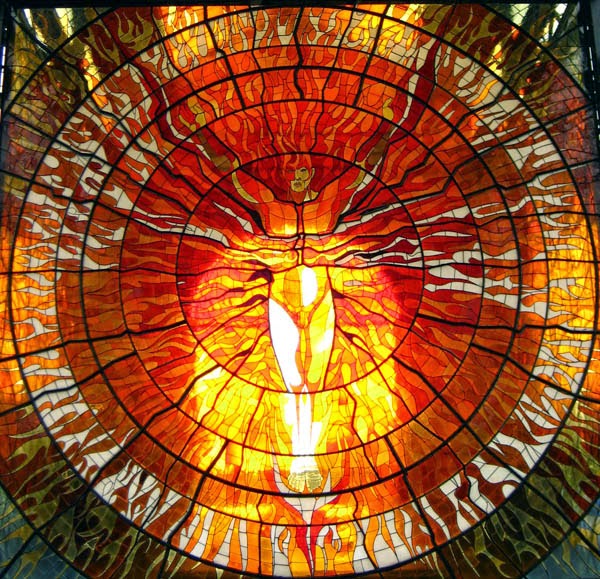
Cosmovitral, Toluca, Mexico
“But what does this have to do with learning a tongue?” they asked. “To speak you need only your mouth.”

And Pilli replied, “Say as well that to dance you need only your feet. Do not burden your body with clothes, nor close it off one part from another. Treat it as one thing, the home of you in the world, the temple of your spirit in the world.”

Still there was one who insisted, saying, “Do you mean that we should not know what thing is a mouth, what thing is a foot? They are not the same thing. Their purposes are not the same.”

And Pilli said, “It is only right that we name different parts of our home: the roof, the hearth, the door, the window. Our bodies are our homes and also worlds unto themselves: of course they are made up of many different parts. But a home without a roof, or a world without a sun, is not my body. Whatever it is that you are to do, whatever it is that you are going about doing: engage in it with your whole body uncovered.”

The insistent one asked Pilli, “Then why do you carry around that ragged cloak?”

Pilli smiled. “This cloak were like many tools, for it has many uses: it is my bag for carrying things, my blanket for sitting on, my hammock for resting. I can wrap it around me if I am cold, or wear it like a belt if I do not want it over my shoulders. But look also that in each of the swaths that give it shape, I recall a place I have visited, a person I have met. A few of the swaths hold pockets for what small things I may need to conceal. But most of all I carry the cloak because it is all I need.”

“Have you not sandals? Weapons? Food?”

“Of these first things you mention I have no need. Food, I find where I look and share where I may. Picture-prints of learning—of these I have great need, but they are best shared by those who collect them.”

A man stepped forward. “I collect such things, in my home. Have you no home, then?”

“My home is my body, as it is in the world. Where is your home?”

“In this village, on the next road.”

“What, then, is that which you use to walk in the world?”

That man,whose name was Chimallamatli, Bark Shield, had no response. So he smiled and sat to speak at length with Pilli. Eventually he invited Pilli to the place he called his home,where he shared food and picture-prints for several days.

Naturist Support in Children’s Media

If you’re a naturist parent or educator, you’re probably as sick as I am of skinny-dip slasher flicks or penis-for-laughs “bromance” films and their reinforcement of the “either-sin-or-comedy” definition of nudity. Awful message for the kiddos, right? Well, here are two (at least) examples of mainstream media with strong positive naturist content, not only for children but for adults as well.

Kirikou and the Sorceress is a 1998 animated film by French director Michel Ocelot. (I found out about the film years ago from a naturist-friendly film list at clothesfree.com – thanks, Clothesfree!) The film treats the legend of a West African boy, Kirikou, who is “small in size, but he is wise.” We see this extraordinary boy crawl right out of his mother’s womb, talking already, and immediately proceed on a quest to avenge his male relatives. Almost all of the men in the village have disappeared, and Kirikou must battle the sorceress Karaba and her army of fetishes to reunite the families of his village.

What does this have to do with naturism? Almost all the characters go about their lives “clothesfree” or “topfree,” and not only that but in their culture they probably wouldn’t have the need for such terms. How much more naturist can you get?

The children of the village dance for joy in Kirikou and the Sorceress

Some folks level the following critiques at the film: (1) The “National Geographic” critique: that if the film were exactly the same except with “white” unclothed characters, it wouldn’t have been made; and (2) the feminist critique: the depiction of the villain may hone a bit too closely to stereotypes of the “evil woman.” But I think these Eurocentric critiques do little to move beyond face value. The film was made in France by a European and African team, including Senegalese musician Youssou N’Dour, intending to stick to the original West African stories and incorporate the music and art of that region. The film proved so successful that a sequel, Kirikou et les bêtes sauvages (Kirikou and the Wild Beasts), came out in 2005 (though not available in English, purportedly because of American outrage over the nudity in the first film). Also, the live musical Kirikou et Karaba was produced by some of the same creative team members and first performed in Paris in 2007. There is apparently a third film in production, Kirikou et les hommes et les femmes (Kirikou and the Men and the Women), due out late this year.

A scene from Kirikou et les bêtes sauvages

The takeaway? The beautiful art and music of the Kirikou films will beguile you, and their depiction of nonchalant, normal nudity is a powerful message for young and old alike. One of the catchiest songs from the soundtrack, “L’enfant nu,” celebrates Kirikou’s nudity as an essential part of his heroic, clever character. Kirikou has become a favorite in my household. See for yourself!

The Battle of the Books by David Michael Slater and illustrator Jeff Ebbeler is a 2009 children’s story based on the moral, “Don’t judge a book by its cover.” Paige the romance novel and Mark the history book are new to the library. They are very quickly and superficially judged by the other books.

Segregated by their covers, Mark and Paige are pulled into opposing cliques, but they escape by letting their dust jackets slip off in the struggle. This incites the battle of the books, in which the volumes literally rip the covers off each other. Only then do the book characters finally open up and “read” each other and thus get to know each other beyond appearances. The parallel between the anthropomorphized books’ covers and human clothing is very easy to catch, and it makes this not only a powerful message for all, but also an inherently naturist message. This is a good example of “covert”-yet-overt support for naturism, hidden in plain sight but open for all to see and understand!