Customs & Costumes

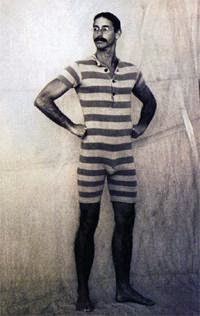
Bathing costume: there’s a phrase hardly anyone uses anymore. Yet the different textile objects to which the phrase can refer are still so widely used that the costume has become a custom.

According to my trusty old American Heritage Dictionary, costume and custom have a common etymological root, “seu,” meaning “of oneself.” Think of old British travelogues describing the customs and manners of the Chinese, or the costumes and habits of sub-Saharan Africa: these are the characteristics that were thought to distinguish one group from another anthropologically.

The word habit comes from a root meaning “to give” or “to exhibit.” The habits of one person make her distinct from another. A nun literally hangs her habit over her body.

English words like habit, custom, and the related accustomed, habitual and customary are similar in Spanish and Portuguese. But costume is not. The Portuguese fantasia (costume) shares obvious origins with fantasy and fantastic, implying an act of the imagination, like playing dress-up or once-upon-a-time. The Spanish disfraz (costume) shares an origin with the English disguise, meaning to literally undo, and thus change, the appearance of something. In these languages, donning a costume is more obviously linked to doing something that is not customary.

Also telling among the three languages are the differences from the English use of customs to mean the clearance process for entering another country. The Spanish aduana and Portuguese alfândega share Arabic origins, but in any instance in any language, the process of “going through customs” is usually invasive. In previous centuries it involved undergoing a personal registry of one’s pockets and saddlebags, etc. and the confiscation of illegal or censored items, along with extensive questioning about one’s family, education, and abilities, and maybe even receiving a vaccination or two. Today these aspects of migration between countries are more spread out over several processes, but the degree of invasiveness of one’s person and belongings has migrated to “going through security”!

It’s easier to take on new situations with an open mind. It would be easier to go through security naked, wouldn’t it? Today, nudity at security or at customs is not customary (or rather, it is, except that it’s “nudity” through those scatterscan images or whatever they’re called). It’s also a lot easier to swim naked. Before the invention and marketing of the bathing costume, people simply disrobed to bathe and/or swim. Bathing and swimming were often the same thing. You think a bathing costume sounds ridiculous? As if you were soaping up last Halloween’s superman duds? Well the bathing costume became the bathing suit or swimsuit and it’s still just as ridiculous.

What is unfortunate, unless you’re a textile magnate, is that the original, capacious bathing costume has proved highly adaptable, morphing over time into everything from the almost-just-as-capacious bermudas with t-shirts, to skimpy bikinis. But customs change, habits change, and what is “of oneself” or what one can “give or exhibit” depends not only on societal customs but also on one’s own attitude and informed opinion.

Why wear any kind of costume or suit to swim and sun? Your engagement with this question determines what is customary for you, while revealing a customs profile of your attitudes toward mental, physical, spiritual, and emotional health.

Cheek

Definitions of “cheek“:
(1) the fleshy part of the face on either side of the mouth
(2) a buttock
(3) a frank, daring attitude
(4) the way some people pronounce that French word for “cool”
All of these definitions apply to one of naturism’s newest, cheekiest, and most dynamic web presences. Nurba: Urban Naturism and Body Freedom began as a website organization in late 2011 and has expanded to include Twitter and Tumblr feeds and a Facebook page.
I love nurba for encouraging people to engage with innovative contexts for nudity by pushing past boundaries–not just traditional boundaries like religious and governmental strictures, but even the boundaries of what we mean when we talk about naturism or social nudism. I think this is a highly commendable mission.
“There’s no use in dividing us all into separate groups with different names. We stand behind social and non-social nudity, body freedom, acceptance and free-thinking. Put your skin to the wind and feel for yourself: it doesn’t matter whether you call it naturism or nudism, it’s the same naked.”
Nurba aims to shake things up by focusing on (1) urban nudity, (2) nude art and design, and (3) sex-positive nudity (affirmative attitudes toward sexual practices and orientations). Here’s nurba speaking for itself:
(1) Urban Nudity
The folks at nurba posted the following text as one of the first items on their tumblr, and it was widely reblogged:
“It’s funny, isn’t it? Funny that we can promote the right to be naked, to enjoy our body, to feel freedom, all from the comfort of our own home. And we can pretend to disregard the idea of shame, all the while we tuck ourselves away into the remotest corners, into the forest, into the desert, in our own home, where nobody will find us. We haven’t fought for our rights, we have simply found places where they aren’t challenged. We haven’t proven that we feel no shame, in fact we have proven the exact opposite, that we don’t have the courage to be outspoken, that we are complacent living secretly amongst everyone else: we have proven that there is shame where there should be none. People fear what they do not know, and we have almost deliberately denied them the understanding of nudity that we have always known.”
I read this less as a rejection of traditional nudist enclaves and more as the need to add to them–to create a wider range of options–by coming up with other ideas that specifically engage urban youth. That view is supported in subsequent nurba tumblr posts:
“As a society, we have moved away from the farms, away from fields and rolling countryside, in favor of brick walls and starless skies. Rather than consent to believing that our urban life should be spent in a protective state, under wraps, hidden behind walls and clothing, I embrace my mortality and my vulnerability. I embrace my skin, and I am not ashamed of it.”
“It has become altogether too convenient for us to imagine ourselves as something innately more than human, more than animal. In the name of fabricated morality and decency, we have institutionalized an incredible dissonance towards one of the few links that ties us to our natural roots: our bodies and our skin. The most sensuous, raw, uninhibited sensations that we will ever feel as human beings have essentially been banned for the sake of an ideology that both overly sexualizes and wrongly demonizes.”
(2) Nude Art and Design
The nurba designers set up a tumblr feed that offers something other than candid beach photos by showing contexts for urban nudity, indoors as well as outside. This makes it a unique gallery. (The Vita Nuda folks deserve a shout-out here for their attractive and innovative Nudazine, which also has to do with nude art and design). Also, the nurba news feed has featured articles or reviews about design innovations of interest to naturists, such as grass carpeting and second-skin type footwear.

(3) Sex-Positive Nudity
Sex will always be controversial, right? (I mean, for some people, just the idea–just the word–sex is controversial.) But I think the tenor of Nothing to Dread’s support of YNA’s sponsorship of a booth at a Guilty Pleasures Party (earlier this year, in New York’s Museum of Sex), with which I agree, can apply to the nurba mission as well. Nothing to Dread wrote:
I believe that nudists are generally open-minded sexually. I honestly can’t see someone who isn’t comfortable with their own sexuality being comfortable while nude among strangers. I believe that the state of mind that results in our being comfortable in our own skins extends to most areas of our lives. That includes sex and sensuality.
The people at YNA understand that you must reach out if you expect to reach new people. At the Museum of Sex, they met people whose minds were already open to ideas outside the confines of America-Puritanica.
“I believe that nudists are generally open-minded sexually. I honestly can’t see someone who isn’t comfortable with their own sexuality being comfortable while nude among strangers. I believe that the state of mind that results in our being comfortable in our skins extends to most areas of our lives. That includes sex and sensuality.
The people at YNA understand that you must reach out if you expect to reach new people. At the Museum of Sex, they met people whose minds were already open to ideas outside the confines of America-Puritanica.”
nudists are generally open-minded sexually. I honestly can’t see someone who isn’t comfortable with their own sexuality being comfortable while nude among strangers. I believe that the state of mind that results in our being comfortable in our own skins extends to most areas of our lives. That includes sex and sensuality.
The people at YNA understand that you must reach out if you expect to reach new people. At the Museum of Sex, they met people whose minds were already open to ideas outside the confines of America-Puritanica
I believe that nudists are generally open-minded sexually. I honestly can’t see someone who isn’t comfortable with their own sexuality being comfortable while nude among strangers. I believe that the state of mind that results in our being comfortable in our own skins extends to most areas of our lives. That includes sex and sensuality.
The people at YNA understand that you must reach out if you expect to reach new people. At the Museum of Sex, they met people whose minds were already open to ideas outside the confines of America-Puritanica.
The Sex & Love feed at the nurba site shows agreement:
“We cannot very well promote human nature and human nakedness without promoting an open view of sex and sexuality: sex may not define us, but it is integral to human life and, despite society’s attempt to dirty it up, it makes us happy and it helps us build connections with fellow humans.”
And finally I love nurba for their clever tweets. Here is a selection of some of my favorites that you may have missed (and if you missed them why aren’t you following already?):
Unnakedness is a serious issue in society today. Friends don’t let friends suffer from unnakedness.

Naturism isn’t a choice: it’s how we were born. It is instinct. Denying naturism is the choice, and it is one that is made by far too many.
¡Ponte de pie y desnúdate!
I think your clothes have been seeing someone else. I didn’t want you to find out this way, but it might be time to break things off.
The ones telling you to chop off your foreskin for hygiene are the same ones telling you to stuff your penis in a dark, humid pouch all day.

It’s this tweet-cheekiness of nurba that makes me want to support the cause! It’s this cheekiness that makes me want to promote adding to what organized naturism has built over the past eight decades by widening the range of ways to think about and express nudity. Fun, whimsical, youthful, refreshing, chic, cheeky, nurba! All cheeks to the breeze bringing fresh and clever contexts for nudity.

Naked Mexico: Landless and Landed

♪ ♪ “México, lindo y desnudo” ♪ ♪

I wrote a post last month on traditional aspects of nudity in ancient and modern Mexico. This post continues the Mexican theme with a focus on one of my favorite areas of that country: the lush and diverse Gulf Coast state of Veracruz. Veracruz figures prominently in recent stories relating to nudity as protest of the landless, and to nudity as incentive for a landed resort.

A group of indigenous peoples from Veracruz state has been making headlines over the past decade or so due to their nude and semi-nude protests in the state capital, Xalapa, as well as in Mexico City. The group is known as the “400 pueblos” and is protesting the loss of their land that they allege happened at the end of the governorship of Dante Delgado (1988-1992), whose face graces the signs that the protestors sometimes wear as loincloths. Some observers accuse the protestors of being paid by political parties to protest other politicians as well.

So the political motives behind the group’s twenty-year-old protests aren’t always easy to follow. And they may have switched allegiances – partly it was their frustration with being ignored for the first decade or so that led them to begin protesting nude in 2002. But their passion and dedication have been portrayed in at least one documentary and a photo gallery, and analyzed in a book in English published in 2009. The oft-quoted gist of their decision to protest naked is that they do so from the desperation of having nothing left, that the governor may as well have stolen the shirts off their backs. The communal lands they had used were known as ejidos, an ancient Mexican concept from before the time of the Aztecs. The Aztecs maintained a strict dress code, and only certain barbarous peoples would appear nude in public in their capital city of Tenochtitlan (now buried under Mexico City). Curiously, the best known of these “barbarous” peoples were the Huastecs, who hailed from the same region as the 400 pueblos today.

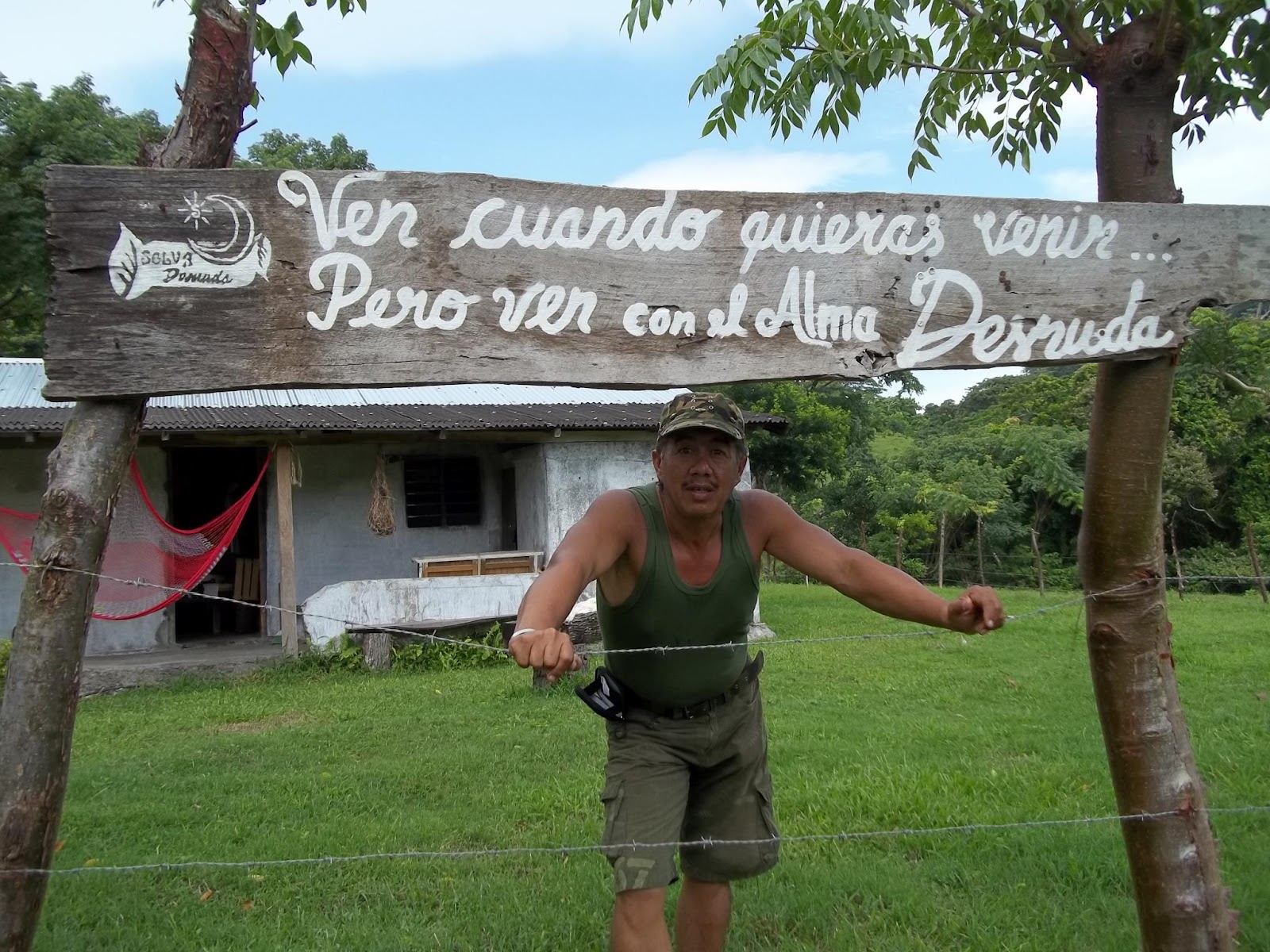
Further south in the luscious curve of Veracruz’s tropical topography, along a difficult-to-access and difficult-to-traverse road in the heart of the Los Tuxtlas biosphere, there is a new naturist ecotourism resort called Selva Desnuda (Nude Forest). Owner Miguel Vicente works with his family and seven other local families to provide the maintenance and service for the year-old site. It is designed as a more rustic and economical alternative to the well-known nudist sites along the Maya Riviera, which are luxurious in comparison. Selva Desnuda can host up to twelve people in the main cabin (three bedrooms, two bathrooms) with additional space for camping (tenting) on grounds, or lodging in the nearby community. Miguel and his staff offer packages including services such as the Olmec Bath, a photo safari, hikes to nearby caverns and waterfalls, and a workshop on the ancient and sacred practices of cornmeal preparation and tortilla-making. Instead of pools on site, there are two crystalline freshwater streams. Optional tours are available to nearby beaches, hot springs, and the mystical town of Catemaco with its lake of monkey-reserve islands.

En la Selva Desnuda

Miguel studied in France and was inspired to develop a naturist area in his home state. The sign in the photo above reads, “Come whenever you wish, just come with your soul unclothed”! A visit to Selva Desnuda would be a great addition to an itinerary including stops at the fabled port of Veracruz, the colonial colonnades of Tlacotalpan, the cultural capital of Xalapa with its outstanding Museum of Anthropology, the verdant beaches along the Costa Esmeralda, and the beautiful ruins site of El Tajín near Papantla.

You can find more information about Selva Desnuda on its Facebook page.

 ¡Sólo Veracruz es bello!

The Body Poetic

The body poetic
                       is greater than the sum 
                                      of its infinite parts.
Have you felt?
The body_poetic palpitates and alliterates abundantly
           and shines,
                       when wet and lustrous,
                               naturally nonchalantly nakedly nude.
The body-poetic rhymes
                      sometimes
but its contours burst the bindings of
                                                       stanza                      and
mediated, stereotyped font terse verse.
                                                             One 
size does not fit all.
          What is the same is that each
                                               body PoetiC
                  is uniQue.

The BoDy POEtic is a series of articulations that are speech acts 
                     in a corporeal repertoire                   of the utmost utterance.
The body (poetic) dives
                             swims 
                                   and 
                                        twists
so its skin can skim and shimmer in a sunlit sunkissed skinny dip 
                                             of slippery linguistic interminglings.
The body* poetic has but one tongue but speaks many 
                                                      and its voices sing and shout 
but also hum and throb and slap and sneeze 
and cough and sigh and sob and wheeze.
The BODY POETIC nakedly and brazenly avoids the editor and the photoshop
but keeps up with hygiene
                     and healthy diet
                         and exercise
                            and sex
                               and recycling
                                  and life-long learning
because health and wit make lust for life.
The bodi poetik is so HIGH and so low and so W  I  D  E and so nude:
Have you felt?
                                  It is
a probe more intimate than the deepest penetration, 
         a projection  more   far – – – – – flung    than     the      wildest          ejaculation       .

The Body Politic

It’s an ancient and common allegory used by the apostle Paul among many others: the body politic. The various sectors or classes of a society are likened to the organs and systems of the human body. Just as we need all the body parts to function in harmony–from the heart and liver and fingers all the way down to tear ducts and lymph nodes and red blood cells–we need men and women, toddlers and grandparents, traders and teachers and truckers and all the rest to work together in cohesion.

Medieval depiction of the body politic

Usually the allegory goes in that direction: projecting the idea of the body onto the politic or populace. But the other direction works too, and when you look at it that way–projecting the politic onto the body–, surprising and unsettling associations arise, especially regarding the legal and political understanding of discrimination.

We live in an imperfect society, even though great strides have been made in many parts of the world toward a truly universal recognition of human rights for all members of the body politic, regardless of ethnicity, age, sex, sexual orientation, or physical disability. People everywhere are finding or reaffirming the right to assert many more, if still not all, aspects of their identities.

But the reverse is not true. Society at large in the US and many parts of the world continues to discriminate, wrongly and wrongheadedly, against certain parts, systems, and functions of our bodies. I’m no psychologist, but when I read here (next-to-last paragraph) the glaring ridicule–the outright hostility–toward certain delicate but noble areas of our body that the wise among us treat with much more respect, I am moved to the conclusion that not only will ignorance always mistake segregation for security, but that it will do so with deliberate repression. The text I have linked to is but one cheap thrill in an “amusement” park of chuckling intolerance, a run-down sideshow that broadcasts in a flashing neon sign this willful but misled need for clinging to mechanically and artificially closed categories that is so often the hallmark of ignorance.

The discrimination against these parts of ourselves related mostly (though not exclusively) to our reproductive and excretory systems relegates these systems to some sort of seamy, unseemly status outside or on the border of the body politic. And since those same parts are the ones most reluctantly unclothed by the greater textile world, those of us who willingly unclothe ourselves as often as possible are associated in the popular imagination with those body parts and their forced exile to the fringe. This results from people aggressively drawing and quartering themselves, and setting up little reservations on their anatomical landscapes. It does not make for a cohesive body, but rather one that struggles with an incomplete sense of itself, a segregation the mention of which becomes, itself, a taboo.

It is for this reason that so many people’s first-time experience with social nudism is quite literally a revelation. It is an *unveiling* that leads to deeper comprehension and broader appreciation for the parts that make up the whole of the body, as well as the people that make up the body politic. Social nudism or naturism simply accepts areolas and ankles like it accepts arms and anuses–anatomical non-discrimination–because the emphasis is on the holistic, natural, fully integrated and articulated state of the body and not religious or political perceptions of shame-based segregation. Nudism inherently seeks to avoid these restrictive scriptures of church or state: no cover-ups of mysteries or policies, but rather the transparent contemplation of nature and our place in it, our human nature. Naturally and anatomically, social nudism does, however, accommodate the strictures of biology, which is why there exists a minimal etiquette policy related to hygiene and arousal. That’s all.

And that’s more than enough to drape over the body politic. Anti-anatomical discrimination is as untenable as anti-nudist discrimination. For more on the topic, read an outstanding article by Larry Darter on “Nudism and the Pursuit of Happiness.”

That Appealing Banana Dance

It was a rainy Spring Break this past week, which ended up meaning extended TV time here and there for the kiddos. We all got to see and hear the commercial below MANY times:

Gotta deconstruct this a little: We don’t know if Banana Kid is dancing in front of a mirror, a window, or maybe even a webcam. At one point, he removes his peel and swings it over his head, like a stripper. When Banana Kid turns around, you can see banana buttocks, just in case you missed that the peel is his clothing.

So I’ve already used the words “stripper” and “webcam” to describe a commercial on kid-friendly Cartoon Network. But the whole thing is, it’s innocent fun that even Banana Dad decides to get in on (though without removing his peel). There can be a very strong sense of empowerment from dancing naked in a celebration of body acceptance. The problem is that when Banana Kid realizes that Dad is dancing behind him, he throws the peel at him and says “Get outta here!” Then he looks a little chagrined: is it because his Dad saw him dancing, or maybe because he realized that he yelled at his Dad and threw his peel at him for no good reason? Or both, or something else? Unfortunately, that sense of empowerment through rhythmic nude movement is yet one more aspect of nudity that society shames and relegates to pornography, and that nudists and naturists must continue the struggle to reclaim.

You may remain unconvinced as to the meaning or intent of the banana dance clip, or my interpretation of it. Would I like the commercial more if the whole banana family, along with their apple, kiwi, and grapefruit neighbors, casually removed their peels and danced and swam and had a picnic? Sure. Nonetheless, this catchy and subtly subversive commercial has actually promoted a nude-friendly message, at least in our home. Two family members of different age brackets, and not counting yours truly, have been inspired to imitate the Banana Kid’s nude exuberance while “na – na”-ing the song and swinging clothes overhead. That’s just one household–and a nude-friendly one at that–but still, can you imagine the dance-appeal effect all across the country?

Polite Nudists

Nudists are often the most *polite* people you’ll ever meet.

Why?

Because, when in textile company, they *politely* manage to restrain themselves from

  • ripping their clothes off
  • talking to you non-stop about the benefits of living clothes-free

Because, when at a textile beach or pool, they *politely* manage to refrain from

  • flinging away their bathing costumes as far as they can throw them
  • rather strenuously helping you out of yours, too

Because, all too generously, they *politely* tolerate

  • pop culture stereotypes about nudity being only sexual or comical
  • the use of airbrushed nudes and the word “naked” to sell just about anything
  • the general ignorance of textile folk about how social nudity drives body acceptance, self-awareness, and environmental responsibility

Being *polite* is important for respectful dialogue.

But it’s possible to be *too* polite!!!

Nude Spa of Ancient Mexico

Over the last few years, Mexico’s clothes-free tourism industry has steadily increased in quality and quantity of venues. There are now a half-dozen or so official clothing-optional or nudist sites, mostly along the Riviera Maya (see here for a recent list of Mexico’s nude beaches and resorts).

It’s interesting to note that at several of these nudist resorts and beaches, an ancient Mexican form of communal nudity is making a comeback: the temazcal.

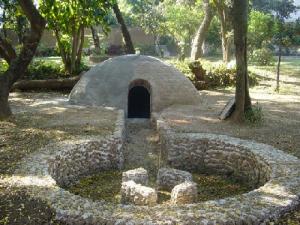
Example of a temazcal

The temazcal is a round earthen structure akin to a sweat lodge. Although many well-to-do citizens of pre-Conquest Mexico had their own, the most common ones were public. Taking a sweat bath was a communal part of daily hygiene for the ancient Mesoamericans, who were famously fastidious about their hygiene. So much so that there were many more among them who considered the newly-arrived Europeans to be fetid devils than gods. This was because the Spaniards seldom bathed or shaved (their beards reeked of repasts past), and would wear the same heavy clothes and boots for weeks on end!

But the temazcal could also be used for therapeutic purposes. In addition to controlling the temperature inside the temazcal, skilled bath attendants chose from a variety of kindling, logs, and herbs in order to produce a steamy smoke best suited for a given patient’s particular ailment, whether muscle aches, infection, rash, etc. Modern-day reinterpretations of the temazcal as a place of healing are popular in Mexico as well as the southwest US and are not limited to nude recreation areas. In fact, the modern-day non-nudist temazcal unfortunately (in my opinion) tends to focus less on the benefits of sauna-like relaxation, and more on the alleged spirituality of suffering for as long as one can tolerate inside the small, cramped, asphyxiating space in order to then experience a “rebirth” upon leaving the “womb.” The best documented, specifically nudist temazcal I could find is in Argentina.

Because the Spaniards destroyed indigenous Mexican documentation and art with such great zeal, we don’t have nearly as much information as we could have about other contexts for nudity in pre-Conquest Mexico. But a name that comes to mind in that regard is Nezahualcóyotl (Fasting Coyote, 1402-1472), a leader of the Acolhua people in Texcoco in central Mexico and ally of the Aztecs. He was renowned as a man of great culture who not only composed lyric poetry and compiled a new code of law, but also designed aqueducts, gardens, and other landscaping projects including a royal retreat he maintained on a hillside called Tezcotzinco, now a ruins conservation site in Mexico state. Tezcotzinco was an open-air spa where Nezahualcóyotl would bathe with great spiritual ceremony, in the tradition of the Toltec leader Quetzalcóatl from centuries previous.

Bath of the exalted leader

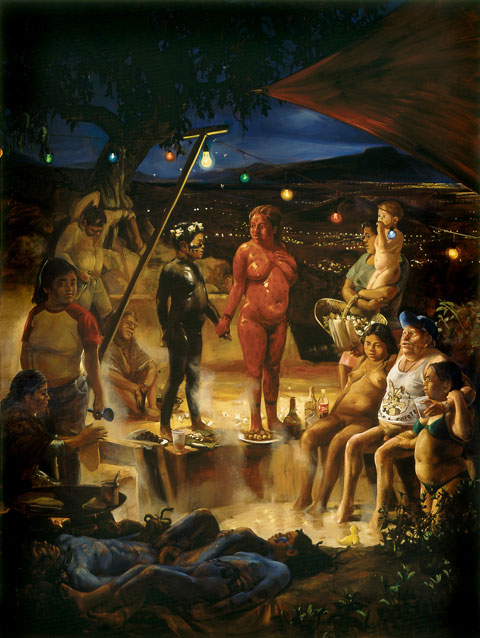
Today’s ruins site features one stone bath basin in particular that has a glorious view of the surrounding valley, apt for inducing the meditation of a head-of-state. The site is popularly known as Baños de Nezahualcóyotl, which is also the title of a wondrous re-imagining of the bath by Mexican painter Daniel Lezama. In Lezama’s vision, modern-day Mexicans convene at the spa site in an oneiric atmosphere (a fiesta? a sacrifice?) featuring bodypainted nudes, non-painted nudes, and other subjects in various stages of dress.

Daniel Lezama, Baños de Nezahualcóyotl

This mingling of nude, clothed, and painted subjects is characteristic of Lezama’s beautiful and richly symbolic allegories. The brightly painted bathers also bring to mind a recent Mexican bodypainting festival in which the participants became fanciful human alebrijes (the original alebrijes are fantastical, multicolor creatures made from papier mache by the family of Mexican artisan Pedro Linares). Perhaps, when the festival was over, the human alebrijes all scrubbed each other clean in the Baños de Nezahualcóyotl.

Further information on contexts for nudity in Mexico, in a continuation of this post here.

Know What Censorship Is

Censorship is ignorance. How to fight it? Read more about naturism, including Co-ed Naked Philosophy! The excerpt below is based on an actual incident a few years ago in Florida, involving a complaint about a lawn-statue replica of Michelangelo’s David:
   
Censorship resulting from a “concerned citizen”?
To their credit, the Channel 5 news team deemed the Michelangelo’s David controversy much less important than the energy crisis, peace negotiations in the Middle East and in Colombia, and the campaign to rewrite the state’s ridiculously antiquated, astronomically amended racist constitution. But that didn’t stop the broadcast’s organizers from tantalizing their viewers, just before each commercial break, with tawdry teasers like: “Risqué statues: Would YOU put Michelangelo’s David on YOUR front lawn?” and “Coming up: male sexuality on display. Why one concerned citizen said, ENOUGH is ENOUGH.” As the anchors read these lines the viewer would be treated to a ridiculous shot of a replica of David in front of Tucker’s shop, with that infamous blur covering his p#### and s######.
Only in the last two minutes of the broadcast did the David story finally appear. Standing underneath the LOUISDALE LANDSCAPING sign, and next to the blurred David, the young female reporter introduced the topic while recycling the same tawdry teasers as before. Christopher guessed the replica must have been about six feet tall. Then the reporter interviewed the concerned citizen: 
“Mr. Schillinger, can you describe the circumstances of your complaint?”
“My daughter and her friend were in the backseat of the car when I drove by here the other day on my way to Wal-Mart. They started to giggle and asked me some questions, and, you know, I found myself in a situation where I had to explain what a…you know…what a penis is. It was real embarrassing.”
The reporter interviewed Tucker: “Mr. Bierson, had you ever had complaints like this before?”
“No.”
“What did you decide to do when the police called you?”
“I don’t think there’s anything wrong with that statue. It’s a classic. But I didn’t want to stir up any trouble, and I didn’t want the media to come—huh, so much for that—so I decided to put a leopard-print thong on him.”
The camera froze awkwardly on Tucker’s image for a few seconds before the screen split with two shots of David, labeled BEFORE and AFTER, showing the nude but blurred David on the left and the garishly clad David on the right. The reporter’s voice-over could be heard: “What a difference a swimsuit can make. This is Lana Fitzgerald in Louisdale for Channel 5 at 5.” 
The co-anchors, with forced smiles and no teleprompting to read as the show ended, looked gamely at each other. The male anchor said “How’s that for an exposé?” while the female anchor shrugged and delivered the catchphrase “Channel Five: Covering the Coast.”
Christopher laughed out loud. “Covering the Coast MY ASS!” he roared, jumping up to moon his TV. “The whole ass, or NOTHING! Exposé this!” Then he pressed the mute button on the remote control and sat dumbstruck for a few minutes. He called Tucker, not knowing what to say, and got his answering machine. While he prepared and ate his dinner, he couldn’t stop going over the remark of the “concerned citizen,” turning it over and around in his mind, exposing it to the need for knowledge crying out from the concerned citizenry: 
“I found myself in a situation where I had to explain what a…you know…what a penis is.”
I found myself in a situation where I had to explain what a…you know…what a vulva is.
a situation where I had to explain what a…you know…what an erection is.
a situation where I had to explain what…you know…what menstruation is.
where I had to explain what…you know…what pregnancy is.
where I had to explain what…you know what sex is.
I had to explain what you know what anatomy is.
had to explain what you know what philosophy is.
to explain what you know what doubt is.
explain what you know what curiosity is.
you know what discussion is.
know what censorship is.
what love is.
life is.
“What spirit is so empty and blind, that it cannot recognize the fact that the foot is more noble than the shoe, and skin more beautiful that the garment with which it is clothed?” 
Michelangelo

My thoughts beyond this scene: The media tend to react to these complaints at face value. If they’re going to devote time or space to “coverage” of complaints like this, why don’t they turn the tables, and gently make fun of the fact that there are still people out there who feel the need to complain like that? The media could do much more to contextualize nudity within art, health, fun, and well-being. In the second part of Co-ed Naked Philosophy, the reporter from the scene above, Lana Fitzgerald, has a change of heart about the media’s relationship to nudity and makes a very daring decision…

Need a Swimsuit?

You need a swimsuit…
like a chicken needs suspenders
like an eagle needs a parachute
like a maple needs a hat
like an elephant needs shoes
like a dolphin needs a swimsuit
like a filing cabinet needs an apple pie!
You need a swimsuit…
like the sand needs an hourglass, 
like the waves need a bathtub, 
like the sun needs a lightbulb.
Swim free, live free, live nude!