Disrobing Suspense: P. Z. Walker

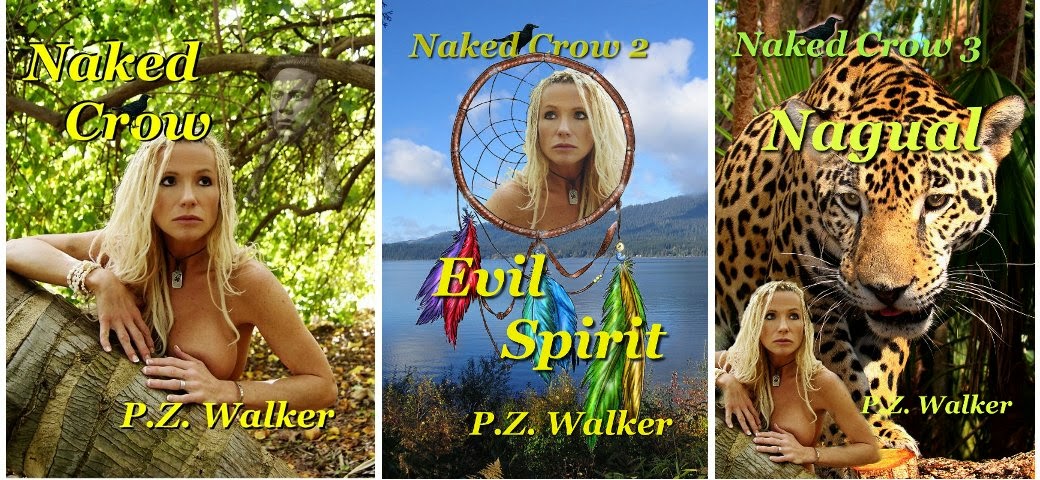
The latest featured writer in this new run of Disrobing Suspense is P. Z. Walker, author of the three-title Naked Crow series. Paul (P. Z. Walker) tells me that he wrote the books “for non-nudists as well as nudists. Nudists like to read books in which nudism is treated as the normal thing it is, and I found there’s a scary lack of decent naturism-centred books. That’s why I started writing some myself.” He goes on to affirm that what he tries to convey to non-nudists is that “nudism isn’t something that has to do with sex and porn and all that. There are all kinds of people in nudism, normal people like you and me, from all ways of life, and they share appreciating the freedom of being clothes-free.”

The Naked Crow series by P. Z. Walker

In fact, the books’ main character, Sheila, begins the series as a non-nudist. She works as a dental hygienist, and is also a Wiccan. About this spiritual path, Paul states “I am a Pagan, and many of my female Pagan friends are Wiccan, which was my reason to make Sheila a Wiccan too. My own Pagan path is based on the Druid philosophies but I don’t follow those very strictly. They’re a guideline for me.” When the series starts, Sheila goes into the woods “to prove to herself that doing a Wiccan ritual dressed is just as good as doing it naked. She isn’t planning on becoming a nudist or naturist.” Having read an article on nude Wiccan ritual, Sheila is curious:

Sheila got up and walked around, her dress catching in more twigs and bits of forest. She listened carefully to make sure that she was indeed as alone here as she thought. There were no sounds of cars or people, no barking dogs either. She bit her lip. Would she do this? Would she be brave enough to take all her clothes off here in the small forest, and read a few [Tarot] cards?

After walking back to her blanket she slowly unbuttoned her blouse. She wore her bra under it, it wouldn’t be a problem if people say that. It was a nice bra, after all. Not very confident yet she took off the blouse. It took her longer to gain the courage to unzip her skirt. A little bit of wind came through the trees and caressed her back and shoulders. It felt nice, much better than before. “Okay, here goes.” A few movements later she stood on her blanket in her underwear, arms crossed over her chest, spying around and listening intently. The only thing around was the occasional breeze of warm wind which played around her.

Only because her best friend disappears at a nudist park does Sheila have to adapt to social nudity in order to investigate the disappearance, and Sheila “slowly discovers that being naked is actually pleasant, but she needs to undress a few times before she feels secure in that.”

Regarding any suspense or tonal shifts in the narrative built around the act of undressing, Paul says that he tries “to keep the moment that someone goes naked the first time very uneventful. It shouldn’t be something that people are ‘going for’ as if it’s some porn part when they read it. It has to be a natural moment, although I do try to convey the unease or worry about their body when they first undress.” For example, Sheila arrives at the nudist resort but is not ready to disrobe, and has a conversation with a friend there who’s been a life-long nudist:

“Wendy, what the hell are you doing?”
“Come on, we’re in a nudist camp so I’m going to be naked,” Wendy grinned as she tossed her clothes in the back of the car and stretched out like a cat in the sun. “Aren’t you going to?”
“Me?!”
“Yeah, you. Unless you see someone else here,” Wendy shrugged as she looked around.
“I couldn’t,” Sheila resolutely said, “who wants to see me nude?” She wasn’t sure what to do as Wendy walked around the car, all nude, and stood in front of her.
“It’s not about others,” Wendy said, “it’s about being free.”
[…] 
“Wendy, wait!” Sheila’s fingers trembled as she started unbuttoning her blouse. Because of her jitters it took her longer than usual to take her clothes off, but then there she stood, naked next to her car and her friend, and her cheeks on fire. “I can’t believe I’m doing this.”

As evident from the titles and covers, Sheila / Naked Crow becomes a confident naturist while getting involved in more mysteries featuring elements of Native American spirituality such as dreamcatchers and naguales (in the Mesoamerican spiritual traditions, a nagual, or nahual, is the spirit animal double of a shaman). Paul says a fourth Naked Crow novel is in the works! In the meantime, he is also a prolific writer of fantasy, steampunk, and science fiction (page here).


Here are direct links to Paul’s books for order:

"There’s Not a Bathing Suit in Russia"

I was recently looking through The Naturist Society’s naturist bibliography, compiled by Mark Storey, when I came across the title There’s Not a Bathing Suit in Russia and Other Bare Facts by Will Rogers. My interest was piqued, because Will Rogers is everywhere here in Oklahoma – he is the state’s favorite native son. Rogers was an extremely popular public persona in the US and abroad, especially from about 1917 to his untimely death in 1935. As a humorist and political pundit, he wrote regular newspaper columns as well as books, in addition to being a rodeo rider and Broadway star, roving reporter and aviation enthusiast.

When I discovered that a local library’s special archive holds an original edition of the book, I just had to go have a look. It was originally published in New York in 1927 by Albert & Charles Boni, with illustrations by Herb Roth.

Well…it’s a fun read based on Rogers’ time in Russia, but it has very little to do with naturism. The title is meant to titillate, as is so much marketing along the lines of NAKED juice, etc. The frontispiece declares “If you like the following subjects you will just love this text book,” and then includes  “Bathing Bareback” in the list of subjects. The brief book is more consistently about the Russian political scene of the time than anything else, but it does include plenty of wry commentary about social customs, and among these comments is a brief section on skinnydipping. I’ve reproduced the passage here with Rogers’ original spellings:

“Now while I am on this Athaletic stuff I better kinder call you over to one side and tip you off to a little bit of the life that is really very interesting, in fact kinder exciting, and to an outsider makes life worth while in Moscow. The river runs right through the town, and contrary to the general notion and looks of some of them, why, they do bathe–that is, some of them do; and when I say bathe, I mean they bathe together. They don’t let race, creed, or sex interfere with them. And what I mean–they bathe right. They just wade in what you would call the Nude, or altogether. No one-piece bathing suits to hamper their movements.

If there is a bathing suit in Russia, somebody is using it for an overcoat. Why, there is only two pair of trunks in Russia, and they were being mended the weeks I was there. Well, when I saw that I just sit right down and cabled my old friend Mr. Ziegfeld: ‘Don’t bring Follies to Russia. You would starve to death here.’ But you know the way they do it there–don’t seem to be so much what we used to years ago call–what was that word? Oh, yes, ‘Immoral.’ Well, they just walk down there to the bank of the river and everybody skins off their clothes. They don’t have much. Underwear is about as scattering there as bathing suits. 

Now if it hadent been for this bathing existing I would have got out and seen a lot more places in Russia than I did. But I want to state positively that while I did not get to see all of Russia, I got to see all of some Russians” (pp. 130-133)

The passage shows many hallmarks of Rogers’ plainspoken humor, such as that last line about not seeing all of Russia but seeing all of some Russians. His comic timing is brilliant in the line, near the end of the first paragraph, that starts “They just wade in” and you’re expecting to read “the river,” but the sentence heightens the element of surprise by continuing with “what you would call the Nude.” Yet he does not even make fun of the Russians for skinnydipping. In fact, he recognizes that no textiles on the bathers means nothing “to hamper their movements.” He even says their “bathing” is not immoral, and suggests that the scantily clad women of the Ziegfeld’s Follies format (Rogers himself had participated in the show in 1917) could not compete.

Here is Herb Roth’s illustration that appears in the middle of this passage:

 
Herb Roth, illustration in There’s Not a Bathing Suit in Russia by Will Rogers, p. 131

Given Rogers’ words of support for the bathers, it’s a shame that his caricature does not participate with the fit skinnydippers but instead stands at a remove, fully clothed and holding his hands up. Is he shielding his eyes, or applauding, or is his gesture the one where you’re letting your pal in on a secret? I imagine the latter, although it’s ambiguous. I can also acknowledge that maybe the illustrator couldn’t imagine how to depict Rogers without drawing him in his signature garb. Maybe the publishing team imagined their readers would be offended by the depiction of a nude Will Rogers. Yet Roth could not resist including a phallic rendering of St. Basil’s Cathedral in the background.

I don’t know if people still skinnydip in the Moskva River. Somehow I doubt it. But I do know that skinnydipping was common during the time of Rogers’ childhood in Indian Territory (now Oklahoma); it’s a safe bet he made reference to this fact elsewhere in his writings. Another safe bet: There are plenty, in fact way too many, bathing suits in Russia now. 

Disrobing Suspense: Robert Longpré

The second post in this new series of Disrobing Suspense interviews with writers is a very special one, because it was the first time I was actually able to meet with my interviewee in person. Robert Longpré, the SkyClad Therapist, has written numerous books that happen to include naturist titles such as his three volumes of Naked Poetry and a new novel, A Small Company of Pilgrims. 

A retired academic administrator, Robert is a Jungian psychotherapist and proud husband, father, and grandfather. He is also an inveterate Canadian snowbird who has begun “winterludes” in Mexico, and last month, while I was enjoying a vacation along the Riviera Maya with my family, I was able to travel with my wife and mother-in-law to Puerto Morelos for an afternoon to meet Robert and his wife Maureen. We enjoyed drinks and conversation at La Casa del Farito with live music as well, and then we walked a bit along the main stretch of beach and plaza to observe some fantastic sand sculptures. It was a lovely afternoon!

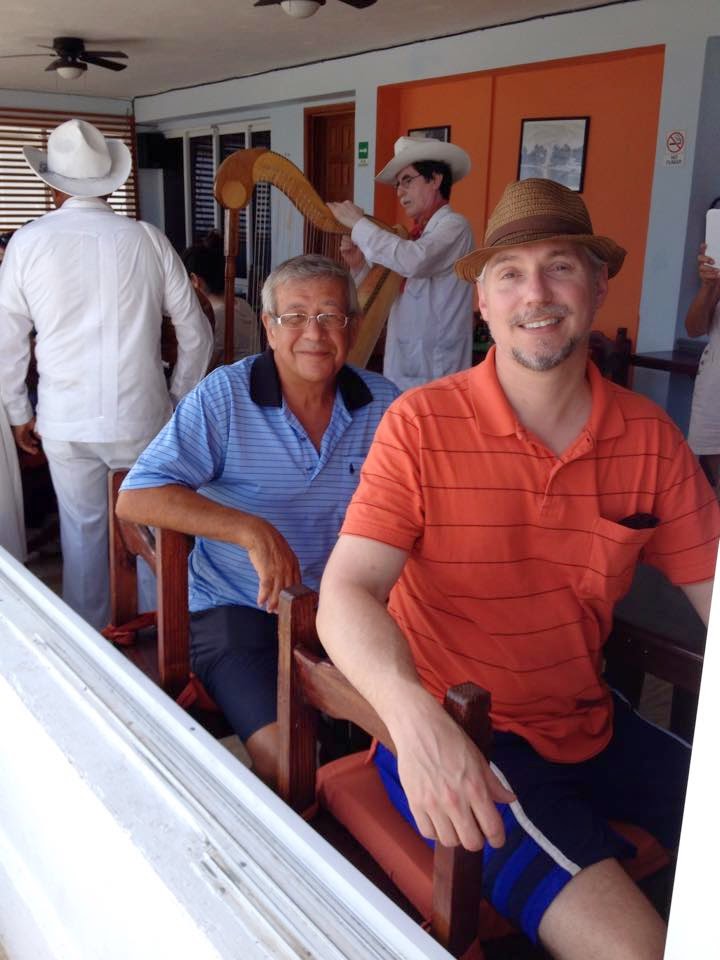
Robert Longpré (left), with yours truly
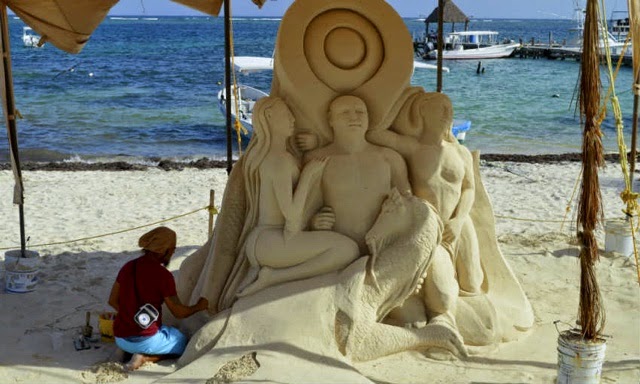
One of the sand sculptures in Puerto Morelos
I was already familiar with Robert’s poetry, having written a forward or two and helped with a bit of editing, but Robert and I had not met. What a joy it was to get to know Robert and Maureen, who together had just recently finished the photographs for the third volume of Naked Poetry. While in Puerto Morelos, Maureen and Robert were assiduous beachcombers (as you can read on his blog), walking ten kilometers daily in training for the famous pilgrimage to Santiago de Compostela, Spain, which they plan on trekking later this year. In fact, Robert’s research for writing the novel A Small Company of Pilgrims, including very specific geographical descriptions, has served him in preparation of their own pending pilgrimage. I asked Robert if he would be willing to engage in some follow-up questions about his fiction for this interview, and he graciously agreed.  

In A Small Company of Pilgrims, Robert tells the story of an impromptu family-like community that forms among contemporary pilgrims along the Camino Francés to Santiago. It is the story of René Beauchemin, a Canadian psychotherapist and something of a doppleganger for Robert, although the plot is not strictly autobiographicalFrom the French, his name means Reborn Beautifulpath, which indicates a forecast of his trajectory in the novelRené is a middle-aged father, recently divorced, who makes the sacred trek not out of devotion to Catholicism but because he has heard the Call, the Call to go and walk, and reflect, and achieve a greater consciousness of his life and circumstances. In Robert’s words, René undergoes a “process of transformation (alchemy), sort of a waking up to a bigger universe with mid-life”; his pilgrimage is a dare “to take the challenge of the heroic journey (a la Joseph Campbell).” Along the way he meets an almost unreal cast of characters, each with his or her own personal quest. 

Each character, as well, in her or his own way, helps Robert overcome his resistance to nudity, a resistance that surprises and mortifies Robert initially. Some of the characters are already familiar with the practice of meditation, and prefer to meditate skyclad. Other characters are only beginning to understand the benefits of spiritual mindfulness, let alone the gift and wonder of being able to meditate nude. At first, René becomes known jokingly as “the half-naked pilgrim” (shirtless), and this causes him embarrassment and stress

Here is an excerpt from the novel that depicts the tension between pilgrims clothed and unclothed, a tension that is essentially the “disrobing suspense” that naturist writers inevitably confront and utilize in building characters, settings, and themesIn this passage, René’s meditation is interrupted by a vision worthy of Akka Mahadevi, the twelfth-century Indian poet and holy woman:

René took off his socks and boots and took a sitting position for meditation. Try as much as he could, he just couldn’t find a comfortable posture. He struggled trying to hold his meditative attention for quite a few minutes before giving up and laying back on the grass to enjoy the heat of the sun. It wasn’t long before his tee shirt was off so that he could feel the breeze coming off the river. He was tempted to remove his shorts and sunbathe, but the possibility of someone seeing him naked was enough to kill that idea. However, perhaps meditating half-nude would work. Strangely, it was much easier, though he could still feel the strain that his shorts put on his body in comparison to the freedom he felt on the rest of his body. 

As he closed his eyes and began focusing on his breathing, he heard a voice singing, a woman’s voice. Rather than have the beautiful sounds become a distraction, he simply accepted the music as part of this place and time and returned to noticing that small space between the outbreath and in breath, that in between space of nothingness. The woman’s voice became stronger,letting René know that whoever was singing was coming closer. Almost against his will, his eyes opened and he saw her on the other side of the river, slowly walking as she sang. Her long black hair framed her unclothed body which was glowing like dark gold in the sunshine. As if aware of René’s eyes on her, she turned her head and smiled. Giving him a slight wave of her hand, she then turned and continued her song and her riverside stroll. He listened as he watched her. He heard the words of her song: 

“People,
male and female,
blush when a cloth covering their shame
comes loose.
When the lord of lives
lives drowned without a face
in the world, how can you be modest?
When all the world is the eye of the lord,
onlooking everywhere, what can you
cover and conceal?”

A half hour later, René put his tee shirt, socks and boots back on and walked into Zubiri wondering if he had imagined the scene with whom he could only describe as some golden goddess. Was she real? Or as with Sid the day before, was this simply an illusion, another product of his mind?
It didn’t take too long for René to reach the Albergue Escuela in the town, an old school building that had been converted into a basic needs hostel. The talk among the group from the night before had suggested that this would be the first place they would check into upon reaching Zubiri in hopes of meeting up together for another afternoon of enjoyable company and of recovery from two good days of hiking. As expected, the hostel had lots of room for pilgrims yet to come. René checked in and found that Sid had already claimed their bunks in one of the three dormitories. Then he saw her, the golden woman from alongside the river. She was talking to Sid in a manner that suggested that they knew each other. 

René claimed a bed near their bunks after greeting them with a smile and a voiced “Namaste!” with hands clasped together as if in prayer, something René had learned from the month spent in India. René liked to honour others in small ways such as with greetings in their own language if he could. In his opinion, it was all about respect. It was obvious from their smiles that both were pleased with his efforts. As he set his backpack on the bed, he asked about their walk that day, as well as making small talk about the pleasant weather. As they chatted, he got out his change of clothes and his shower kit. He knew that washing his socks and tee shirt needed to be done early so that they would be able to be dry by the evening for repacking. As he headed to the shower, René asked Sid and his friend if they would join him for a late lunch at one of the local restaurants. Receiving a nod of assent from both of them, René then left the room to shower, shave and wash his few items of clothing. 

In the shower, he thought again about the incident at the side of the river. He could still hear the words of the song and the voice that sang them. The words seemed to have been burnt into his mind, or perhaps his heart. Wearing a clean top and a pair of lightweight runners, René rejoined the golden woman and Sid as they set out to discover a place to eat. It wasn’t a long walk before they found a sidewalk café just past the non-descript square building that appeared to be the village’s church. Before leaving, René had posted a note on the bulletin board letting Gabe and Karl know that he and Sid had already checked in and were out for lunch. 

“Sid,” inquired René, “could you introduce me to your friend?” 

“Of course, René, forgive me,” he apologised. “I thought you already knew Asha. Asha is from my country as you have probably guessed. Thank you for the honour you gave us with your greeting earlier.” 

“Pleased to meet you, Asha,” smiled René. Your presence is like sunshine.” 

“It is an honour to finally meet you, René,” she replied. 

With a bocadillo, a glorified Spanish sandwich, on his plate with some fries, and a cup of café con leche, René felt like he was in heaven. It wasn’t too hot out, if that was ever possible in his mind, and it was sunny. What more could a man ask but to share this with someone? That thought brought a small cloud over his mood . . . ‘with someone’ . . . he didn’t have someone to share this with anymore. Sensing his quick change of mood, Sid asked René how his meditation by the river had gone. René was jolted out of his inner mood with a start. How did Sid know he had meditated beside the river? 

“Ah, my friend,” soothed Sid as he noted the look of surprise on René’s face. “Asha had told me earlier that she saw you meditating by the river.” 

“She saw me?” 

“Yes, she said you were meditating half-naked, and so she finally got to know why others call you the half-naked pilgrim.” 

Turning a deep shade of pink, René mumbled, “Uh, yeah, I was meditating there. I didn’t think anyone would see me there hidden from the road and nearby buildings.” 

“Oh,” remarked Asha, now speaking for herself. “I am sure that I was the only one who saw you. I thought that you saw me, René?” 

“Um, I guess I did see you. I, I . . . I just thought that, maybe I was imagining that I saw you,” he replied softly and with a hint of embarrassment. 

“Oh no!” apologized Asha, “I hope that I didn’t offend you.” 

“No.” René quickly returned. “I just thought that maybe you had hoped to have privacy while you walked and sang.” 

Asha looked at René with a hint of a smile of understanding. “You are so gentle, René. Yes, you saw me walking without my clothes on while I was singing one of my poems. I didn’t mind that you saw me. After all, it was an honest and innocent moment that we shared by the river, don’t you think?” 

“Um, yes; I guess,” he spoke hesitantly. All of a sudden, what Asha had just said about singing her poem registered in his head. “You wrote that song, er, poem?” 

“Yes,” replied Asha, “Did you like it?” 

“It was beautiful, your voice was even more beautiful. I can still hear the words – People, male and female, blush when a cloth covering their shame, comes loose. That you were nude as these words came from within you was somehow appropriate; I mean, it just seemed so perfect.” 

“Yes, for me it was a holy moment,” agreed Asha. “For me I feel closest to the gods and goddesses when I sing to them without hiding behind clothing. As you say, it was a moment of perfection.”

Robert explains that his protagonist is “intellectually accepting of nudity in private” but needs to be shown how to progress to social nudity. Several of the characters help in this regard, to the extent that René eventually “becomes comfortable with participating in social nudity within the context of the group.” His ease with the idea increases as he approaches his sacred destination – the physical destination of Santiago, as much as the spiritual destination of enlightenment that is brought forth in the “small company of pilgrims” who meditate together, every day of their journeys, gradually adopting nudity in the process. Disrobing becomes a literal manifestation of enlightenment over the course of the novel. René’s growing ease with his body also parallels his involvement with Frieda. She is a strong-willed character at ease with her own nudity. René initially clashes with Frieda as a result of misunderstandings, but eventually bonds with her in a deep and reciprocal trust.

Robert’s delightfully surprising and profound novel is in fact not just naturist but “a blend of fantasy, Jungian psychology, Buddhism and naturism” (“Afterword”). In A Small Company of Pilgrimsall of these philosophies and modes of perceptionmutually reinforced through the practice of daily nude group meditation, combine to produce a unique and seamless message of self-acceptance and compassion.
The naked pilgrim treks onward

Disrobing Suspense: Nick Alimonos

This series of interviews called “Disrobing Suspense”* is about the idea that writers of naturist fiction (and writers who may not identify as naturists but who nonetheless write about social nudity) deal with a particular set of recurring tropes or motifs that are necessary to the subject matter. In the same way that if you are writing a vampire novel, there will be blood, and maybe garlic – or if you’re writing a thriller set in 19th-century London, there will be footsteps echoing in the fog, etc. – naturist writers are often depicting confrontations between clothed and unclothed characters, and consequently building suspense around the act of disrobing. In the interviews I ask fellow writers about content, about technique, and specifically about portraying social nudity and/or conveying naturist philosophy. 

Nick Alimonos is a writer of fantasy. Over the course of a decade and a half of careful planning and plotting he has created the world of Aenya, where the naked heroes Xandr and Thelana, last of a long-gone race called the Ilmar, team up to save the rest of the planet. Nick explains that the heroes “are from a culture where clothes do not exist. In the Ilmarin language, for instance, there is no word for ‘naked.’ However, I realized early on that having a ‘nude planet’ would be boring from a storytelling perspective, so naturally the Ilmar encounter civilizations where nakedness is taboo. A lot of the tension is derived from this clash of cultures.” The world of Aenya is “a tidally locked moon of a giant gas planet, so one hemisphere is perpetually frigid while the other is scorching hot. When the Ilmar cross into the desert region, or Emma’s home town in the snowy mountains, they dress to survive.”

From a naturist perspective, o
ne of the very interesting ways in which Nick maintains the importance of the heroes’ nudity to the plot is that it is something like a superpower for them; the heroes “don’t mind other people wearing [clothes], but they do have a very acute sense of touch, which has a spiritual dimension to it. They believe in a kind of pantheism, where all living things are part of a singular body, known as the Goddess. So, feeling the wind and the grass and the rock on your skin is partly communing with their deity.” This aspect of their nudity means that the narrative voice can highlight sense perceptions that are more traditionally ignored: “I’ve never believed naturism to be about ‘seeing nudity’ so much as ‘feeling nudity,'” says Nick, “and this is where I put my focus. And from a literary standpoint, I find it interesting, because most writers focus on just the two senses: sight and sound. So, there’s a lot of me talking about how gravelly the ground is underfoot. Of course, there’s also other characters’ reactions to the nudity, which is fun. What I try never to do is talk about body parts. I just don’t think it adds much to the story and it gets old fast.”

Xandr and Thelana. Illustration by Frans Mensink

Nick’s drive is the creation of a worldview that, while promoting the benefits of nudity, forms just one part of the independent world of Aenya. In fact, Nick’s current novel, The Princess of Aenya, “though set on Aenya, has no real nudist characters.” Nick clarifies that with the world of Aenya, “the characters are naked, and there is plenty of pro-nudist philosophy, but the story and the world can stand on its own even without those aspects. Nudity is a powerful metaphor for many things and has been used for ages in literature. One of the primary themes in Ages of Aenya is the dehumanizing effects of civilization. Nudity represents, in this framework, a departure to simpler, more innocent times, to a time when we were more in tune with nature.” 

To give a sense of Nick’s excellent writing and world-building for his naked heroes, I’ve chosen a sample from his work in progress, The One Sea (below). In this passage there is a fundamental contrast between the nudity of the arriving heroes and the rich robes of the royal court that receives them. The inherent emotions at play, the competing senses of strength and vulnerability in nudity, and a surprising turn of events are all portrayed convincingly here in Nick’s writing.

Xandr followed the guards, hand-in-hand with Thelana. He could feel the moisture budding in her palm, her skin quivering. She would not release him, for his presence, he knew, strengthened her resolve. Shame could possess such power, but such power was an illusion, for it could do nothing to harm them. They had only to suffer their scorn and ridicule, and become pariahs. And yet, despite having lived much of his life in solitude, Xandr could not quell the racing of his heart, as though some predator were upon him. Ilmarin or no, he was like a beast removed from its habitat. Hundreds gathered around him, soldiers and magistrates and holy men, and families of royal birth, and his body quailed and shrank at the sight of them, his member like an ambling minnow between his thighs. And still he could not be called entirely naked, for he remained burdened by his sword, Emmaxis, weighed to his back in its scabbard.

The interior was cold and stony and lacked of wind, despite the searing sun beyond its walls, and the granite floor, patterned in semi-precious stones, was unforgiving against his soles. Every eye was upon them now, from the queen’s courtesans in their flowing silk and lace, to the magistrates in their ceremonial garb and conical hats, to the guards in their bronze and leather. Many had not gone out to the pier to receive them, and would not have known to expect their custom. 


What little air circulated the room seemed to rush out of it just then, as Xandr and Thelana exposed themselves before their prodding eyes, and waited for the jeers and the laughter with which the Ilmar were so accustomed. He was armed for battle, but could not defend against the onslaught of judgement. His only recourse was to stand there, in as proud and godly a manner as one might manage, but truly, what did he know of them and their gods? 


Arriving from port, Sif had led them to a bathhouse, where he and Thelana were washed and oiled and meticulously groomed. Their bodies glistened, and their scars masked, and not a follicle was out of place. No sign of human frailty was allowed them. So much trouble for a charade. A lie for a truth. Surely, his scabbard could be altered, with a belt to gird the loins, but Thelana was adamant that they go naked before the world, so that other primitives in hiding might come forward without shame. Even the captain took increasing interest in their stand. While she did not care to preserve their traditions, the idea of a god or gods speaking on behalf of the Delian people could only appeal to her. Even Xandr could recall how the supreme god of the Hedonians—Sargonus—wore no clothing, at least the idol he had seen, did not.


Queen Frazetta acknowledged the Delian host, showing only curiosity, as though she were looking upon some extinct species of man. 


It was a long bearded priest who broke the silence. “Who are these rabble? How come they to this hallowed place with such disregard for custom? Do you mean us insult? Have you no respect for our queen?”


Sif addressed the man before anyone else could answer, “Take care how you speak, priest, lest you damn yourself. Citizens of Thetis, we mean no disrespect. As you can see, I, Daughter of King Frizzbeard, Princess of Northendell, stand here in the regal accouterments of my station, as prudence dictates. But I stand here also, humbled before two great divinities.”


“Divinities? What do you mean by this?”


“Have you not heard of the goings-on in Northendell? Of the giant who threatened our world and the gods who cast him down?”


“Gods?” He was about to laugh, but stopped himself, to study the two naked bodies again. There was enough doubt and superstition in him for the captain to twist his mind.


“You think us mad, to bring this man and woman before you, naked as newborns? No . . . do not let your mortal eyes deceive you. Men are frail things, prone to sickness and death and injury, to the cold of high moon, to the heat of the western sun. Men have need of clothing and armor. Gods do not.”


“Jafenji, could this be true?” the queen asked him. “Might they be immortal?”


“I would ask that they grace us with their divinity, so that we may be blessed.”


“Clever words,” Sif answered, “but not so clever to hide your intentions. You wish to test them. Is that not blasphemy? To question a god? To doubt a god? You wager your very soul that they are but mere mortals?”


“I will give him proof,” Xandr said, his voice resonating from wall to wall, “so no one will doubt us.” The naked warrior moved into the center of the room, slowly drawing the six feet of steel from over his head, and where the sun painted mosaics of light against the floor, he thrust the blade down, and the sound of metal on stone resounded, followed by an unearthly rumble and flashes of light. 


All who watched were stunned to silence. Even Thelana looked on, forgetting herself entirely. Xandr released the weapon, and it remained, suspended on its tip. Before that moment, even he was unaware of it. But the sword had a will of its own, whispering instructions into his mind, that he often mistook for his own thoughts. The priest opened his mouth, but no sound came out, and at last he cowered with fear.


Standing from her throne, her arms wide, Queen Frazetta addressed them, a slight tremor in her voice, “Truly, the gods of old are not bound by custom, and may come to us in whatever fashion they so choose.” Her words were diplomatic, but whether she spoke out of some religious fear, or to appease those with whom she would seek a favorable treaty, he could not be certain. But his nakedness did not faze her, and he did not doubt that, as queen, she was accustomed to many stranger habits. Rather, it was Emmaxis that moved her. “Welcome to my kingdom. We shall do what we can to honor you.” Without hesitation, the queen moved from her dais, unfastening the gold brooch at her shoulder, and her stola crumpled about her feet, so that she stood wearing only her crown and the gold bands about her arms and wrists and ankles. String of gasps followed. A number of others looked away or covered their faces. It was a powerful act, evoking only confidence, and Xandr could not help but admire the woman. Even stripped of her clothing, she took on a regal air.


The seeds of change were planted. He could feel it in the way they watched him, and Thelana, and the naked queen. What was for ages a sign of poverty and slavery, and debauchery, would in time fade into obscurity.


For the latest from Nick, check out writersdisease.blogspot.com.


*Links to the original series of “Disrobing Suspense” interviews in 2012: 

Naturist Art Double Standard

Let’s say I‘m an amateur painter. I paint a nude, show it in a gallery, and attempt to sell it. Naturists, in general, will support me. 

Let’s say I’m a fairly accomplished sculptor. I sculpt a nude, show it in a gallery, and attempt to sell it. Naturists, in general, will support me. 


It’s the same if I were to produce naturist dance, short film, theater, photography, music – even poetry! All of these would be generally supported by naturists.
One of Julien Wolga’s wonderful, whimsical illustrations for Nude Arts Festivals in France
But woe to us novelists. A couple of naturist establishment gatekeepers have come out complaining that there’s a glut of self-published novels by people calling themselves naturists, that there’s another bad nude beach novel self-published weekly, and that there are so many bad self-published novels claiming to be “naturist” out there that why should anyone take naturist novelists seriously. 

Look, there are bad novels just like there are bad paintings or songs or films, according to the criteria of any individual. I’m not going to defend other writers’ bad nude beach novels (which, frankly, I can’t even find, and I strongly doubt they even exist to the alleged degree of hyperbole). But I do want to point out some generic differences between novels on the one hand, and the other arts I’ve mentioned on the other hand. As a genre, a novel is an art that you have to experience more through time than through space. That means it demands plot development, character development, realistic dialogue, suspense, and recurring motifs, among other elements mostly absent from these other genres. And so I understand that a reader invests in a time commitment to appreciate a novel, a commitment far longer than the time required to appreciate a nude painting, or a series of nudes, or even a short experimental film on naturism. I get it. This is why reviews are important. You can read reviews before you decide to make a commitment. 

But for some of these look-down-your-nose folks out there, it’s a matter of not having been published by a big New York publishing house. Again, do painters or photographers have to do that? I pitched Co-ed Naked Philosophy for a couple of years to agents, during and after development of the novel at a writing workshop. I got a few bites but no offer. The readership for this novel is a niche market, I realized, and so I decided to take advantage of relatively new and legitimate options like CreateSpace to, literally, get the word out. The novel has good reviews and continues to sell in both print and electronic formats. Why are naturist novelists held to a different standard than naturists in the other arts?

Unabated, I am working on a new novel, and I will also be posting new entries in a series I started previously on this blog called Disrobing Suspense – interviews with other writers of naturist fiction, along with samples of their work. The previous series includes Tom Pine, Stephen Crowley, Cor van de Sande, and a wrap-up with yours truly. These profiles include discussion of the craft of writing about nudity, of writing about naturism as an idea, and of successfully developing plot, characters, and setting in order to further a naturist or nude-friendly message all while creating suspense and maintaining the readers’ interest. The new series on Disrobing Suspense will start soon, featuring Nick Alimonos


Please support your naturist artists… in all the arts. Thank you!


Dress Right

There’s a connection between clothing and rights that I want to look into here. It has to do with the word origins for “dress” and for “right.” In previous posts I’ve written about the right to dress or undress (here and here, for a start), and explored etymologies related to nudity and clothing (exuberant, reserve, body politic, customs and costumes, outfit, “open carry”). The focus here is on the meanings of “right” and “dress” and how they have informed each other over time. 

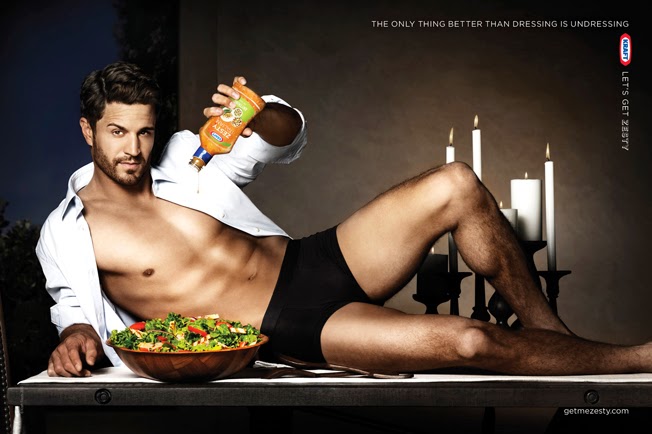
When you “dress” something, whether it’s a salad or a turkey or a window or your own body, the sense of the word is that you are basically preparing it, setting it “right,” or setting it “straight.” The Spanish word for salad DRESSing is aDEREZo – you can see the similar root. Continuing on in Spanish, it’s an easy move from “aderezo” to, for example, “enderezar,” which means to set straight or set right. Any confusion between what might be the difference between setting straight and setting right is compounded in Spanish, where, if you’re giving directions you say “derecho” for “straight ahead” and “a la derecha” for “to the right.” Another meaning of “derecho” in Spanish is law. If you go to law school, you attend La Facultad de Derecho, where you might study human rights, or “derechos humanos.” The French “droit,” Portuguese “direito,” and the cognates of several other languages contribute to this semantic web as well.

A clever wordplay and image from Kraft’s marketing team

What led to the association of our rights with our clothes? It seems to me that the connection must have had to do with rank and class. For example, even before there were mass-produced military uniforms with their stripes and badges, it was common in many cultures that the right to wear a certain garment, color, haircut, or tattoo was either earned by some positive action – say, vanquishing an enemy – or it was a punishment for some negative action, such as committing an act of piracy or of prostitution. In some instances, too, it could be the renunciation of rights that led to a certain kind of dress: monks and nuns wear drab costumes that symbolize they’ve relinquished the right to own property or to get married. As civilizations became more complex, conquering or otherwise absorbing peoples of foreign tongue and/or custom, they found that their desired distinctions of class and rank could be maintained easily through dress. Without need of spoken or written language, social norms could be confirmed visually through your garb, which announced your station in life and your attendant rights. And just as you could earn rights, you could lose them, with the consequent “dressing down.”

Another related term to throw in the mix here is “address.” As a noun, your “address” physically locates your domicile and thus may also reveal something about your social position. As a verb, “address” has precisely to do with these social distinctions, because you might “address” the person to whom you’re speaking differently depending on both of your social standings. English has lost much of this kind of verbiage (“you” vs. “thou,” for example), but many languages (including Spanish) still conserve these nuances of pronoun and conjugation.

When you put the two terms together you get “dressing right,” which means dressing in the appropriate way, or dressing in a way that reflects the rights you acquired either by birth or through action. The phrase “dress right” also shows the conflation of two of the main meanings for “right”: the noun meaning “privilege” and the adjective meaning “correct.” If you dress right you are correctly adorning your person with the accoutrements that signify your level of privilege.

Nudity at social protests is often explained as merely a crude method of grabbing attention. But protesting for rights by undressing is a way of symbolizing having been stripped of one’s rights, as in, you have taken away our land, our right to our land, so we may as well go undressed (un-righted). PETA and the World Naked Bike Ride similarly embody nudity to mean vulnerability, whether animals or cyclists they have been stripped of their rights.

Firemen in Asturias, Spain (2012): “From so much cutting away (salaries), we’ve been left ‘butt’ naked”

I find fascinating these intertwined etymologies of “dress” and “right,” but I also find frustrating the link that they reinforce between nudity and a lack of rights. As naturists we are continually challenged to protect our right to undress, and to inform the law as to the best places and circumstances for that to happen. We like to point out that in social nudist settings, the lack of traditional markers of status such as clothing brands and styles means that such settings are optimally egalitarian. Ultimately a “state of undress” is a “statement of dress,” with its inherent rights and responsibilities like any other. In the brief history of modern naturism, confronted with the very recent rise of the Internet, we still have to struggle to defend our right to our choice of dress.

A Year of Cheese and Cake

Looking back on advancements for social nudism in 2014, I think it was not a year of cheesecake, but rather a year of cheese and cake: a year of reclaiming the parts from the whole. Very specifically I have in mind a pair of female celebrities, K.K. 1 and K.K. 2, who used the media power of their images to support certain attitudes toward the body that are ultimately favorable to social nudism. The images in question were not without controversy, which I will address below.

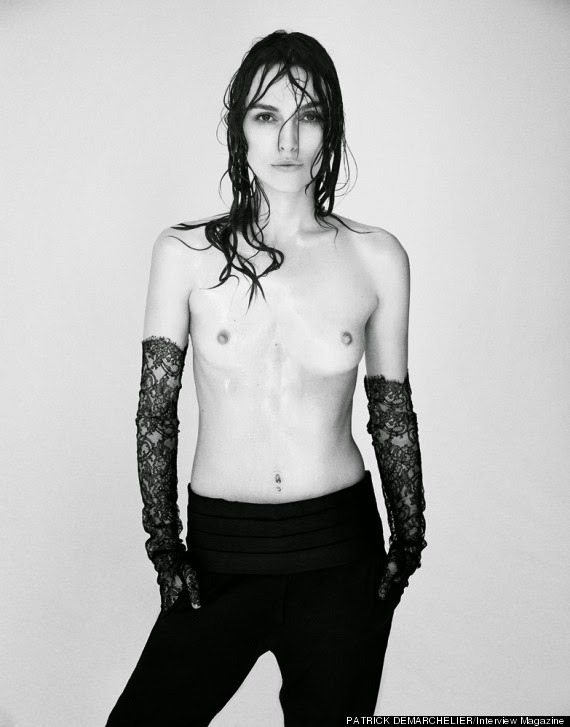
The first Ms. K.K., the actor Keira Knightley, posed topfree for a spread in Interview magazine back in August. Ho hum, right? But she later revealed, in November, that she had insisted that no retouching or Photoshopping be applied to her breasts after the shoot, saying, “Because it does feel important to say, It really doesn’t matter what shape you are.'”

Interview magazine

The second Ms. K.K., Kim Kardashian, also posed topfree and bottomfree for a photo shoot, for Paper magazine in November, in an attempt to “break the Internet.” While she offered no comment that I’m aware of about retouching or using Photoshop on the images, Ms. Kardashian did nonetheless proffer such an outstandingly goofy, mischievous smile that many people found the image to be at least supportive of the idea that going clothesfree is fun, and not to be associated with shame.

Paper magazine

When I ask naturists and nudists I know, along with folks who don’t necessarily label themselves either way, about the importance of these splashy photos, they show a range of opinions from “it doesn’t matter one way or the other” to “this is a huge deal” to “if anything, it has a negative impact on social nudism.” I’d like to point out that technically neither of the K.K.s is nude in the photos; therefore, the photos are not “nudist.” Furthermore, the photos are of course very elaborately produced and have nothing to do with the natural world; therefore, the photos are not “naturist.” Neither K.K. has publicly supported the Free the Nipple movement, for example, in the way that Scout Willis has… nor supported for that matter any similar kind of recognized body-positive movement, to say nothing of naturist or nudist organizations.

It will have been much more important, in the larger scheme of things in 2014 or in any year, that organizations such as TNS and AANR in the United States, and similar associations worldwide, continue to do their hard work of supporting our rights and our designated places for going sans clothes. And if we limit the assessment to only media contributions to the support of social nudism in 2014, arguably it will have been more important that the Free The Nipple film was released or that Act Super Naturally, sequel to Act Naturally, was filmed by J. P. Riley and his crew to be released in 2015. It was certainly a year that saw a continued increase of nudity on TV (although more often pixelated than not), along with the general growth of advocacy for body acceptance and breastfeeding.

Were K.K. 1 and K.K. 2 paid for the photos? Probably quite handsomely. Are they already well-known, with little to fear in the way of negative repercussions? Yes. Could it even be said that the images actually help them in their particular career goals? You betcha. Haven’t many other famous people, of all genders, already done similar things in photos and film? Undeniably true.

And yet…I do support the K.K.s, for having their cheesecake and eating it too. In their own ways, Knightley and Kardashian, among others (comedian Chelsea Handler, for instance, has chastised Instagram for banning her staged-but-more-natural topfree photos), have tried to call attention to what happens with the production, distribution, and censorship of these kinds of images, and how they contribute to what Knightley called a “battleground“:

“I think women’s bodies are a battleground and photography is partly to blame. It’s much easier to take a picture of somebody without a shape; it simply is. Whereas you need tremendous skill to be able to get a woman’s shape and make it look like it does in life, which is always beautiful.”

Even though in some ways it’s inappropriate to even compare Knightley and Kardashian, who have very different abilities and personas, it’s still true that both celebrities, in this way, have supported the cause of the Free the Nipple movement by bravely baring their breasts. They have won a public focus on the “ingredients,” so to speak, that go into the manufacture, display, and consumption of cheesecake images, and, in the controversy and social media outpourings surrounding the photos and their frequent, ridiculous “barred” censorship, they have provoked more much-needed contemplation of our bodies and how we present them.

No Pockets

Ever since our hominid ancestors started walking upright, we’ve had the need to move things around with us from one place to another. The grip of our opposable thumbs was a huge benefit for carrying things, yet it was often necessary to use our hands to throw rocks or pick berries, while still holding something “on board” the body. This explains why one of the main factors leading to the invention of clothing (cloth-ing) was probably the need to provide wrappings, folds, pouches, or pockets where we could fit and secure objects–or infants–to be carried around on our persons. But for those of us who prefer to avoid clothes as much and as often as possible, what are the ergonomics of object transport on the nude body?

Our musculoskeletal frame provides some natural “perches”–the head, the shoulders, the hips–as well as “posts”–the neck, the wrists, the ankles. These anatomical opportunities gave rise to the development of hats, necklaces, bags, belts, bracelets, and anklets, all of which can be used as decorative accessories, or more for a certain functionality, or both. A charm bracelet that includes an actual key, for example, or a belt that has a decorative buckle and also has a sheath for a pocket knife – these exemplify both aesthetic and practical objectives. Even rings on fingers or garters on thighs can be used to carry items, or those armbands that people use to hold their phones or MP3 players while they exercise. Backpacks, fannypacks, satchels, and fishing hats are further examples of items that are not necessarily clothing per se but are designed to fit on the (nude) human body and to supplement it with utilitarian purposes of transport and/or storage. There are some naturist-friendly manufacturers who make towels and caps with pockets – very useful indeed, and not just for naturists!

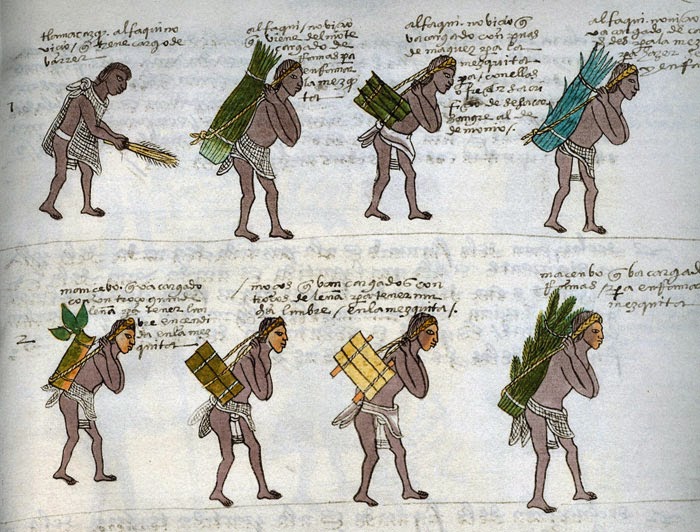
Since the neck and shoulder muscles gain strength simply from holding the head aloft, many cultures have built on that strength by practicing the transport of bundles or vessels on top of the head, without securing the loads in any way. Why don’t these loads fall off? Practice. That, and the sense of balance we have from our inner ears. The tumpline is another great example of using your head for transport. Especially in areas like ancient Mesoamerica, where there were no beasts of burden, the tumpline enabled a corps of workers–or, unfortunately, slaves–to retain the use of their hands while transporting stone or other construction materials from far away. The same nearly naked laborers could then climb with the materials right on up the steps of a building in progress like the Temple of the Inscriptions in Palenque, Chiapas, Mexico.

Use of the tumpline. Codex Mendoza, folio 62r.

Here’s another good way to “use your head”: Tales are told of Africans fleeing slavery into the hinterlands of the Americas who carried seeds or grains of rice in their richly and densely curled hair. The seeds would be planted to sustain free societies (quilombos or cimarrón communities) far from the colonial European governments of the major cities. Certainly this is an ingenious logistical use of one of the body’s naturally occurring phenomena!

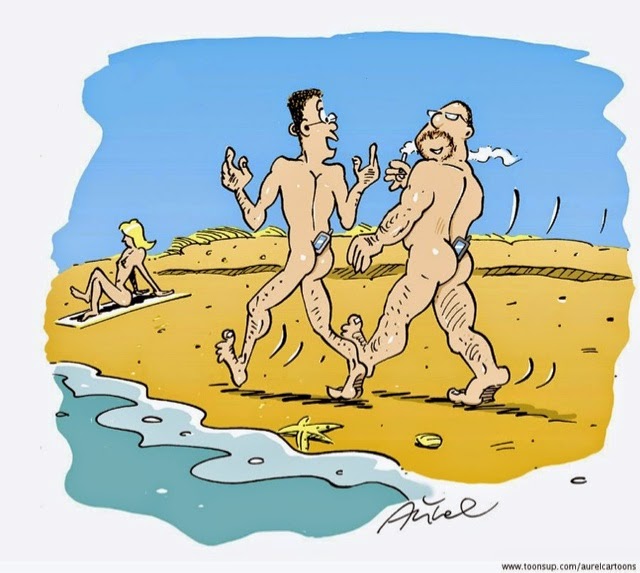
Another entirely natural “hack” that people use frequently, myself included, is to rest my pen over my ear. And of course, it’s very common to clamp items with our arms against our sides, or our chins against our chests, or we grip something in our mouths – usually for a very short period of time if whatever it is needs to stay dry! Finally, the nude gentlemen in the cartoon below are modeling a few more examples of natural perches. As you can plainly see, they’re wearing glasses that rest on their noses and ears, and one of the men is smoking a cigarette that can be held in his mouth:

http://www.aurel-cartoons.de/

Oh yeah – you may also have noticed that these 21st-century nudists are carrying their cell phones in their gluteal clefts. Ha! Hmm… pushing the limits of hygiene – but then again, if you wanted to keep your phone from falling, you’d end up with some seriously well-developed buttocks!

Work in Progress

My second novel is in development! It’s an adventure story involving the search for lost testimonies from the 16th century. When an earthquake damages the oldest public library in the Americas, an anthropologist and an art collector start a quest that leads them to a major scientific discovery on the relationship of the human body to the natural landscape.

I reorganized the headers on this blog to set up a separate page for the novel, working title Aglow. The page, accessible above, includes the blurb and the prologue. Also some concept art I’ve borrowed from To Capture the Sun, a pre-Columbian necklace from Panama:

Interview with Steve White

Steve White maintains one of the most body-positive Facebook pages and Twitter feeds you will find anywhere. Follow him, and his inspirational messages and images will remind you every day how important you are, how beautiful you are, and how much you should love yourself first and foremost.

①. Steve, how did you become interested in naturism? Was there a particular day or event that sparked the interest in you, or was it there from as long as you can remember, even before knowing what “naturism” meant?

 SW: Technically speaking, my initial involvement with naturism and the positive concepts it promotes is actually posted via the Internet upon my local naturist club website (Tallahassee Naturally). It’s an unique sporting event called the Greek Athletic Meet. My name is posted there on a side link of victors who have won that competition in past. It was back in 2000 and I’m listed as Steve.

As someone who has been involved with many sports throughout my school years and recreational sporting activities even today, this particular event back then really peaked my interest due to competing with this type of track and field which has the dress code of nudity and was very intriguing to me. However being involved with that particular naturist event for the first time really opened my eyes to a whole new world – something that immediately took me by surprise. The nudity that day was nothing more then a tool, the result of using the tool was the concept of body acceptance, basically the byproduct of naturism anyway. I was there to just compete, but I found that due to everyone being nude (expressing and exposing) all different body types, there was an appreciation of the human body form and all of its uniqueness. Which in return for individuals to love their own bodies by appreciating and accepting others while others are appreciating and accepting of theirs. That’s a very powerful concept.

②. Living in Florida, you have many options for naturist clubs and resorts. Tell me about your experiences there and your participation in Tallahassee Naturally.

SW: As a Floridian – someone who’s basically born and raised in the Sunshine State, my involvement with this particular lifestyle is truly a blessing due to the geographic location of Florida itself. Naturism can almost be enjoyed all year-round, and there’s only two or three months out of the year where clothes are necessary as being practical. Other then that the weather here in Florida is absolutely fabulous for outdoor nude activities. Even with my own local naturist club Tallahassee Naturally (TN), which is in North Florida, it’s still enjoyable to spend the majority of the year clothes-free. And with that said, I have spent more time in the last few years with Tallahassee Naturally in starting new events as well as being a part of our board – you know, being part of the politics in keeping our club running strong. Hey, you never know that maybe in the future I can start working on doing thing such as workshops, lectures and seminars at TN on body acceptance through the means of naturism.

③. You must do a lot of writing, just to guess from your many Facebook posts! How do you find time or make time to write, and what do you like to read? Do you have favorite writers on topics like love, self-worth, body acceptance?

SW: Do I do a lot of writing…?
HaHa… That’s a good one.Let me phrase it as I “USED TO” do a lot of writing the old fashion way, but now there’s new technology out there (even via your cell phone) where you can talk out and record your words into sentences, phrases, paragraphs etc. etc. etc. something that I see is very valuable for an individual like me who has dyslexia. Before technology such as this, I used to have to spellcheck, proofread and fight through my dyslexia to get what I wanted to convey to others by repeatedly checking over and over to get what I wanted to express. Now I can just let the words completely flow for how I feel on things that interest me such as my motto of “Body acceptance through the means of naturism”, a catchphrase that I use a lot. So when something is a good idea that pops up in my head, I  immediately record my own voice to type it into clear readable words to share with others. Very useful tool for people who love to write, but struggle with writing itself. I may not be the next James Baldwin or great poet like Maya Angelou, writers who I highly admire, but if any of my words can touch the heart, spirit and soul of another person – isn’t that what writing is all about?

④. Your Facebook page and tweets are full of good advice for people who would like to convince their loved ones to try naturism. Is there anything else you would like to add here, or any stories from your own experience, about attracting newbies to naturism?
 
SW: Well, I don’t consider that I’m using a Facebook page when I post what I do there. I use my own personal profile like everybody else (which is not actually open to the public), but to my friends and acquaintances that are a part of my Facebook profile friends list, they are the ones who reap the benefits of what I post there. To which it’s more personal with my fellow naturists and non-naturist friends alike to see me posting things like everybody else on Facebook (event status of my day-to-day life) and some promotion of the lifestyle. However, due to having non-naturist friends there on FB – of course it’s only reasonable to post to them the benefits and tips on giving it a try. Hey, why not promote something that will honestly change their lives for the better – something that would give them self-love, self-confidence, a better self-esteem and improving their body image tremendously. So if I do receive a personal message or a reply comment from some non-naturist interested with naturism or even to help out other fellow naturists to introducing someone else to social naturism – I would tell them that I honestly believe that the best way is to invite them to a very active social naturist event. Something to occupy the mind of that person from the anxiety/stress of the initial nudity factor due to once they’re caught up doing certain activities anyone new to the lifestyle can easily forget that they’re nude – it becomes totally natural to them being that way and seeing others in that way.

Now as for me using Twitter (@AfroMandinka), well that’s open to the public. Little short tweets to provide information on gaining a better self-esteem, self-confidence, self-love and of course my motto of body acceptance through the means of naturism. And even there my Facebook profile is attached as a link on my Twitter account, just in case for anybody who wants to read more than just short tweets on Twitter.

⑤. One of the many awesome things about naturism is that it’s universal – good for anybody of any age, color, gender, nationality, sexual orientation, physical ability, etc. But sometimes writers about naturism differentiate advice for women from advice for men, advice for young people or strategies for attracting young people to naturism, etc. As an African-American, do you think there is any particular advice to offer for people of color?

SW: In my humble opinion, naturism is universal or at least it’s supposed to be universal. There isn’t one particular way to help one group of individuals from the next – either it’s by age, gender, race/ethnic background to what have you, body acceptance is universal because all of us have one of those – a body. When a person has a negative body image in return they end up having a low self-esteem, lack of self-confidence etc. etc. etc… all of which can fall upon any individual – no matter who they are. But how can someone find a means to recover from this type of thinking, feeling and depression? Well that’s where naturism can come to the rescue. I am not saying that it will actually cure someone from negative body image, but I will say that social naturism is an escape or sanctuary from our society pressure to achieve a perfect body.

If the promotion and advertisement of naturism can be focused on this point of view (the body acceptance aspect) a whole lot more than what it is, I’m pretty sure it will be appealing to all different types of individuals – no matter what their race, color, sex, age to what have you is. If negative body image is universal and any person can be affected by it, then on the flipside of that, body acceptance is universal too and naturism is a powerful tool in achieving this goal. So how do I talk to people of my same ethnic origin, the same way I talk to everyone else – by using my motto again “Body acceptance through the means of naturism.”

Many thanks again, Steve, for your words of wisdom and encouragement supported by your years of experience and your unflagging optimism.