Anything Goes?

“In olden days a glimpse of stocking
was looked on as something shocking.
Now, heaven knows,
Anything Goes!”
-Cole Porter

American composer Cole Porter’s marvelous musical Anything Goes debuted on Broadway in 1934, in the middle of the Great Depression. The American Sunbathing Association, precursor to today’s AANR, was just three years old at the time. The storyline of the musical explores the “shocking” behavior of societal types like the Gangster, the Evangelist, the Aristocrat, and the Debutante with plenty of dated references such as “cellophane” and “the great [Jimmy] Durante” in the song “You’re the Top.” And yet…reading the lyrics to the title song now, they seem timeless. It may be more difficult today than it was in 1934 to imagine how a glimpse of stocking could be so shocking, but the “anything goes” line seems to have been evoked anew in the recent Huffington Post piece by Jessica Pearce Rotondi, “State of Undress: Is Nudity Still Newsworthy?”

Rotondi raises some pithy questions. Regarding San Francisco’s consideration to mandate towel-sitting by nudists, she asks, “When a practice arrives at the point where it has a system of etiquette, has it lost its shock value?” Regarding recent nude protests against animal abuse and war, she asks, “with so much skin being bared, does nudity really shock us anymore? And if not, has it lost its power to make a statement?” I notice that the author has used the word “shock” twice in these questions, recalling the “shock value” of Porter’s shocking stocking. Indeed, Rotondi explores a gamut of contemporary headline-grabbers related to nudity, along a scale of contexts sliding from sexual to non-sexual, from Janet Jackson and Anthony Weiner to Demi Moore and George Davis.

How to answer these very good questions? And what might have been the role of organizations like AANR in leading up to the asking of these questions?

There will always be ways to shock, I think, and there will always be contexts in which some practice or another, such as social nudism, can be shocking. The revolution in communications technology–think of all the changes since 1934, let alone since 1994–opens a bigger question about how some such practice can shock when the contexts of news coverage approach ubiquity. In the United States, The Naturist Society and AANR–in their sometimes divergent, sometimes convergent ways–have no doubt helped make the idea of social nudism less shocking. But context is everything. As Rotondi shows, yet-another mass nude protest demonstration or calendar may be overlooked in the flood of such happenings, and Demi Moore’s nude-while-pregnant photoshoot was revolutionary at the time, though much less so now. And yet some of the most ancient artifacts made by human hands are carved fertility idols in the shapes of pregnant women and aroused men.

If such a fact is shocking, it can only be because contemporary society has tended to lose touch (literally) with the fleshly nature of our humanity. Some products of the communications revolution, such as this very blog and many others like it (see side bar list), can be helpful in advocating a social nudism that leads to body acceptance, a term that needs to be understood here as including awareness of learning about sexuality and the reproductive system, physical and mental diseases and disabilities, and the aging process. And, although the Internet more often commodifies and objectifies without instigating participation, it is nonetheless through the Internet that many people first learn of social nudism and where to find like-minded people, appropriate places, and organized events. It’s a lot easier now to find out about nudist events than it would have been for “the set that’s smart” in these lesser-known lines of Porter’s from the same song:

“When every night the set that’s smart is
intruding in nudist parties
in studios,
Anything Goes!”
-Cole Porter

There are still plenty of private “nudist parties,” but for most people, instead of depending on word-of-mouth and private invitations from those-in-the-know, there are now many more ways to find out about and participate in social nudist or naturist events heralded online.

And yes, “anything goes” in the sense that some people use social nudism to promote overtly sexual contexts. This is why the AANR and TNS imprimaturs on organized events, and on established parks or resorts, need to be as fiercely defended as possible in order to guarantee contexts that can be promoted as “naturist” and “family-friendly.” The family unit is indispensable to the promotion of naturism’s claims to body acceptance, because only by encompassing the entire range of human experience, from newborn to centenarian, can social nudism through naturism be truly considered a viable way-of-being in the world for the betterment of our own health and of our environment.

Returning to Rotondi’s questions, I can only hope that some day, yes, social nudism’s system of etiquette will allow it to lose its shock value as a practice in greater society. (Obviously, for many of us it already has.) Perhaps one day mere but essential nudity, whether on the street or in a staged crowd photograph, will not be shocking in a negative or off-putting way. But, in contrast, I hope that “so much skin being bared” never loses its power to make a statement that is vital, constant, and humble: body acceptance.

From Forest to Garden

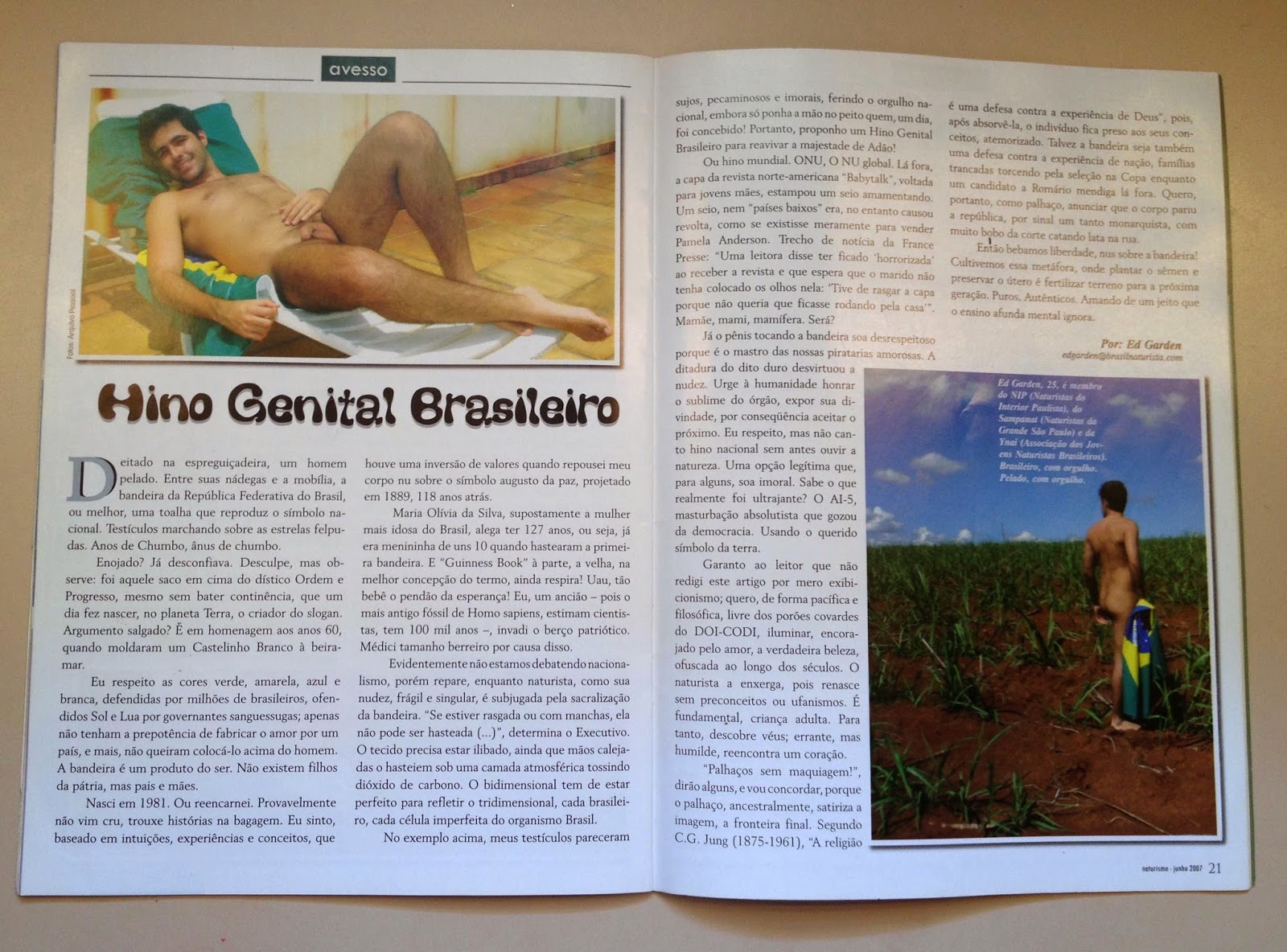
Tenho saudades dos escritos de Ed Garden.

Ed Garden was (maybe still is?) a young naturist based in Brazil who set up a terrific naturist blog called Nus Pela Terra (Nudes Around the / For the World) at nuspelaterra.com.br. He compiled a terrific variety of posts on everything from public nudity to the philosophy of naturism and ecology. The blog must have lasted from approximately 2008-2009, but is long since inaccessible.

A few seedlings from the Garden remain, however, because Ed was also a featured columnist for the early numbers of Brasil Naturista magazine (back issues are still available). His seasonal and well-seasoned takes on nudity and nudism refreshed the reader with their push-the-envelope irreverence and wry wordplay such as the title “Nádegas a Declarar” (Buttocks to Declare but sounds similar to Nothing to Declare, as when passing through customs). In Ed’s daringly off-kilter, off-with-the-kilt world, fig leaves from the Garden of Eden were on sale for a buck a dozen, the national anthem gave way to the genital anthem, and societal mores undressed as giddily as the naturists in the photos accompanying his columns.

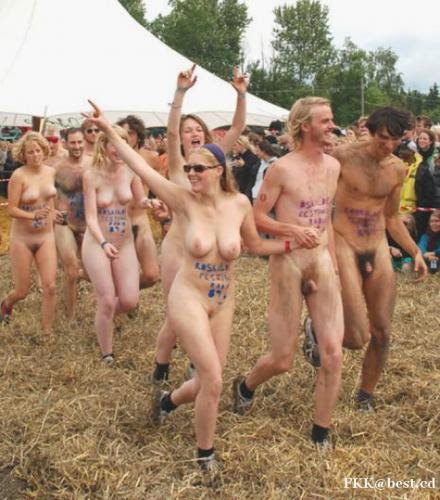
Then, something happened, and Ed seems to have stopped tending his Garden of clever delights. Apparently he was last seen running away from it all at the Roskilde nude race in 2009. So here’s a belated shout-out from Forest to Garden, from one great place for naturism to another, and from one internet voice for naturism to another:

Where are you, Edgard de Oliveira? Come tend your Garden!
Cadê você? Sumiu!


Brasil Naturista 2 (Jun-Jul 2007): 20-21.


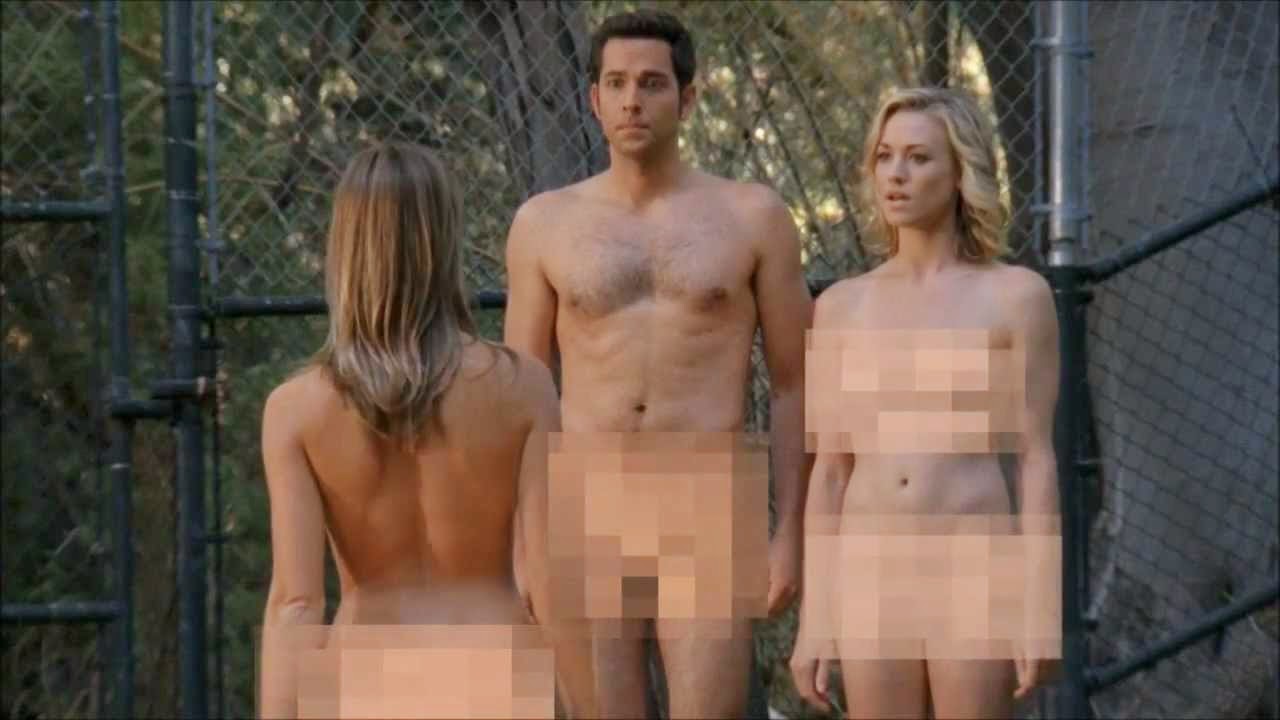
Pixelization = Titillation

Far from supposedly protecting the innocent or the easily offended, pixelization on TV or in the movies actually increases prurient and overtly sexual interest in the body. Can there be any doubt that the TV networks and the government don’t realize this? Of course they do: sex sells. Bars or spots covering the breasts, buttocks and genitalia in diverse print media have the same function. As everyone knows, one of the best ways to sell a book is to get it censored or condemned by some church or organization. Pixelization works the same way. It literally makes a mystification of the body by blurring body parts in a fuzzy mist, and this is how it reinforces the belief that certain parts of ourselves, just by being seen, can corrupt us morally or incite us sexually.

Talk about a self-fulfilling prophecy! If there is any truth to this Power-of-the-Nipple or Power-of-the-Penis notion at all, it obtains precisely because of the media’s insistence on pixelization. The media thus sexualizes contexts, with stripping and teasing and peekaboo, that would not otherwise be so. Another example: cleavage, or the presentation of the breasts pressed tightly together. This look depends on tight garments, which means that it is impossible to maintain when nude. The cloth hides the nipples and areolas, while emphasizing the volume and aperture of the breasts. So the look is fetishized precisely because it is an artificial arrangement of exposed flesh designed to appeal sexually. (Codpieces and certain tribal groin accoutrements have the same function with regard to the penis.) Cleavage is designed to draw the gaze to a gap–the space between the breasts–just as pixelization also presents a gap or missing space on the body. Both cleavage and pixelization produce a lack, a mystified space that sells and incites and awakens prurient curiosity. In contrast, nudity demystifies, failing to fulfill these gravity-defying fantasies. For that reason, nudity facilitates comprehension of the real shapes of ourselves in our bodies.

Mere (yet essential) nudity rends the veil between supposedly noble parts like the head, arms, or hands and supposedly ignoble parts like the buttocks, penis, and breasts. Working toward a complete humanity means overcoming these false dichotomies and fetishizations. To be clear: sex is great, sexual contexts are an integral part of our humanity, and nudity can be sexual, just like fully-clothed contexts can be sexual. But the hypocritical media titillate (creating a charged sexual context) when they pixelize (purportedly acting morally to censor sexuality). If we persist in creating hide-and-seek contexts for censoring and incessantly fetishizing certain parts of ourselves, then the detrimental consequence will be greater fragmentation between ourselves and our understanding of ourselves. Partial humans yield partial humanity. In other words: no half-assed contextualizations. It should be the whole ass, or nothing!

Naked Social Euphoria

 A brief review of Co-ed Naked Philosophy from Martin Brant:

Author Will Forest has a unique appreciation for the human body. I call it unique when it should be considered normal, but somehow our society has gotten onto a path of misguided morality that somehow judges the human body as shameful. Hence Co-ed Naked Philosophy, Forest’s eclectic novel about a college professor who decides to swim upstream against society’s mores by creating a clothes-free environment in his classroom.

Masterfully written, this novel will delight you and take you into a world which is a mix of controversy and naked social euphoria. As you read one chapter after another, you’ll wonder why our world can’t be more like professor Christopher Ross envisions his should be. You’ll want to take off your clothes and find out what it’s like to enjoy your body in the sunshine and fresh air in the company of others that think like you.

Highly recommended. Co-ed Naked Philosophy is a tale unlike anything you’ve ever read.

Martin Brant
Author of Five Married Men, A Part of My Soul, The Strange Haunting of Johnny Feelwater and other novels


I love Martin’s phrase “naked social euphoria”! 
Here’s one of the examples from Co-ed Naked Philosophy that may have inspired the phrase:


Greg matched Alex’s pace at the front of the streak. He felt his toes pumping the wet grass. He felt the wind, full force, against his chest, his abdomen, his shins. Most pleasurably, he felt his penis and scrotum bobbing up and down, occasionally back and forth, between his thighs. Why on earth doesn’t this happen more often, he asked himself, sincerely astonished. This is like… like what? Like learning you can do something new with your body that you never even suspected, like learning how to fly. Like a joy unleashed, and like a oneness with humanity. He slowed down, wanting to observe more than to run just another race, and he was treated to the vision of his fellow students jumping on and off benches, for the sheer joy of it, and hugging trees, and stopping, far too briefly, to roll in the autumn leaves.
A young woman jogged by in front of him, her orange breasts oscillating up and down and her ponytail slapping her yellow shoulders right and left. Greg smiled, stopped completely for a moment, and planted his red hands on his yellow knees. He looked around him: everywhere, iridescent bodies running naked through the night of All Hallow’s Eve! Exhilarated, he felt his scrotum contract and his penis stir with the novelty of the chill breeze, and then a hand slapping his buttock.
            “Don’t stop now, Mr. 800-Meters!” Terrence called out as he sprinted past with Renee, blending into the darkness until all Greg could see were the green stripes down their backs and the pale soles of their feet flashing up and down in unison.
            And Greg understood. He collapsed onto the cool grass a little out of the way, rolling around with his knees up so the approaching streakers wouldn’t trample him. “I sing the body electric!” he hollered to the sky. There were no clouds; the stars and the luscious moon shone as naked as he. He lay there a few minutes, enchanted by his worm’s-eye view of the muscular multicolor pillars that were the legs striding past him, and the arching rainbow backs, the wavering paisley buttocks, the bouncing polka-dot nipples. When he sensed he was the last, he jumped up and chased after them as fast as he could. “Hey, wait up! Wait for me!”
Runners at the famous Roskilde event


The Most Revealing Part

Can you imagine a clothes-free or clothing-optional university? Here’s a sample from Co-ed Naked Philosophy, and it’s not the same as the free download sample at Smashwords!
In this passage, the student group Corporal Rights Movement (CRM) has organized a rally on the campus of Gulf Coast University:
The Most Revealing Part
Bodies in various stages of skin exposure began to populate the Humanities Building courtyard on a comfortably warm evening in February. The courtyard was the most appropriate and convenient venue for the Corporal Rights Movement’s first rally. Drs. Ross and Saucedo and many of their students attended, along with Jaime Castellón Reyes, a ready-to-retire Spanish Republican exile whose decades of teaching the literature and culture of Spain to American students led him to remark to his colleagues: “These students, most of them, they don’t know how to reeeead, they don’t know how to eeeeeat, even, they don’t know how to live life. They are too buttoned up. We need to shake them out.”
“Shake them up, Jaime,” Christopher corrected. “Prepositions are so very arbitrary.”
“Yeees, shake them, how do you say it, all over the plaaaaaace,” and with that he began to waggle his ungainly orangutan frame: bald pate and prominent forehead, Roman nose, heavy jowls, spare chest, mid-size paunch, gangly arms and legs, fallen buttocks, and a hairless, rather long, uncircumcised penis that swung around quite shamelessly. 
The CRMers had announced the rally, both on campus and off, as a public information meeting, with brochures, posters, rows of chairs, and extra towels just in case. As the CRM president, Daphne introduced the featured speaker, Dr. Saucedo. In the presence of approximately thirty people, Dr. Saucedo stood nude at a podium and began her remarks: “Social nudity is like learning to walk.” Her audience began to pay attention as she continued.
“Have you ever seen a baby learning to take its first steps, or even just to stand up on its own? Sometimes, what happens is that the baby will stand up and not even realize how different or important that is, until someone gasps and yells, ‘Look, the baby’s standing up!’ Then, of course, the baby is startled, and immediately sits down or falls down. If you interrupt a new behavior as it’s developing, as it’s being learned, sometimes even if you interrupt for the purpose of encouragement, you risk ruining that new behavior. 
“What I’m saying is that a new behavior often just happens naturally, and we only become conscious of it if others are surprised by it. Children don’t understand why they have to wear clothes, especially around the house or at the pool or beach. They only learn that running around naked is ‘bad’ if adults or older kids tell them that. So the first time you go nude socially as an adult, or even as a teenager, you feel uncomfortable, self-conscious. You have to unlearn all the cultural phobias about nudity. But once you get used to it, there you go: you’ve learned a new behavior, like riding a bike or playing the piano, that from now on comes naturally to you and even becomes a part of your body memory, your repertoire of corporeal acts…”
As Angela spoke, a growing group of fully clothed protestors began to assemble, standing to one side of her audience. They wore black t-shirts with the letters CLGFC in white over a white cross. After it seemed that enough of them had arrived—about a dozen, young and old—they began chanting, gaining force and volume with each iteration: “Nude is crude! Nude is lewd! God says get a new attitude!” 
The slogan bluntly and efficiently drowned out Dr. Saucedo’s speech. She stopped talking. At that moment, a man from the back of the black-shirted group raised his arms over his head. He held a three-foot white cross. His eyes were closed.
“My children, Children of the Lord our God Fundamentalist Congregation, let us pray that these sinners before us can find the way to God’s forgiveness. Let us pray that here, in this house of secular education, they forget not the lesson of Adam, the lesson of Eve, whose disobedience of God’s holy command brought upon us the sin and the shame of nakedness.”
“Good show!” Dr. Ross rose to his feet, clapping. “I recognize you, Brother Sean, you would-be exorciser of nude beach demons. What I hope for you and your herd is to realize that what you wear, or don’t wear, is no more a condition for sinfulness than for holiness. The Old Testament God recognized Adam’s and Eve’s new self-knowledge by making their coverings for them himself. But, being vengeful, he kicked them out of the garden…”
“And God made us in his image, did he not?” Angela interrupted from the podium. “There is no shame inherent in nudity. If you, as the shepherd of your flock—what is it, CDEFG?—if you say nudity is shameful, then I don’t know what you’re doing here. Look around—are we breaking any of the ten commandments?”
Sean had not opened his eyes, but he was smiling with lips sealed.
“I know not the nature of your sins, and I remain ignorant of them. My eyes are closed, my body is clothed. 
“I know not of your disdain for the Word of God. My eyes are closed, my body is clothed.
“I know not the desire of your sex. My eyes are closed, my body is clothed.”
His followers shut their eyes and joined in on the refrain.
“I know not your temptations of the flesh. My eyes are closed, my body is clothed.
“I know not the wantonness of your spirit. My eyes are closed, my body is clothed.”
“And your mind!” Christopher yelled over the chanting. “Obviously your mind is closed too!”
“I know not the color of your lust. My eyes are closed…”
¡Basta!” shouted Dr. Castellón-Reyes from his chair, “¡Basta!” The Spanish professor continued his call until the confused protestors desisted. 
“Whyyy do you disturb us with this mindless mumbling of mutterings? And whyyyy are you afraid to loooook, not at the color of lust buuuut, uuuuuuuuuh, the colors of liiiiife. We have what is called the riiiight to peaceful assembly. You have what is called the riiiight to protest. But, you have made your point, uuuuh, such as it is. Let us contiiiiinue to hear the inestimable Dr. Saucedo’s conference on learning new behaviors. I assure you, padre, that you will beeee, uuuuuhh, illuuuuuminated.”
Daphne and Terrence smiled. Renee and Lisa giggled. Alex laughed. Soon there was general mirth, from which Greg called, “Please continue, Dr. Saucedo! You were on the part about getting over cultural phobias to nudity!”
As Angela arranged her notes, her audience stood up too, and some moved over, closer to the uniformed congregation. 
But this was too much. Without warning, one of the protestors in front threw a stick, which scraped Angela’s arm before landing on Christopher’s toes. Angela turned angrily to face their assailant. She avoided words for as long as possible, her icy gaze cooling. Christopher also watched the stick-thrower, whose companions were urging him to leave but who would not move, as if he had been turned to stone by the stare of a medusa. 
Finally Angela addressed him loudly: “Please don’t throw things at us. We are unarmed. WE ARE NAKED. You gonna throw something at me you gotta take your clothes off first.” 
When Christopher and the rest of the group laughed, the young man snapped. He threw his black t-shirt over his head in an instant. His pants were halfway down before he realized what he was doing. “Hocker cool it, you’re crazy” from one of his companions as the stick-thrower stood up straight, bare-chested and with his pants around his knees, staring at Angela and the group. The courtyard kept still.
Paul Hocker, angry but helpless, turned and grimaced at the other protestors. Then he kicked off his shoes. A seagull called out as he pushed his briefs and pants off together. For a moment he just stood, naked and alone, staring into the sunset. 
When he finally moved, walking slowly into the CRM group, a cheer sprung from the nudists in the courtyard. Angela and Christopher hugged him. Brother Sean’s congregation dispersed, disgusted by this betrayal, but some of the other bystanders disrobed on Paul’s example. Immersed in a sea of welcoming skin, Paul learned that the most daring and the most revealing part of himself that he had exposed was not between his legs, but between his lips: his teeth, bared by his just-born smile.

Stripping and Teasing

One Monday morning in the fall semester of 1997 or 1998, when I was an assistant professor at a university in Alabama, the phone rang in my office. 

“Are you married?” the female voice asked. 

“Yes, why?” 

“My friend, So-and-so, used to be your student. She’s getting married this weekend and we’d like to know if you’d perform a striptease at her bachelorette party on Thursday.”

“Really?” I asked, and then, vainly trying to sound business-like and nonchalant, “How much will you pay?”

“Name your price. So-and-so had a huge crush on you and nobody else in the whole state could do this and have it mean as much for her.”


Mostly to make sure I wasn’t dreaming, or falling for a hoax, I discussed the call with my colleagues and my wife, who all egged me on. I was flattered, confused, unable to sleep all week. Too concerned about ramifications on my fledgling career, I never did the striptease. The lost opportunities of youth! But I did start writing, and little by little the writing became the novel Co-ed Naked Philosophy. The novel’s protagonist, philosophy professor Christopher Ross, receives a similar striptease invitation and – braver than I – he accepts, though he must later accept the aftermath as well! And he tries to steer student interest in being naked toward a questioning of society’s stances on nudity.

I have always considered nudity mundane, and yet fascinating, a contradiction born from our society’s mixed messages. The Christopher Ross character, a philosophical provocateur, incites his students to explore these contradictions: stripping and teasing, clothing and unclothing. As he often says, “Context is everything”!

In general, the characters and events in Co-ed Naked Philosophy spring from the positive stand-outs of my years of practicing naturism. Some of the specific plot points are based on my own first family naturist visit at an unofficial nude beach in Florida, and uniformly positive experiences since at other beaches, landed clubs and 5K races. I did, unfortunately, see a suspicious person fussing with his hat on that first day at the nude beach. He may well have been taking photos with a camera concealed behind the hatband, as happens in the novel. Another character in the novel – an enterprising sing-nude-for-a-buck naked Santa cyclist – was someone I observed in traffic. He rode right off the street and into the novel!

But the splashy events that punctuate the first part of the novel come straight from the headlines: a concerned citizen demanding to cover up a replica of Michelangelo’s David statue; a male cop detaining women drivers and forcing them to strip (and one woman who threw her menstrual pad at a him); young women and men working as strippers to pay tuition. These nude-negative episodes, along with the consequences of a Halloween streak, spur the students, professors, and community allies to action: they form their own naturist activist group and sponsor events and happenings to “reclaim the image” of the nude body as an essential part of everyday life. 

Read all about it in Co-ed Naked Philosophy, now available through Amazon in print format, Smashwords for e-reader formats such as Kindle, Nook, Kobo and PDF and also directly from Barnes & Noble in Nook format. 

Naturism in Brazil

I’ve had the opportunity to meet several naturist leaders in Brazil and visit a couple of naturist sites there. In a nutshell, here’s what I’ve learned about Brazilian naturism:

Besides the US and Canada, Brazil is the only other country in the Americas that has a national naturist federation. Its sites and groups range from Colina do Sol–a large naturist community in the southernmost state of Rio Grande do Sul–to Graúna, a non-landed group that is the only naturist community in the vast northern Amazonian area. In between there are a dozen or more beaches and parks also affiliated with the FBRN or Brazilian Naturist Federation. A website associated with the FBRN, Brasil Naturista, claims to be the largest and most popular naturist site on the net. They also produce Latin America’s only print naturist magazine, Brasil Naturista.

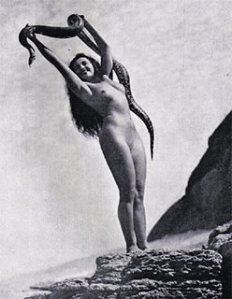
In Brazil a national naturism day is observed on February 21, the birthday of the woman regarded as the country’s naturist pioneer. Born Dora Vivacqua in 1917, she became known by her stage name Luz del Fuego. She was an exotic dancer, famous for her pet snakes, and she managed to earn enough to set up her own naturist retreat on an island right in Guanabara Bay in Rio de Janeiro. She called it Ilha do Sol (Sun Island) and its famous visitors included Errol Flynn, Lana Turner, Brigitte Bardot, Ava Gardner, Tyrone Power, Glenn Ford, and Steve McQueen. Luz del Fuego fulminated against society’s hypocrisies regarding the body in her 1950 text A Verdade Nua (The Naked Truth). She was murdered on the island in 1967.

Luz del Fuego (Dora Vivacqua, 1917-1967)

Contemporary Brazilian naturist leaders include Jorge Bandeira, founder and organizer of the above-mentioned Graúna group in Amazonas state and also playwright, actor and activist who has written a biography of Luz del Fuego in verse, the reference work Naturismo de A a Z, and staged NUances, a performance event based on the writings and illustrations of Khalil Gibran; Paulo Pereira, longtime activist and author of Corpos Nus (Nude Bodies), a history of naturism in Brazil; and Pedro Ribeiro, founder of the Praia do Abricó (Abricó Beach) group, activist for its use as a nude beach within the Rio city limits, and editor of the online journal Olho Nu (Naked Eye), a publication also affiliated with FBRN. Currently the FBRN leadership is making an effort to visit all Brazilian naturist sites along with several others in Latin America and Europe. The Brasil Naturista group’s young leaders have been doing an excellent job of incorporating a younger generation into the practice of naturism.

Even though Brazil is often perceived as a “sexy” country, undisturbed by nudity during its world-famous Carnival or on its beaches, the reality is that there is most often a fine line between what is accepted and what can be prosecuted–about as thin of a line as the popular “fio dental” (dental floss) G-string bathing bottoms! Competing carnival groups are docked points by judges for nudity–for example if a dancer is not wearing, or has lost, her “dental floss” and pasties. And although Brazil is one of the world’s leaders in plastic surgery, including breast augmentation, the practice of being “topless” at public beaches is not at all common. Much like the rest of the Western world, and even in spite of a strong tradition of nudity among the nation’s indigenous populations, Brazilian society harbors mixed messages about social nudity. Brazil’s broadcast media, famously liberal in the 70s and 80s, are now just as likely to “pixelize” as the media of other Western nations.

But Brazilian naturist groups are in an enviable position, with a growing and youthful demographic. A proposed law that would establish norms for naturism in Brazil, named after former representative Fernando Gabeira, has been tabled several times but may yet come to fruition. In the meantime, the number of landed sites or traveling clubs affiliated with the FBRN continues to grow, and the website claims a new high of 500,000 naturists in Brazil.

The Raw Ones

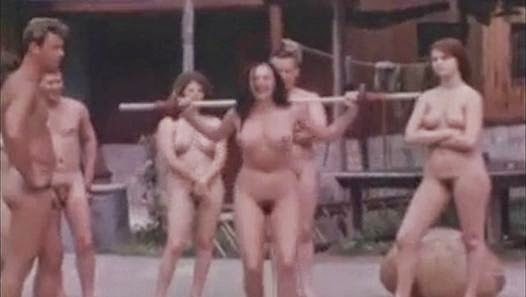
As a public service to the naturist community, I’ve typed out what the narrator reads in the 1965 naturist film The Raw Ones. Directed by John Lamb and narrated by Ron Gans, the film was one of the best known nudist documentary films, a somewhat popular genre that has been explored by Mark Storey of The Naturist Society in Cinema au Naturel. The Raw Ones is a well-filmed production featuring both male and female naturists playing, jumping, swimming and running in the sun, over a soundtrack of classical music, in uncensored full nudity. I like the analogy implied by the equation of raw with nude: if you’re dressed, you’re cooked. Not only do we use the verb “to dress” sometimes to mean to prepare food, but also if you were to attempt to follow the raw ones, dressed, as they leap and skip and bounce, you’d be cooked alright, or at least steamed!

“Cooked” here would also have the meaning of censored or altered, as in “he cooked the (accounting) books.” The “raw” narration strongly condemns censorship of any kind while tying social nudism very effectively to the rights guaranteed by the United States Constitution and defended by the United States Supreme Court. The narration also incorporates quotes on nudity and health by heavy-hitters such as Henry David Thoreau, Jean-Jacques Rousseau, Thomas Jefferson, George Bernard Shaw, Bertrand Russell, Havelock Ellis, Hugo Black, and even Hugh Hefner. You can watch The Raw Ones here in four parts. I’ve placed the transcription as a separate page on this site; the transcription shows the breaks between one part and another.

Here’s a sampler of some of the quotes:


Rousseau: “Clothes only hinder children’s growth and size and strength, and injure their constitution. Where children are swaddled in clothes, the country swarms with the humpback, the bow-legged, the rickety, and every kind of deformity. Their first feeling of wearing clothes is one of pain and suffering. They find every necessary movement hampered, more miserable than the galley slave. In vain they struggle. They become angry. They cry. Their voice alone is free. Why should they not raise it in complaint?”


Thoreau: “Every man is the builder of a temple, called his body, to the god he worships. We are all sculptors and painters, and our material is our own flesh and blood and bones. Let our mind descend into our body and redeem it, and treat ourselves with ever-increasing respect.”


American Sunbathing Association (today’s AANR): “We believe in the essential wholesomeness of the human body and regard it neither as an object of shame nor a subject for degrading exploitation. We believe that sunlight and air are vital to human life and wellbeing, and that exposure of the entire body to these elements is desirable at such time and at such places as are fitting and proper for the purpose. We believe that we are entitled to enjoy the benefits of such exposure, without interference as long as we do not cause injury to our fellow citizens. Nudism is potentially one of the steps to greater human acceptance and, therefore, human awareness and growth.”

Dare To Go Bare

I love listening to good music about social nudism! The clothesfree.com site has been featuring Ton Dou’s catchy naturist-inspired music, with some fun house-produced videos, and of course the theme music of Shane Gentry and the Nekkid Monday Band. Another great song about the topic is Dolly Parton’s “Sugar Hill”!

I’d like to feature one of my favorites, the song “Bare” by Britico Beats. It’s a great melody with a positive metaphorical message. I contacted the lyricist, Ben Ie, and have his permission to transcribe the lyrics below. Click here and enjoy the music!

“Bare”
No shame and no fear
Would you ever dare go bare?

Would you ever take a stand and dare to go bare?
Stepping out of the shadows of your shame and your fear,
Would you bravely bare all on the billboard of life?
Does the very thought make you want to run away and hide?
Would it turn you cold inside?

(Chorus) Be strong and go bare,
Be strong and go bare!
Keep the faith and you’ll be there!
Have no shame and no fear,
No shame and no fear.
Would you ever dare go bare?

You don’t have to take all your clothes off, so don’t get me wrong.
It’s another way to free yourself from ties so strong.
There’s a method to the madness, you can learn how it’s done.
Learning how to bare your soul can be so much fun,
And we’ve only just begun!

Stand and be strong,
Stand and be strong!
Keep the faith and you’ll be there!
That’s where you belong,
It’s where you belong.
Would you ever dare go bare?


Would you ever…

(Chorus) 

Would you ever take a stand and dare to go bare?